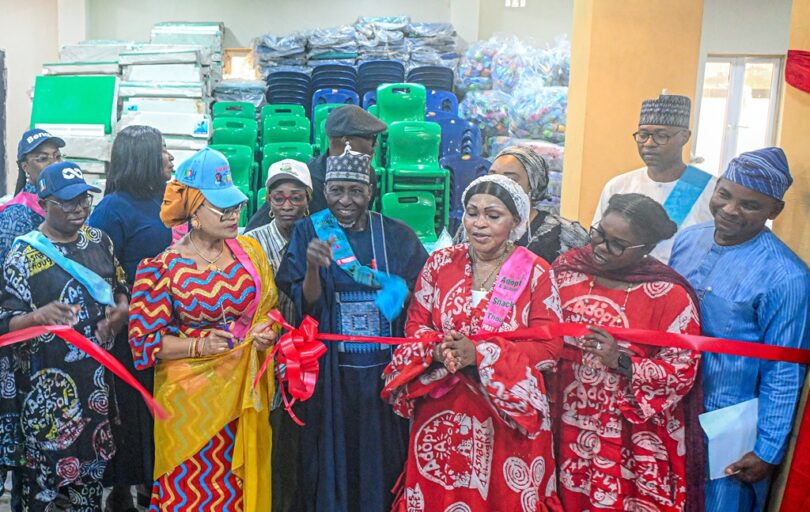
The Federal Government, in collaboration with the Lagos State Government and 57 Local Government and Local Council Development Areas, on Tuesday launched the Adopt-a-School: Snacks for Thought – PBAT FEEDS initiative to provide nutritious breakfast meals for primary school pupils in Lagos.
The programme, introduced under the Renewed Hope National Home-Grown School Feeding Programme, was officially flagged off on Tuesday at Lagos Island East Local Council Development Area (LCDA) secretariat in Lagos Island.
The PBAT FEEDS, is aimed at improving school attendance, participation, concentration and academic performance.
The initiative was launched in different centres across the three senatorial districts and 20 local governments and 37 Local Council Development Areas (LCDAs), designed as a public-private partnership that encourages support from corporate organisations, development partners, philanthropists and other stakeholders to enhance the welfare of schoolchildren.
The event featured the distribution of breakfast packs, school bags, tablets, snack boxes, water bottles, flasks, notebooks and other educational materials to pupils.
Stakeholders at the event expressed confidence that the initiative would improve child nutrition, strengthen learning outcomes and help reduce the number of out-of-school children nationwide.
The Lagos State Governor, Mr. Babajide Sanwo-Olu, during the programme said the initiative is an investment into the nation’s future, noting that nourishing children is key to building a stronger society.
Governor Sanwo-Olu, who was represented by the Secretary to the Lagos State Government, Mrs. Abimbola Salu-Hundeyin, stressed that the government remains open to partnerships that improve the wellbeing of children, adding that nation-building requires the collective efforts of both the public and private sectors.
He said when hunger is addressed, poverty is reduced. He also noted that collective efforts were essential to achieving sustainable development.
“Lagos State will continue to partner with the Federal Government, private organisations, NGOs and every well-meaning individual willing to support our children. Nation-building is not the responsibility of government alone. We are doing our best, but we welcome every genuine partnership that will improve the lives of our children.
“This programme is not just about providing food. The children are also receiving school bags, tablets, snack boxes, water bottles, flasks, notebooks and other learning materials. Our doors remain open to organisations and individuals who want to contribute to child development under Governor Sanwo-Olu’s THEMES Plus Agenda,” he said.
The National Programme Manager of the Renewed Hope National Home-Grown School Feeding Programme, Princess Aderemi Adebowale, said Lagos was selected for the official launch because of its leadership role, despite the earlier pre-launch activities in Kano and Abuja.
Princess Adebowale explained that the initiative would provide pupils with nutritious breakfast snacks and beverages before the start of school each day to combat classroom hunger, improve concentration and support better learning outcomes.
She said: “Lagos leads and others follow. We conducted successful pre-launches in Kano and Abuja, but we chose Lagos for the official launch because of its leadership role.
“Children do not know political parties; they only know food. Our objective is to ensure that no child starts learning on an empty stomach,” she said.
Adebowale added that the programme would be managed through a digital dashboard, enabling individuals, Nigerians in the diaspora, corporate organisations, faith-based groups and philanthropists to adopt schools and sponsor breakfast meals as part of their Corporate Social Responsibility.
She said the initiative is intended to complement the Federal Government’s existing National Home-Grown School Feeding Programme rather than replace it.
“The Federal Government will continue with the regular school feeding programme, while this initiative mobilises the private sector and communities to provide breakfast before classes begin.
“We will never give children food that we cannot eat. The goal is to ensure children come to school early, stay in school, perform better academically and ultimately become future leaders,” she said.