
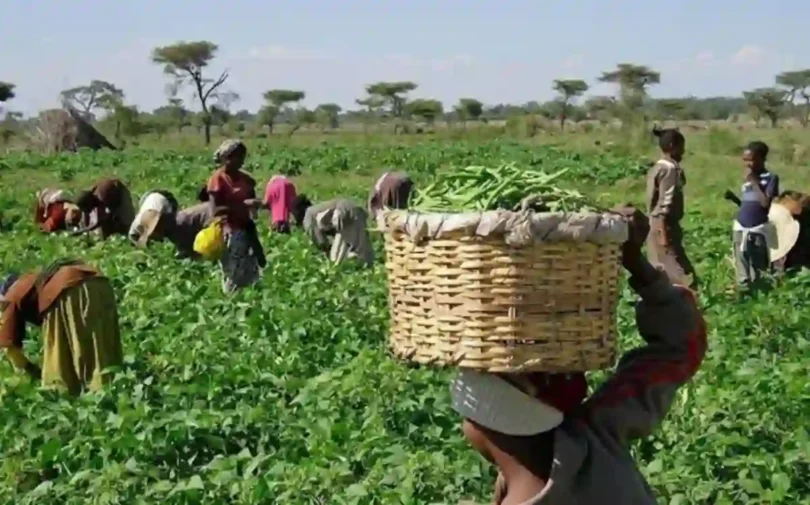
The Federal Government has disbursed a total of ₦396.7 million in insurance claims to over 43,000 smallholder farmers impacted by climate-related losses, in what officials describe as a strategic step toward strengthening Nigeria’s food system resilience and protecting vulnerable agricultural livelihoods.
The payout, facilitated through the Presidential Food Systems Coordinating Unit (PFSCU) in partnership with Leadway Assurance and PULA Advisors, was formally unveiled at the 2025 Wet Season Insurance Pay-out Ceremony under the National Agribusiness Planning Mechanism (NAPM) held in Abuja.
Beneficiaries of the intervention span four states—Plateau, Borno, Kaduna and Taraba—where farmers experienced varying degrees of losses linked to erratic rainfall patterns, flooding, drought conditions and other climate-induced risks that have increasingly disrupted farming cycles across the country.
A state-by-state breakdown of the disbursement shows that Taraba State received the highest allocation at ₦154.31 million, followed by Borno State with ₦127.19 million. Kaduna State received ₦69.73 million, while Plateau State accounted for ₦45.47 million, reflecting the scale and intensity of losses recorded in each location during the wet season.
The initiative underscores a growing policy shift by the Federal Government and its partners toward institutionalising agricultural insurance as a core risk management tool, aimed at cushioning farmers against seasonal shocks and preventing income collapse after adverse climate events.
Speaking at the ceremony, the Chief Executive Officer of Leadway Assurance, Gboyega Lesi, emphasised the inherent vulnerability of agriculture to environmental factors, noting that structured insurance solutions remain critical to sustaining farmer livelihoods and ensuring continuity in food production.
“Agriculture is inherently exposed to the elements, but through the strategic application of climate insurance, we are ensuring that a bad season does not lead to a total loss of livelihood,” Lesi said.
He acknowledged the coordinating role of the PFSCU in aligning the initiative with broader national food security objectives, while also commending PULA Advisors for its technical expertise in risk modelling and yield assessment, which he said enhances the credibility and transparency of the claims process.
“I want to specifically acknowledge our partners in the PFSCU. Your coordination is vital in aligning these efforts with the national food security agenda. PULA Advisors, your expertise in risk assessment and yield data continues to drive the transparency and accuracy of these payouts,” he stated.
Lesi further highlighted the importance of state government participation in expanding the reach of agricultural insurance, stressing that sub-national engagement will be crucial in ensuring that coverage extends to farmers in remote and underserved communities.
“To the state governments represented here, your commitment to scaling this coverage at the sub-national level is the key to reaching farmers in every corner of the country. As we review the impact of the just-concluded wet season, we are already looking ahead,” he added.
According to him, insights gathered from the current payout cycle will inform future programme design, with a focus on improving accessibility, awareness and the overall effectiveness of insurance products targeted at smallholder farmers.
“The data we have gathered is not just for retrospection; it is a blueprint for our strategy for the next farming season. We remain committed to leveraging technology and innovation to ensure that insurance is accessible, understandable, and most importantly, impactful to our beneficiaries,” Lesi noted.
He described the disbursement as evidence of both farmer participation and the viability of agricultural insurance in Nigeria, adding that it reinforces confidence in risk-sharing mechanisms within the sector.
“This payout is a testament to the hard work of our farmers and their foresight in embracing insurance. We are proud to be your partner in growth and in building a resilient Nigerian agricultural sector,” he said.
Lesi also reiterated the broader significance of the initiative in supporting farmers during periods of economic and environmental distress, pointing to the role of insurance in stabilising food systems.
“This payout underscores our promise to stand by our farmers when it matters most. Agricultural insurance is a vital tool for building resilience within Nigeria’s food systems, and we are proud to support farmers in mitigating the impact of climate risks,” he stated.
Also speaking, the Global Head of Agricultural Risk Solutions at Leadway Assurance, Fatona Ayoola, stressed that timely claims settlement is central to building trust and encouraging wider adoption of insurance among farmers.
“At Leadway Assurance, we view agricultural resilience as vital to Nigeria’s food security, and our commitment to claims payment exemplifies this ethos. We understand that empowering farmers to recover from losses, rebuild, reinvest, and sustain their operations fosters the confidence needed to continue producing food that nourishes the nation,” Ayoola said.
He commended the PFSCU’s NAPM framework, describing it as a practical demonstration of how coordinated public-private partnerships can effectively address structural risks within the agricultural sector.
On his part, the Country Manager of PULA Advisors, Michael Enahoro, described the programme as a proof of concept that large-scale agricultural insurance is both feasible and scalable within the Nigerian context.
“This is a proof of concept that indemnifying agricultural production in Nigeria is workable and can be done at scale to ensure food security,” Enahoro said.
He, however, clarified that while compensation is important, the ultimate objective of the programme is to enhance agricultural productivity and reduce systemic losses over time.
“But it is important to note that the payout itself is not the goal. The goal is to increase food production. If you aggregate the losses farmers experience annually, it runs into trillions of naira. What we are doing is starting somewhere and building a system,” he explained.
Enahoro revealed that over 43,000 farmers were enrolled under the scheme, although initial rollout challenges exposed gaps in farmer identification, awareness and onboarding processes.
“You had about 43,000 farmers we had to find. Many did not even know they were part of the programme. That shows the scale of the challenge, but also the opportunity,” he said.
He emphasised that building a sustainable agricultural insurance culture will require consistency over multiple farming cycles, noting that a one-off intervention is insufficient to drive long-term behavioural change among farmers.
“You cannot do this once. It has to be done repeatedly, two, three, four cycles, until farmers begin to see insurance as part of their farming practice. Over time, they will take ownership, and governments will only play a supporting role,” Enahoro stated.
He added that the long-term vision is to create a system where farmers can independently access and pay for insurance, reducing reliance on government subsidies.
“This is how we build a system where tens of thousands of farmers can independently insure their farms. That is when the programme truly succeeds,” he said.
Enahoro also raised concerns about the rising cost of agricultural inputs, warning that inflationary pressures and global supply chain disruptions are further exposing farmers to financial risks.
“Inputs have increased by as much as 70 to 90 per cent. A farmer who suffered losses last season is now expected to raise as much as ₦500,000 to farm again. Without structured support from government and partners, that is simply out of reach,” he noted.
He stressed that sustained collaboration among federal and state governments, private sector players and development partners will be essential in scaling the initiative and ensuring its long-term impact.
“The road ahead will be challenging, but we must stay the course. This is not about us; it is about millions of Nigerians. By some estimates, up to 65 million Nigerians are involved in agriculture. Supporting them means securing the country’s food future,” he added.
The latest disbursement builds on previous interventions under the programme. In 2024, Leadway Assurance and its partners paid ₦110 million in claims to 1,138 farmers affected by ginger blight disease, an exercise that helped strengthen confidence in agricultural insurance schemes.
Nigeria’s agricultural sector continues to face significant exposure to climate variability, including flooding, prolonged dry spells and pest infestations, all of which contribute to recurring production losses and food supply disruptions.
Despite employing a large share of the country’s workforce, access to formal insurance among smallholder farmers remains limited, largely due to affordability constraints, low awareness levels and weak distribution infrastructure.
However, ongoing collaborations between government agencies and private insurers signal a gradual transition toward structured risk-sharing frameworks designed to protect farmers, improve productivity and enhance national food security.
Stakeholders note that scaling such initiatives could play a critical role in reducing Nigeria’s dependence on food imports, stabilising rural incomes and strengthening the resilience of the country’s agricultural value chains in the face of growing climate uncertainty.
What do you think about this?
Drop your opinion in the comment section.
FOLLOW US & Share this with someone who needs to see this.