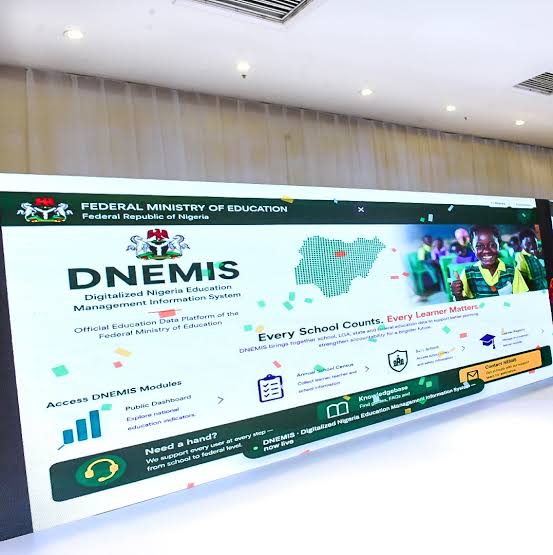
The Federal Government has called on state governments, local government education authorities and private school operators to actively participate in the Digitalised Nigeria Education Management Information System, DNEMIS, describing the platform as a critical tool for transforming education planning and service delivery across the country.
The digital platform provides comprehensive information on school infrastructure, teacher strength, student enrolment, classroom availability, computer facilities, water, sanitation and hygiene services, alongside other key indicators required for effective monitoring and policy implementation.
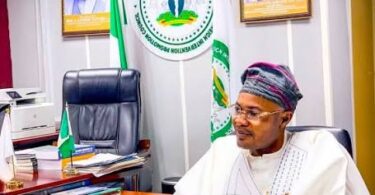
Speaking at the official unveiling of DNEMIS in Abuja on Wednesday, the Minister of Education, Dr. Maruf Tunji Alausa, said reliable and comprehensive data remains the foundation of successful education reforms.
He explained that the platform would revolutionise the collection, analysis and use of education data, enabling governments at all levels to identify gaps, allocate resources efficiently and make evidence-based decisions.
According to the minister, the initiative received significant support from development partners, including the World Bank, the European Union, the Government of Norway, UNICEF and other international organisations, whose interventions helped fast-track its implementation after earlier delays.
“You have to get the data right. Data enables us to monitor progress, design interventions, evaluate outcomes and plan proactively for the future. Without credible data, meaningful development is impossible,” Alausa said.
He noted that the Federal Government was committed to investing in the initiative because accurate information is indispensable for effective planning, adding that the support of development partners substantially shortened the project’s implementation timeline.
The minister also commended Nigerian ICT professionals and international collaborators for developing an integrated and sustainable education information system, assuring that the government would continue working with stakeholders to keep the platform functional, inclusive and responsive to the needs of the education sector.
Alausa appealed to private school proprietors to register their institutions and upload relevant information onto the national database, assuring them that the exercise was strictly for education planning and not for taxation.
He disclosed that while nearly 90 per cent of public school data had already been captured, only about half of private schools had so far enrolled on the platform.
“I encourage every private school to register and upload its data. This exercise is not intended for tax purposes. We recognise the enormous contribution private schools make to Nigeria’s education system,” he said.
The minister observed that private institutions now account for a substantial proportion of basic education in Nigeria, making their participation essential to developing accurate national education statistics and effective policies.
He added that education commissioners, local government education authorities and school administrators would have access to real-time information through the platform, enabling faster and more informed decision-making.
According to him, DNEMIS currently houses data from about 90,000 public schools, while efforts are ongoing to ensure complete coverage of public and private institutions nationwide.
With more than 50 million learners in Nigeria’s education system, Alausa stressed that accurate and timely data is indispensable for policy formulation, accountability and improved service delivery.
“We are building a system that will strengthen education planning, improve accountability and support better learning outcomes. Every stakeholder has a responsibility to ensure that the information provided is complete, accurate and up to date,” he added.
The minister further urged state governments to intensify awareness campaigns and mobilise schools within their jurisdictions to participate fully in the initiative, while reaffirming the Federal Government’s commitment to continuous engagement with stakeholders to improve data quality and expand the platform’s coverage.
Also speaking at the event, the Director-General of the National Bureau of Statistics, NBS, Semiu Adeyemi Adeniran, pledged the agency’s full support for DNEMIS, describing it as the country’s authoritative repository for education data.
He said the NBS would integrate its statistical systems with the ministry’s education database to enhance planning, policy implementation and performance monitoring across the sector.
Adeniran added that the bureau would complement the platform by mapping out-of-school children through household surveys and deploying its Small Area Estimation data to validate information generated by the education database.
“Our objective is to establish a single, credible source of education data. We will integrate the NBS platform with the ministry’s system to produce and disseminate reliable education statistics with broader national coverage.
“The Small Area Estimation data generated by the NBS will also help validate and cross-check information contained on the education platform,” he said.