BERLIN – The sad saga of a humpback whale stranded a month ago on the German coast has sparked a flood of compassion but also a media frenzy, angry spats, conspiracy theories and death threats.
As Germans have followed the travails of the sea mammal, dubbed “Timmy” by a newspaper, on their live news tickers, TV screens and influencers’ YouTube and TikTok channels, some worry about what its epic struggle says about a nation’s collective psyche.
Sociologist Christian Stegbauer said the whale, a highly intelligent and social animal, had become an object of human “projections”, with people engaging, especially on social media, in “a kind of competition on who cares most for the animal”.
While rescue workers have exhausted themselves in cold water, the odyssey has also featured heated rifts between veterinarians and self-proclaimed “whale-whisperers”, fund-raising scams and esoteric attempts to heal the whale through chanting.
The drama began when the 13m-long cetacean was beached on a Baltic Sea sandbank on March 23 at the seaside resort Timmendorfer Strand near Luebeck, far from its Atlantic Ocean habitat, with remains of a fishing net in its mouth and in poor physical condition.
Since then a series of rescue attempts – involving volunteers, environmental groups, maritime police, work crews with excavators and millionaire sponsors – have repeatedly raised hopes that were quickly dashed, as the whale has swum off, zig-zagged and ended up beached again.
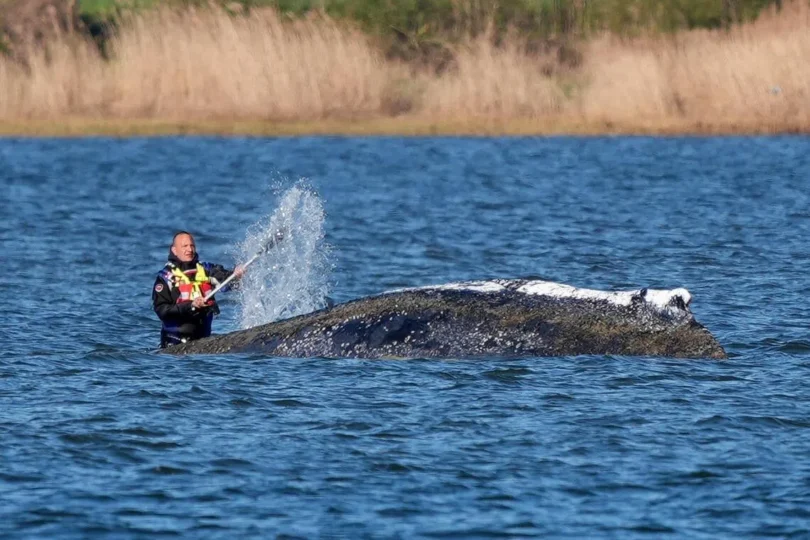
German media have broadcast the hapless creature lying motionless in shallow water for hours on end, with men in diving suits splashing water on it using kayak paddles.
“Timmy” became beached on a Baltic Sea sandbank on March 23, with the remains of a fishing net in its mouth and in poor physical condition.
PHOTO: REUTERS
Tide tables have become the stuff of national interest, and rare moments when the exhausted whale has blown water or flapped its fin have warranted breaking news bulletins.
The wave of sympathy tipped into public anger on April 1 when regional authorities announced they were convinced the badly injured and distressed animal could no longer be saved.
Activists quickly staged beach protests on the island of Poel near Wismar, where the animal had by then ended up, demanding further rescue attempts.
Various government officials, veterinarians and green groups received hate mail.
“The citizens participating in the debate react emotionally, while the scientists try to argue rationally,” Professor Stegbauer, the sociologist with Frankfurt University, told AFP. “The two approaches clash.”
Conspiracy theories surfaced online that the whale had been deliberately driven into the Baltic Sea and all had been staged by a cabal of scientists, authorities and environmental organisations.
Mr Till Backhaus, environment minister for the state of Mecklenburg-Western Pomerania, said some rescue workers had received death threats.

State environment minister Till Backhaus delivering a press statement on rescue efforts on April 19.
PHOTO: AFP
Despite experts warning that trying to save the creature would only cause it more pain, two multi-millionaires then jumped in with an elaborate rescue plan involving inflatable cushions and pontoons.
“I believe that life is the most important thing we have, and I simply felt that I had to do something,” Mr Walter Gunz, founder of a large consumer electronics retail chain, told the Neue Osnabruecker newspaper.
News magazine Der Spiegel ran a long report about a local church on Poel island where the guestbook was no longer filled with personal reflections or prayers, but with messages about Timmy.
“You can do it, big boy!” read one.
During a press conference about the last-ditch rescue effort, veterinarian Janine Bahr‑van Gemmert was heckled by a man who burst through a security cordon.
“We have a right to know why this whale is being managed to death,” he demanded.
Speaking to Welt TV, psychiatrist Borwin Bandelow said the whale may have become a symbol of Germans’ wider and deeper dissatisfaction with a struggling economy and politics in general.
“The government is perceived as incompetent,” he said. “Just as it can’t solve many other everyday problems, it now can’t solve this problem either.”

A nature tourist boat (right, background) navigating past the stranded humpback whale (right) on April 19, as a rescue team on a boat with equipment is seen close to the animal.
PHOTO: AFP
A commentary in the Sueddeutsche Zeitung argued the saga had largely ignored more complex ecological issues and focused on the plight of a single animal, showing how modern society has lost touch with nature.
“In reality, the exhausted animal… is not being saved for its own sake, let alone for the preservation of its species. It is being saved to spare us the live webcam images of its death.” AFP