
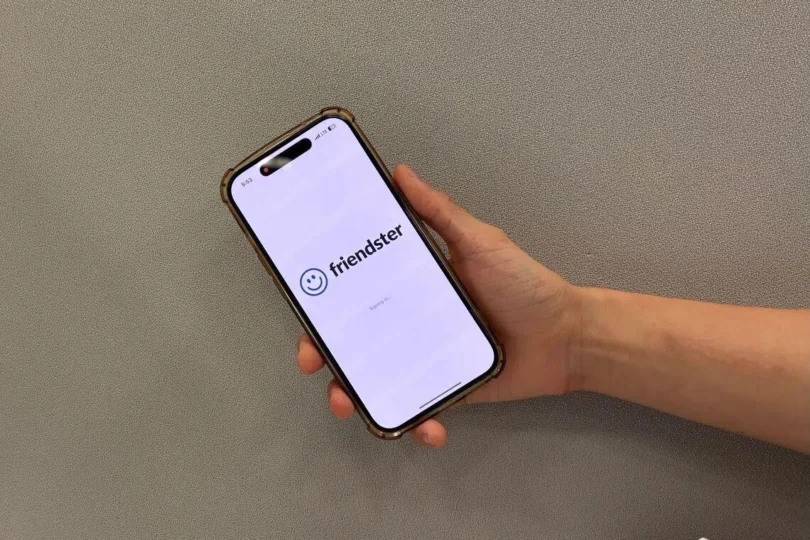
Nearly a decade after going dark, social networking site Friendster has returned with an aim to turn the social media game on its head.
Relaunched as a mobile app in April, it retains some core elements of social media platforms, enabling users to socialise within their existing circle of friends and share details of their life through photos, profiles and interests.
Unlike these services, however, Friendster 2.0 promises “no ads, no algorithms, no spam” and no sharing of user data.
The aim of the new app, said new owner and entrepreneur Mike Carson, is to help you stay connected to real-life friends. Currently available for free on iOS, it does not suggest profiles of people you neither know nor follow online.
To connect, users must open the app and tap their phones together. A check by The Straits Times found that users can also connect when they stand within range of each other with the app open on their phones.
The app does not have access to any of the previous version’s data or content. Users of the earlier version will also not be able to access their old accounts.
In a blog post on publishing platform Medium on April 27, Mr Carson said he bought Friendster’s expired domain name and trademarks between 2023 and 2025, and created a social network that would promote offline interactions.
“The idea that the only way to connect as friends on Friendster is by tapping phones was fun because it would promote people meeting in person. It would also verify that you are connecting to real people, and people that you actually want to connect with,” he said.
Other features are in the works, including being able to see friends’ friends and request to message them, he added. “The hope is that people use it as a reason to actually meet up.”
As at May 1, the app had jumped to No. 2 in Apple’s App Store Free Apps category. Whether it will be made available on Android phones remains to be seen.
Friendster, widely considered the world’s first mainstream social media platform, went live in 2003 and shut down in 2015 amid competition from the likes of Facebook and MySpace. Mr Carson said he decided to launch the new version of the app as there was a need to inject positivity in the social media landscape.
“Today, I feel that social networks foster a lot of negativity, but I remembered Friendster as being a really positive and enjoyable experience (except when the site would not load, which was really frustrating). I wanted to create something positive – something that people would enjoy and find useful.”
Research has shown that heavy social media usage appears to contribute to a drop in well-being among young people, especially girls, in some English-speaking countries.
Professor Jan-Emmanuel de Neve from the University of Oxford, one of the editors of the World Happiness Report published in March, told Reuters that algorithmically pushed, passively consumed and mostly influencer-type content had a more negative impact on users than a platform that connects people socially.
In an interview with The Straits Times, Associate Professor Saifuddin Ahmed from NTU’s Wee Kim Wee School of Communication and Information said the launch of the new Friendster was “cleverly timed”.
“A majority of mainstream social media platforms are drowning users in algorithms, ads and data exploitation without facilitating meaningful user connections. In the midst of all this, Friendster is positioning itself as the deliberate antidote to all the known problems of social media: fake profiles, ads, algorithms, data selling,” he said.
Still, there may be challenges.
“The real question is whether people are ready to swop the dopamine hit of endless scrolling for something that requires actual human effort. The timing feels right, but the habit will be extremely hard to break,” said Prof Saifuddin.
He added that potential paid features for the app, which Mr Carson has hinted at, might shift the incentives behind it.
Social media users have to physically tap their phones together to connect as friends on the new Friendster app.
PHOTO: SCREENGRAB FROM APPLE’S APP STORE
As of now, Mr Carson appears bent on placing the “social” back in social media.
“My wife and I met on (dating site) OkCupid. I wouldn’t have my kids without it. Websites like that genuinely change the course of people’s lives – people meet, fall in love, build families. That’s incredible to me.
“If Friendster helps even a few people find that kind of connection, it will have been worth it.”