Instead, it came to be seen as an attack on democracy itself, one that ordinary citizens had a responsibility to resist.
Related
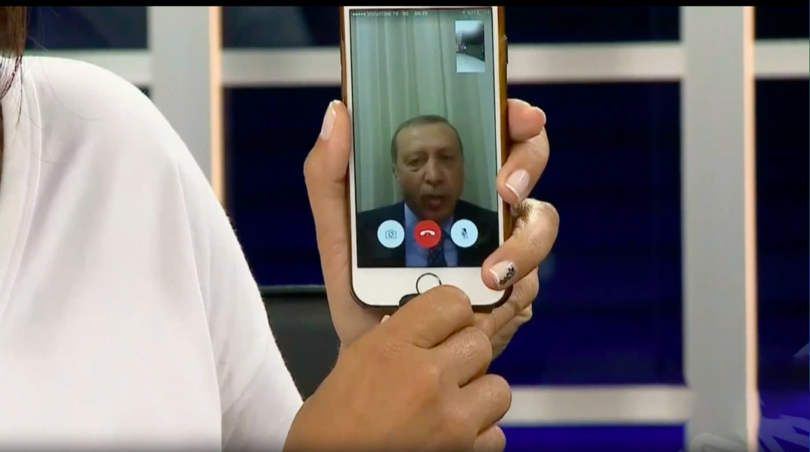
President Erdogan’s FaceTime appearance was the key moment that shaped that understanding.
It gave a dispersed public a clear message at a moment of uncertainty: the crisis required not passive observation but civic action.
One person’s video became another person’s confirmation. One call to gather became a chain of mobilisation.
One image of resistance moved faster than the attempt to impose silence.
The importance of FaceTime, then, was not simply that it allowed President Erdogan to speak.
It was that the call entered a wider ecology of communication in which citizens could hear, repeat, verify, forward, and act.
Of course, the same instantaneity that made mobilisation possible also caused confusion.
Rumours spread. Contradictory reports circulated. Genuine footage appeared alongside unverified claims.
Any honest reflection on July 15 must hold both truths at once: digital platforms can generate extraordinary civic energy and serious information disorder, sometimes in the same feed and within the same hour.
But the decisive fact remains that online mobilisation returned to the streets.
The act that mattered most was not posting, but showing up: on bridges, in squares, outside airports, and in front of municipal buildings and media outlets.
Social media did not replace courage. It made courage visible, contagious and coordinated.
The making of a digital civic memory
A decade later, July 15 has also become part of Türkiye’s digital collective memory.
Each anniversary brings archival footage back into circulation: phone videos, live broadcasts, screenshots, testimonies and hashtags.
The FaceTime image returns with particular force because it captures the night’s broader meaning in miniature: a moment when political authority, public communication and civilian agency passed through a screen and moved back into the streets.
Some of this remembrance is organised through official commemoration, but much of it is also carried by ordinary users who repost what they saw, where they were, whom they lost, and what they remember.
This is collective memory doing the work that monuments, ceremonies and textbooks once did largely on their own.
The memory of July 15 now lives not only in public squares and official speeches but also in archived videos, family chats, old tweets, and images that reappear each year on the national timeline.
For many people, the memory of that night is inseparable from the devices on which they experienced it: the first alert, the first video, the first call from a relative, and the first live broadcast that made the danger feel real.
That cultural afterlife may be one of July 15’s most enduring legacies. Platforms rise, decline, rebrand, and disappear.
But the civic habit revealed that night has endured: when faced with a national crisis, citizens turn to whatever channels are available to organise, document, interpret and remember.
This is also where July 15 speaks to contemporary debates about digital sovereignty.
The phrase is often used in technical or geopolitical terms: infrastructure, data, regulation, platforms and national capacity. Those questions matter.
But July 15 points to another dimension. Digital sovereignty is also about whether a society can preserve its public voice when coercive power seeks to monopolise the public sphere.
The answer that night did not come from technology alone. It came from the interaction among tools and people, screens and streets, and political leadership and civilian agency.
Türkiye did not simply go online on July 15. It used the online sphere as a route back into public life.
That is why the digital memory of July 15 remains so powerful.
It is remembered not only as a night of tanks and aircraft, but also as a night of phones held up in living rooms, of videos shared in panic, of messages sent to loved ones, and of citizens discovering, in real time, that they were not alone.
The attempted coup sought to undermine the democratic will by controlling space, instilling fear, and manipulating communication.
The public response showed that, in the digital age, civic life is harder to silence than it once was.
The square had expanded. It was in the streets, yes, but also in every hand that held a screen, every message that urged courage, and every citizen who turned information into action.