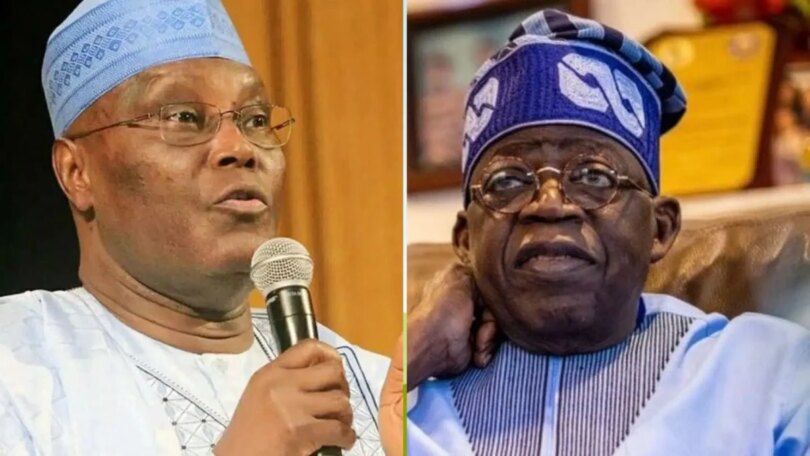
The presidential candidate of African Democratic Congress (ADC), Atiku Abubakar has hit back at President Bola Tinubu over his criticism of the proposal to restore fuel subsidy if elected president in 2027.
This was just as the former vice president accused the Tinubu administration of worsening economic hardship while celebrating increased government revenues.
Atiku said the President lacked the moral authority to describe his proposal as economically ignorant after the removal of petrol subsidy, the liberalisation of the foreign exchange market and the subsequent surge in the cost of living.
Tinubu had criticised Atiku while receiving Osun State Governor, Ademola Adeleke, at the Presidential Villa in Abuja on Thursday. He accused the former vice president of demonstrating a lack of understanding of governance and economic management.
Reacting in a statement issued on his behalf on Friday by his Senior Special Assistant on Public Communication, Phrank Shaibu, Atiku argued that his proposal was fundamentally different from the subsidy regime abolished by the Tinubu administration.
He described it as a temporary and targeted production-support mechanism aimed at boosting domestic refining, moderating petrol price shocks and reducing consumers’ exposure to volatile energy costs.
According to him, the economic conditions that existed when Tinubu announced the removal of subsidy in May 2023 have changed considerably, making a reassessment of government policies necessary.
“Economic prescriptions respond to prevailing conditions. But other things are no longer equal in Tinubu’s Nigeria,” Atiku said.
He maintained that subsidy removal, without adequate measures to cushion its immediate impact, contributed to higher petrol prices, transportation costs and food prices, while the depreciation of the naira further weakened household purchasing power.
Atiku said his proposal was not an attempt to revive what he described as the “corrupt, open-ended subsidy bazaar,” but a capped, budgeted and time-bound intervention tied to domestic production and subject to independent auditing.
He also challenged the Federal Government to explain what he described as continuing under-recoveries and energy-security costs associated with the Nigerian National Petroleum Company Limited (NNPCL).
The former vice president cited figures he put at about N17.5 trillion, including approximately N7.13 trillion in energy-security costs and N8.67 trillion in other petroleum-related obligations.
“If subsidy is dead, why are under-recoveries alive?” Atiku asked, questioning whether the opacity associated with the petroleum sector had truly ended despite the removal of the subsidy regime.
He argued that Nigerians were effectively paying the price for the reforms through higher fuel and living costs, while the government continued to carry financial obligations whose details, he said, had not been sufficiently explained.
The Federal Government has consistently defended subsidy removal as necessary, arguing that the policy had become fiscally unsustainable and was diverting resources that could otherwise be deployed to infrastructure and other areas of development.
The administration has also highlighted increased Federation Account allocations to states as one of the gains of the reform.
Atiku, however, rejected the argument that higher government revenues automatically represented economic progress, saying the ultimate test of reform should be whether citizens experience improved living conditions.
He warned that increased federal allocations could also encourage states to depend excessively on transfers from the centre rather than expanding their productive capacity and internally generated revenue.
“You do not build a federation by impoverishing citizens so that Abuja can send bigger cheques to governors,” he said.
Atiku further renewed his call for the Federal Government to account for about N30 trillion in Federation Account revenues, deductions, savings and transfers which he said he had previously demanded clarification on.
He also questioned the N12.8 trillion Service-Wide Vote contained in the 2026 budget, insisting that the government should be as responsive to questions about public finances as it is to political criticism.
The ADC candidate said economic reform should be judged by its effect on citizens rather than by the growth of government revenues.
“Economic reform is not measured by how fat government accounts become while citizens grow poorer,” he said.
Atiku accused the Tinubu administration of treating the endurance of Nigerians as evidence that its economic policies were working, arguing that the hardship caused by the reforms demonstrated the need for a different approach.
He urged Nigerians to reject what he described as another four years of policies that deepen economic hardship, insisting that his proposed petroleum-sector intervention would support domestic production while reducing dependence on subsidy.
“Nigerians have paid enough for Tinubunomics. They should not be sentenced to another four years of the bitter experiment,” Atiku said.