
Advertisement
Advertisement
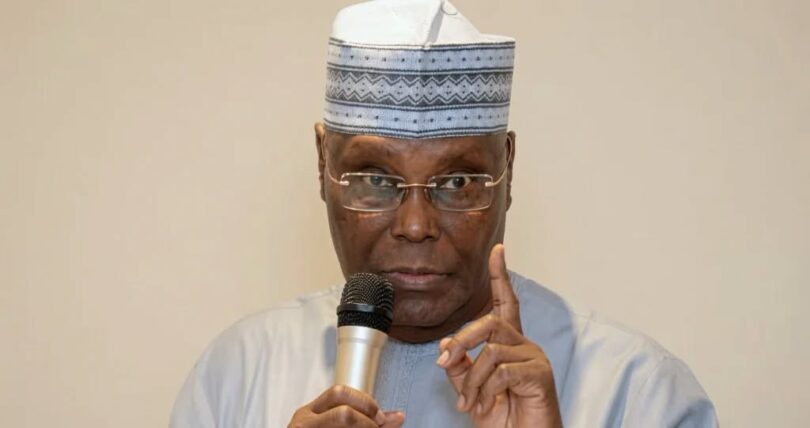
Former Vice President and presidential candidate of the African Democratic Congress, ADC,vAtiku Abubakar, has accused President Bola Tinubu of worsening Nigerians’ cost-of-living crisis through economic policies that, according to him, have eroded purchasing power and placed businesses and households under severe pressure.
Mr Atiku made the allegations in a statement issued by his Senior Special Assistant on Public Communication, Phrank Shaibu, in which he defended his proposal for a production subsidy aimed at supporting domestic production and reducing the cost of essential commodities.
The former vice president said Tinubu’s administration could not rely solely on positive economic indicators while Nigerians continued to grapple with high fuel, food and transportation costs.
He accused the president of removing fuel subsidy while failing to provide adequate relief for ordinary Nigerians, arguing that targeted support for domestic production and refining would help increase supply and reduce prices.
Atiku also cited the position of the Crude Oil Refinery Owners Association of Nigeria (CORAN) in support of domestic refining, as well as measures by the United States to strengthen petroleum production and refining, as evidence, in his view, that strategic government intervention in the energy sector could be justified.
“Tinubu did not inherit this cost-of-living crisis from Nigerians. His policies created and deepened it. He took away relief from the people, made fuel, food, transport and basic survival more expensive, and now wants Nigerians to applaud statistics while their pockets are empty,” he said.
Atiku further argued that declining consumer purchasing power was putting pressure on businesses, citing reports that a significant portion of the short-term assets of some major Nigerian companies was tied up in unpaid customer bills.
“Companies may record sales, but customers increasingly cannot pay because Tinubu’s economy has drained their purchasing power,” he said.
He illustrated the impact with the example of a frozen-food seller in Kubwa, Abuja, who, he said, would have to contend with higher transportation, electricity and restocking costs while customers, facing declining incomes, bought less or resorted to credit.
Atiku also listed increases in the prices of fertiliser, petrol and cement, as well as movements in the exchange rate, to support his argument that Nigerians had been confronted with a sharp rise in the cost of living.
“Nigerians know the prices they meet every day. Fertiliser has moved from about N9,000 to around N50,000; petrol from about N199 to around N1,400 per litre; cement from roughly N4,000 to around N13,500; and the dollar from around N450 to about N1,400,” he said.
The former vice president questioned what he described as the limited benefits of the administration’s economic reforms for ordinary Nigerians, citing challenges in electricity, security, employment and food affordability.
He said his proposed production subsidy was intended to support domestic production and refining, increase supply and ensure that consumers benefited through lower prices.
“This is why my Production Subsidy is about putting money back into people’s pockets. Support what we produce and refine here, increase supply, monitor the price and make sure Nigerians feel the benefit at the pump,” Atiku said.
He also accused the Tinubu administration of granting waivers, incentives and concessions to multinational oil companies and businesses while opposing interventions that, according to him, would directly benefit ordinary Nigerians.
“Why does intervention suddenly become bad economics when ordinary Nigerians are meant to benefit?” he asked.
Atiku urged Nigerians to support policies that would expand domestic production, promote refining and create jobs, arguing that increased local production would help reduce the cost of living.
He concluded by contrasting his economic proposal with the Tinubu administration’s policies, declaring: “Tinubu made life expensive. Atiku will make life affordable again.”