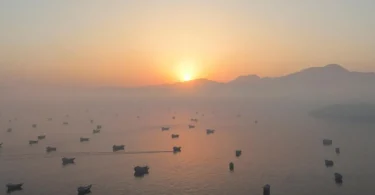
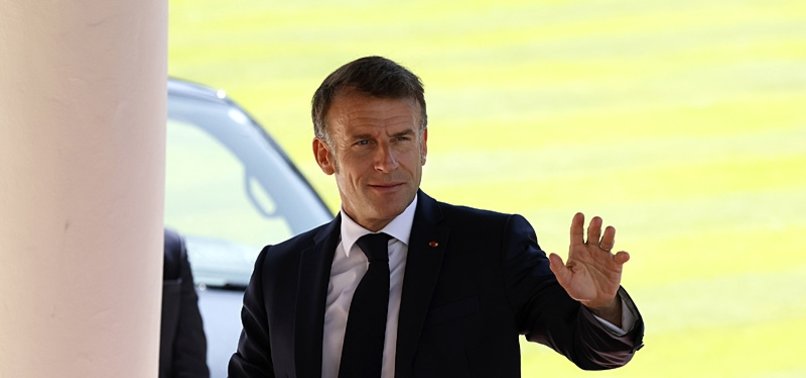
French President Emmanuel Macron on Monday said the G7 countries will do everything they can to ensure that the newly announced US-Iran deal is implemented and the Strait of Hormuz reopens.
“We will do everything, first of all, to ensure that this agreement becomes a reality and therefore that Hormuz can be reopened peacefully and that traffic can resume,” Macron said on broadcaster TF1, as world leaders are arriving in Evian, France, for a three-day Group of Seven summit.
While welcoming the agreement that came after months-long conflict in the region, he renewed his call that everything must be done for its implementation.
“So we have built, together with the British, a mission; we are on the ground, there are several nations on site — the Dutch, the Italians, the British. We are ready to act very quickly: to send aircraft, to send a frigate, to send mine clearance teams,” Macron also said.
He confirmed that France’s aircraft carrier Charles de Gaulle can also be deployed within two to three days following confirmation.
“So what we are going to do with the Americans, in parallel with the Iranians, is to ensure this deployment so that this reopening of Hormuz can take place peacefully and that it lasts,” he explained.
Macron reaffirmed organizing themselves to react very quickly as soon as there is an agreement from all stakeholders, underlining that Oman has already told them they agree to the escorts.
“If the coming days show that this is working, we will therefore deploy together with the British. We will lead this mission. And as I was saying, the French can be proud because their armed forces will be able, in the coming hours, to take part in this stabilization,” he added.
Macron further opposed a possible toll in the Strait of Hormuz, warning it would create a precedent for many other straits across the world, thereby driving up prices globally.
“This is something we will also discuss. It is not in line with international law. We defend international law, and we will do everything to ensure that there is no toll,” he said.
Macron also noted that G7 partners will do everything to reduce their dependence on the strait.
“It means finding other routes,” he further clarified.
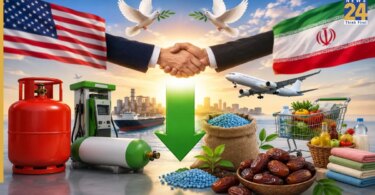
The G7 summit is taking place against the backdrop of a significant diplomatic development in the Middle East, after the US and Iran agreed to a framework deal opening a 60-day window for negotiations.
US President Donald Trump is expected to arrive on Monday afternoon for talks with fellow leaders from other G7 nations: France, Canada, Germany, Italy, Japan, and the UK.
EU leaders, including European Commission President Ursula von der Leyen and European Council President Antonio Costa, will also take part.
Several invited guests from outside the G7 will also attend, including Ukrainian President Volodymyr Zelenskyy, Indian Prime Minister Narendra Modi, Brazilian President Luiz Inacio Lula da Silva, as well as the leaders of South Korea, Kenya, and Egypt.
Gulf leaders, among them Qatar’s Emir Sheikh Tamim bin Hamad Al Thani and UAE President Sheikh Mohamed bin Zayed Al Nahyan, are also expected to attend.