
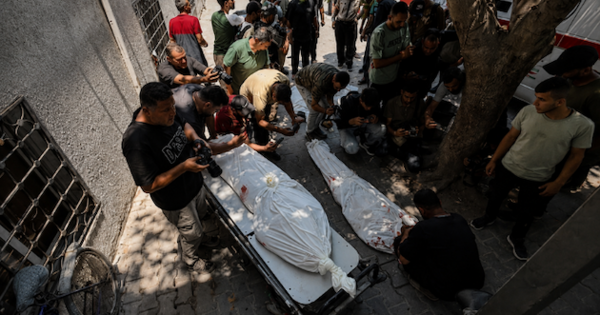
The number of Palestinians killed since the October 2025 ceasefire has now reached 1,110, approaching the 1,200 Israelis killed in the October 7, 2023 Hamas-led attacks that triggered the war.
Israeli military operations in Gaza over the past week have continued to claim civilian lives, with medical sources confirming the overall death toll since the war began has reached 73,233, with 173,707 wounded, a total tally of nearly a quarter-of-a-million.
Recent Attacks
On July 8, Israeli strikes killed at least eight people, including a 10-year-old child in a tent strike within the al-Mawasi “humanitarian zone” and a six-year-old shot in Gaza City’s Zeitoun neighbourhood, according to Palestinian health officials.
A day later, World Central Kitchen driver Ahmad Nasser Saleem was shot dead with his hands raised while transporting coordinated aid from the Karem Abu Salem crossing.
On July 12, nine-year-old Tala Jumaa Abu Matar was killed by Israeli fire near the Nuseirat refugee camp, medical sources told Wafa. Strikes on displacement tents in al-Mawasi continued throughout the week, per Gaza-based activist Hamza al-Masri.
An Israeli drone struck the courtyard of Kamal Adwan Hospital in northern Gaza on July 10, wounding staff despite the facility sitting within Israel’s declared “green zone.” Gaza’s Ministry of Health called it part of Israel’s “systematic targeting of health facilities.”
A Ceasefire in Name Only
Researchers have questioned whether the term “ceasefire” retains any meaningful definition in the Gaza context. The Oslo-based Peace Research Institute noted that while the death rate has decreased from the active war period, the 1,000+ killed during the ceasefire period would itself qualify as a “war” under the Uppsala Conflict Data Program’s threshold of 25 battlefield deaths per year.
A separate analysis published by Genocide Watch described Israeli actions as an “ongoing genocide,” citing the continued killing, infrastructure destruction, and restriction of aid.
Aid Restrictions Continue
COGAT, the Israeli military body coordinating aid, released a report claiming humanitarian supplies had entered Gaza in quantities that “significantly exceeded” UN-identified needs, with its chief Major-General Yoram Halevy stating that anyone disputing the figures was “amplifying Hamas propaganda.”
However, UN data published the following day described severe scarcity. The UN Office for the Coordination of Humanitarian Affairs reported that food parcels distributed in early July covered just 75 percent of minimum caloric needs, and high-energy biscuit distribution had been suspended to preserve dwindling stocks. Only 56 percent of aid cargo through the Egypt corridor was successfully offloaded.
Essential services for an estimated 350,000 people with chronic diseases remain severely disrupted, with OCHA’s Health Cluster recording more than 18,000 new cases of chickenpox, skin infection, and parasitic infestation in a single week.
West Bank Escalation
A report published July 7 by Israeli advocacy groups Peace Now and Kerem Navot documented what it called de facto annexation of the occupied West Bank at an “unprecedented pace,” with 185 new outposts, 118 Palestinian herding communities expelled, and 102 new settlements created between 2023 and 2025.
Settler violence continued throughout the week, with OCHA recording at least 35 incidents causing casualties or property damage in a single week, bringing the 2026 total to more than 1,200 incidents across 240 communities—approximately six attacks daily.
Israeli authorities also issued 49 military land-seizure orders in the first half of 2026, already exceeding the 47 issued in all of 2025.
Photo: Credit: Khames Alrefi, QNN