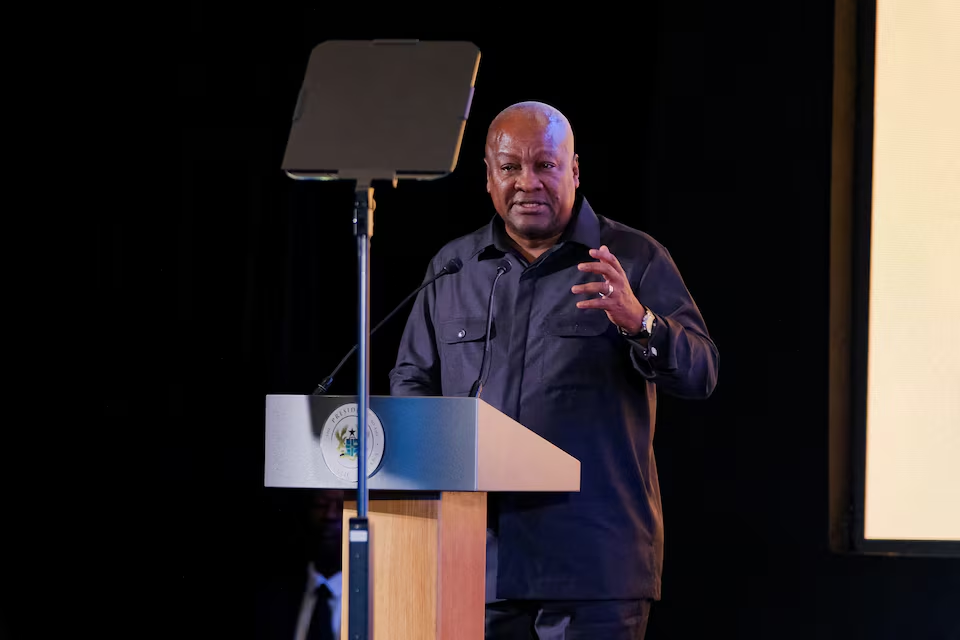

Ghanaian President John Mahama has renewed his call for the African Union (AU) to address what he described as escalating anti-immigrant violence in South Africa, warning that the crisis threatens African solidarity and regional integration.
Speaking on Thursday, July 23, Mahama said the issue should be formally placed on the agenda of the AU summit scheduled for February next year so that member states can work collectively toward a lasting solution. “Placing this on the AU agenda gives South Africa a formal, constructive platform to share its perspective, and together, as a continent, work toward a lasting solution,” Mahama said in a social media post.
South Africa has experienced weeks of protests and unrest targeting immigrants, who are accused by some groups of taking jobs and resources. The violence has led to the departure of more than 160,000 foreign nationals over the past two months, while several people have reportedly died.
Mahama first pushed for AU intervention in May and said AU Commission chairperson Mahmoud Ali Youssouf had acknowledged the urgency of discussing the matter at the continental level. During talks with Youssouf on the sidelines of an AU meeting in Accra on Wednesday, July 22, Mahama expressed concern that the South African authorities were not responding adequately to the scale of the crisis.
“It doesn’t appear that the South African authorities are responding to the magnitude that one would expect them to,” he said. “The persons who are funding these xenophobic attacks are known and they have been left free to continue to do what they want to do.”
He warned that the situation could undermine decades of work toward African unity and integration. “The AU should take an interest in this matter, which has the potential to wreck everything that we have worked for, African solidarity, African integration,” Mahama added.
According to Ghanaian media reports, Youssouf described the violence as “a big source of concern” for the AU Commission and said he had previously discussed the issue with South African Foreign Minister Ronald Lamola, who maintained that undocumented migrants should be dealt with through legal channels.
Ghana and Nigeria have been among the most vocal African countries condemning the attacks. At the weekend, the Economic Community of West African States (ECOWAS) backed Ghana’s request for an AU debate, citing what it called the “despicable treatment of West African citizens” in South Africa.
Separately, two Ghanaians, former government spokesperson Palgrave Boakye-Danquah and counterterrorism analyst Emmanuel Kotin, have petitioned the International Criminal Court (ICC) to investigate what they described as repeated xenophobic attacks in South Africa.
In the petition filed on July 15, they alleged that South African authorities had failed to protect foreign nationals from unlawful killings and hate speech. “We allege that there has been a failure of state authorities to prevent, investigate and prosecute these acts, amounting to acquiescence and potential state responsibility,” the petition stated.
South African government spokesperson Chrispin Phiri rejected the move, saying the petition did not meet the threshold for an ICC investigation and noting that South Africa has laws that criminalise hate crimes and hate speech. The diplomatic tensions have already affected regional engagements. Ghana recently postponed a planned visit by South African President Cyril Ramaphosa to Accra amid concerns that the unrest would overshadow the meeting.
Mahama said he had since met South Africa’s foreign minister and stressed that Ghana bore no hostility toward South Africa but remained troubled by the violence and the economic losses suffered by affected Africans. “Ghana has no ill will toward South Africa,” Mahama said, but the government remained “deeply concerned” about the attacks and the “significant capital losses” experienced by victims.