A coalition of Lagos indigenes’ advocacy groups has urged the All Progressives Congress and its consensus candidate, Dr. Obafemi Hamzat, to consider nominating Mrs. Boladale Dapo-Thomas as his running mate, citing her extensive experience and long record of service to the state.
The appeal, which is gaining traction across policy and governance circles, was made on Monday, where speakers highlighted what they described as a “rare blend of administrative depth, institutional memory, and proven leadership” embodied by Mrs. Dapo-Thomas.
According to the groups, Lagos, Nigeria’s commercial nerve centre, requires a deputy governor with not only political alignment but also a strong grasp of governance systems and public sector reform.
They argued that Mrs. Dapo-Thomas fits this profile, given her decades-long career in the Lagos State Civil Service.
“Her record speaks for itself,” said one of the conveners. “At a time when governance is becoming more complex, Lagos needs tested hands. Mrs. Dapo-Thomas has risen through the ranks, understands the machinery of government, and has consistently delivered results.”
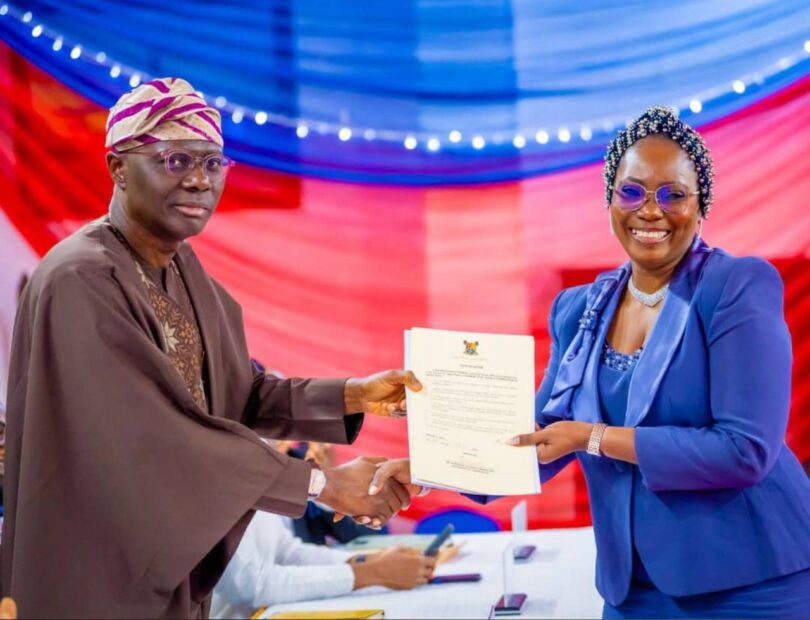
Mrs. Dapo-Thomas, a Lagos-born administrator, currently serves as Chairman of the Lagos State Civil Service Commission, where she oversees policies, staff development, and institutional discipline within the state’s workforce.
Before this appointment, she held several strategic positions, including Permanent Secretary in key ministries such as Women Affairs and Poverty Alleviation; Physical Planning and Urban Development; and Wealth Creation and Employment, where she was credited with driving reforms to improve efficiency and service delivery.
Her career began in 1988 when she joined the Lagos State Civil Service as an Administrative Officer II. Over the years, she built a reputation for diligence and discretion, particularly during her early assignment as Protocol Officer and Private Secretary to the wives of four successive governors between 1988 and 1999. In that capacity, she coordinated high-level engagements, managed social intervention programmes, and helped streamline operations within those offices during a politically dynamic period in the state’s history.
Colleagues and analysts note that her progression through the civil service was marked by consistency rather than controversy—an attribute supporters say is increasingly valuable in today’s political climate. Her tenure in the Ministry of Physical Planning and Urban Development, for instance, coincided with efforts to modernize urban development processes in Lagos, while her role in Wealth Creation and Employment aligned with broader state initiatives on employment and economic inclusion.
Advocates of her potential candidacy also point to the growing demand for greater female representation in top political offices across Nigeria. They argue that selecting a candidate like Mrs. Dapo-Thomas would not only strengthen governance but also signal a commitment to gender inclusion at the highest levels of decision-making.
“This is not just about representation,” another speaker at the forum said. “It is about competence meeting opportunity. Lagos has many capable women, but few with this level of administrative exposure and institutional credibility.”
While there has been no official response from the office of the Deputy Governor, political observers say such endorsements, though informal, could influence internal party discussions ahead of future electoral cycles.
For now, Mrs. Dapo-Thomas has not declared any political ambition. However, insiders within the civil service describe her as a “consummate professional” whose focus remains on strengthening the public sector.
As conversations around succession and leadership continue to evolve in Lagos politics, the push for her consideration underscores a broader shift, one that places increasing value on technocratic experience alongside traditional political capital.