By Aminu Abubakar
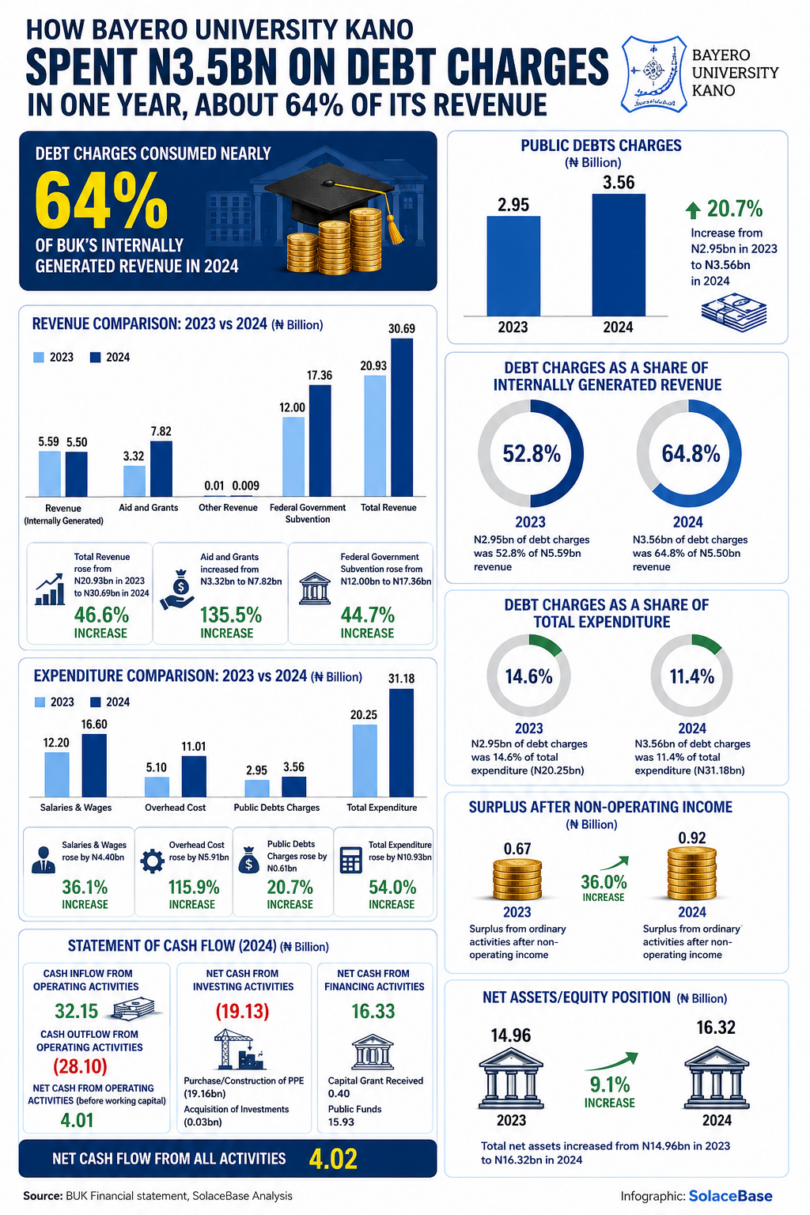
Bayero University, Kano (BUK) spent N3.56 billion on public debt charges in 2024, an amount equivalent to about 64.8 per cent of the institution’s internally generated revenue for the year, an analysis of the university’s audited 2024 financial statements has shown.
The review of the institution’s Statement of Financial Performance, Statement of Changes in Net Assets/Equities, and Statement of Cash Flow indicates that debt servicing remained one of the university’s major expenditure items during the financial year.
SolaceBase reports that the financial statements show that the university generated N5.50 billion as revenue in 2024 but expended N3.56 billion on “Public Debts Charges,” leaving nearly two-thirds of its internally generated earnings committed to servicing debt obligations.
Analysis of the financial statements further shows that the university’s debt servicing obligations increased from the previous year.
According to the audited accounts, expenditure on “Public Debt Charges” rose from N2.95 billion in 2023 to N3.56 billion in 2024, representing an increase of approximately N612.2 million, or about 20.7 per cent year-on-year.
Despite the increase in debt charges, the university’s internally generated revenue declined slightly. Revenue fell from N5.59 billion in 2023 to N5.50 billion in 2024, a decrease of about N92.8 million.
Read Also:Hunger Deepens in the North as Prices Soar: Residents cry out over rising food costs, eroding incomes in 2026
Consequently, debt servicing consumed a larger share of the institution’s internally generated revenue. In 2023, the N2.95 billion spent on debt charges represented about 52.8 per cent of the university’s N5.59 billion revenue. By 2024, that figure had increased to approximately 64.8 per cent, meaning that for every N100 generated internally during the year, nearly N65 went toward servicing debt obligations.
The debt servicing bill also accounted for approximately 11.4 per cent of the university’s total expenditure of N31.18 billion in 2024, compared with about 14.6 per cent of the N20.25 billion spent in 2023.
Although debt charges increased in absolute terms, the university recorded strong growth in overall revenue. Total revenue rose from N20.93 billion in 2023 to N30.69 billion in 2024, representing an increase of about N9.76 billion, or 46.6 per cent.
The increase was driven largely by higher inflows from “Aid and Grants,” which grew from N3.32 billion in 2023 to N7.82 billion in 2024. Federal Government subvention also increased significantly from N12.00 billion to N17.36 billion over the same period, while “Other Revenue” declined from N11.76 million in 2023 to N8.69 million in 2024.
According to SolaceBase, the audited accounts reveal that BUK recorded N5.50 billion as revenue, N7.82 billion under “Aid and Grants,” N8.69 million as “Other Revenue,” and N17.36 billion as “Federal Government Subvention.” Combined, these income sources brought the university’s total revenue to N30.69 billion for the year ended December 31, 2024.
Read Also:We Barely Survive’: Northern states residents groan as high petrol cost deepen hardship
Despite the sizeable inflows, expenditure remained higher than total revenue.
According to the Statement of Financial Performance, the university spent N16.60 billion on “Salaries & Wages,” N11.01 billion on “Overhead Cost,” and N3.56 billion on “Public Debts Charges.” These major expenditure items pushed total spending to N31.18 billion, resulting in an operating deficit of about N492.4 million.
Overall expenditure increased sharply from N20.25 billion in 2023 to N31.18 billion in 2024, representing an increase of about N10.93 billion, or roughly 54 per cent.
A breakdown of the figures shows that salaries and wages accounted for the largest share of expenditure, representing more than half of the university’s total spending during the year. Overhead costs formed the second-largest expenditure item, while debt charges ranked among the institution’s most significant financial commitments.
Personnel-related expenditure also increased substantially. Spending on “Salaries & Wages” rose from N12.20 billion in 2023 to N16.60 billion in 2024, an increase of more than N4.40 billion.
Read Also:Audit Report exposes massive financial irregularities in Kebbi local governments
The most significant jump, however, was recorded under “Overhead Cost.” The university’s expenditure under the category rose from N5.10 billion in 2023 to N11.01 billion in 2024, an increase of nearly N5.91 billion, more than doubling within one year.
The audited report also compares actual spending with the university’s approved budget for 2024.
For salaries and wages, the institution budgeted N15.99 billion but ultimately spent N16.60 billion, representing an overspending of more than N617 million.
Similarly, expenditure on overhead costs significantly exceeded budgetary projections. While the university approved N5.90 billion for overhead expenses, actual spending rose to N11.01 billion, exceeding the budget by more than N5.11 billion.
However, spending on debt charges came below budget. Although the institution made a budgetary provision of N4.26 billion for “Public Debts Charges,” actual expenditure stood at N3.56 billion, approximately N694 million below the approved allocation.