
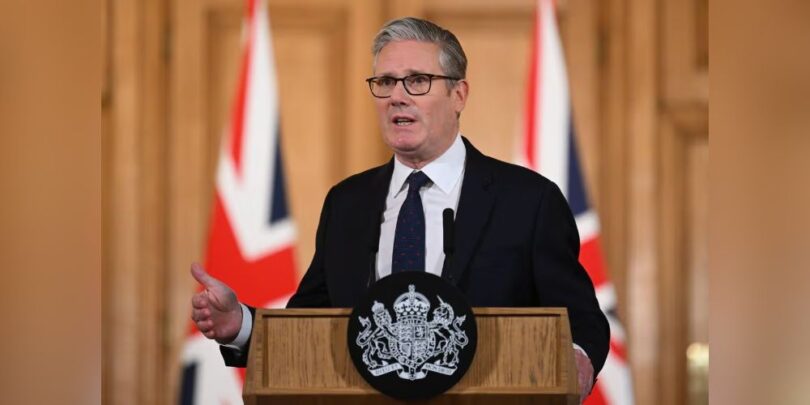
Sir Keir Starmer’s resignation as United Kingdom Prime Minister on Monday brought a dramatic end to a tenure that began with one of the most emphatic election victories in British history and collapsed in under two years.
Starmer defeated Rishi Sunak in the July 2024 general election, returning Labour to power after 14 years with a 174-seat majority.
But his government was ultimately weakened by dwindling poll ratings, Labour infighting, and growing public frustration over its failure to deliver quickly on growth and the cost of living.
The fall was not sudden, it was the product of accumulated scandals, policy failures, internal rebellion, and a final blow from within his own party.
Critics argued that he struggled to define a clear political vision, with voters viewing him as cautious and managerial rather than a leader capable of delivering major change.
By September 2025, only 14 per cent of people approved of his government’s record while 69 per cent disapproved.
By January 2026, 75 per cent of the public held an unfavourable opinion of Starmer, giving him a net favourability rating of negative 57, a figure previously only matched by Liz Truss, who lasted just 49 days in office.
No single misstep damaged Starmer more than his decision to appoint veteran Labour figure Peter Mandelson as the UK’s ambassador to the United States in December 2024.
The scandal erupted after revelations emerged about Mandelson’s past relationship with convicted sex offender Jeffrey Epstein, triggering questions over Starmer’s judgement in selecting him for one of Britain’s most sensitive diplomatic posts.
Documents released by a United States Congressional committee revealed new details about the depth of Mandelson’s ties to Epstein, forcing his dismissal just seven months into his tenure.
Starmer’s Chief of Staff Morgan McSweeney resigned in February 2026, taking responsibility for advising the prime minister to make the appointment.
Starmer admitted the appointment was a mistake and apologised, but the damage to his authority proved irreversible.
The government also faced sustained criticism from those to its right over immigration and tax increases, while those to its left criticised its stance on the Gaza war, welfare reform, and its refusal to introduce a wealth tax.
A 2025 immigration speech in which Starmer described Britain as an “island of strangers” drew fierce backlash from the liberal and left wings of his party, accelerating the haemorrhage of voters towards the Green Party, without winning back those drifting rightward to Reform UK.
Labour’s poor performance in both the 2025 and 2026 local elections saw Reform UK and the Green Party make major gains across the country.
By mid-May 2026, over 95 Labour MPs had called on Starmer to resign or set out a departure timetable, with Health Secretary Wes Streeting and four junior ministers already gone.
In June, the crisis deepened further when Defence Secretary John Healey and two other Ministry of Defence officials quit over disputes about the government’s planned defence spending.
In total, about 20 ministers left his government in under two years, nearly half citing a loss of confidence in his leadership.
Starmer’s refusal to join the American military campaign against Iran, which began in February 2026, also badly damaged his relationship with US President Donald Trump.
Though Starmer won international praise for rallying European support for Ukraine and working to mitigate the turmoil unleashed by the Iran conflict, that praise did not translate into domestic political capital.
Trump’s public prediction of his resignation, posted on Truth Social the day before it happened, added a layer of humiliation to his final hours in office.
The event that made Starmer’s position finally untenable was the by-election victory of former Greater Manchester Mayor Andy Burnham in the seat of Makerfield on 18 June 2026.
The sitting Labour MP for Makerfield had resigned his seat specifically to allow Burnham to return to Parliament and mount a leadership challenge.
Burnham won almost 55 per cent of votes cast, more than 9,000 ahead of his nearest rival from Reform UK.
With Burnham commanding the backing of over 200 Labour lawmakers and Foreign Secretary Yvette Cooper among the cabinet ministers privately urging Starmer to go, the prime minister spent the weekend at his Chequers country retreat before concluding the game was up.
An Ipsos poll published on the day of Burnham’s victory found that 52 per cent of Britons believed Starmer should stand down, five percentage points higher than the previous month.
His departure makes him the sixth prime minister in ten years to stand outside 10 Downing Street and announce a premature exit, coming almost exactly ten years to the day since the United Kingdom voted to leave the European Union.