
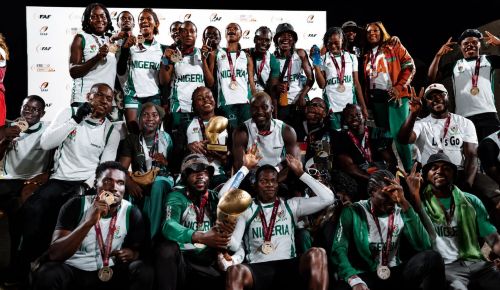
The International Federation of American Football (IFAF) has profiled Nigeria’s men’s and women’s national teams ahead of the 2026 IFAF Flag Football World Championships in Düsseldorf, Germany.
The world governing body featured Nigeria on its official website under the title, “IFAF World Flag 2026 Nation Profile: Nigeria,” highlighting the country’s emergence as Africa’s only representative at the global tournament.
The profile celebrates Nigeria’s qualification after both national teams won gold medals at the inaugural IFAF Africa Flag Football Championships in Cairo, Egypt, in 2025.
According to IFAF, Nigeria lived up to its reputation as the “Giant of Africa” by winning both continental titles.
The women’s team secured the African crown with a 26-12 victory over Morocco, while the men’s team defeated hosts Egypt 13-12 in the final to qualify for the world championships.
Nigeria will be the only African nation represented in both the men’s and women’s competitions when the tournament begins in Germany in August.
The men’s team has been drawn alongside world number two Austria, Asia champions Japan and Canada, who finished third at the IFAF Americas Championships.
The women’s team faces defending world champions the United States, European bronze medallists Spain and Oceania champions Australia in the group stage.
IFAF also identified quarterback Hayes Obinna-Uzoh as the player to watch in the men’s team, while receiver and rusher Esther Kalu was highlighted as one of the standout players in the women’s squad.
The governing body noted that Düsseldorf 2026 would mark Nigeria’s debut at the IFAF Flag Football World Championships.
Nigeria will also become only the second African nation to compete at the global championship after Cameroon made history at the 2024 edition.
The profile recognised Ephraim Fagha Faloughi as head coach of the men’s national team and Anireju Oritsewehinmi Ayida as coach of the women’s side.
Both teams have concluded domestic preparation matches and are expected to continue preparations in Nairobi, Kenya, before travelling to Germany for the championship.
The recognition by IFAF further reflects Nigeria’s rapid rise in international flag football following its emergence as continental champions and Africa’s standard-bearer in the sport.