
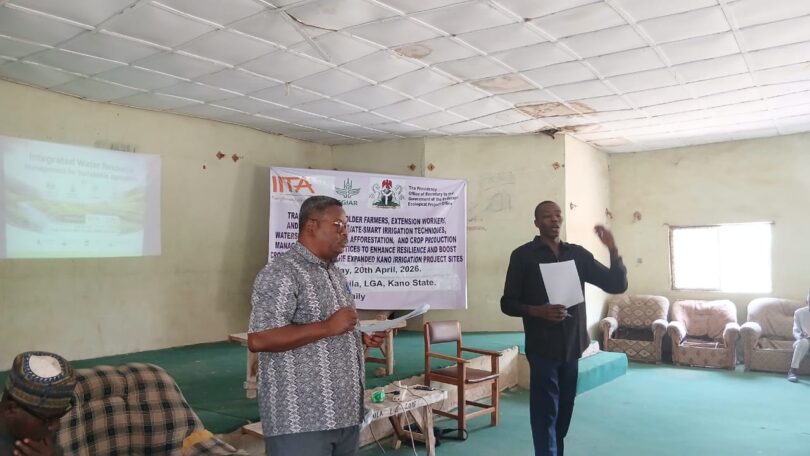
The International Institute of Tropical Agriculture (IITA) on Monday flagged off the day-one session and the opening ceremony of its training programme for 208 smallholder farmers, extension workers, and local government officials in Kano State.
The training, which focuses on climate-smart irrigation techniques, watershed management, afforestation, and crop production best practices, is aimed at strengthening farmers’ resilience to climate change and improving agricultural productivity in the state’s expanded irrigation project areas.
SolaceBase reports that the four-day programme, scheduled for April 20 to 23, 2026, will be conducted across four centres—Sumaila, Garko, Tudun Wada, and Karaye Local Government Areas—with participants drawn from 16 local government areas in the Kano South Senatorial District, while the opening ceremony was held in Sumaila.
Speaking at the event, the project coordinator, Professor Lucky Omoigui, said the training followed the Federal Government’s recent expansion and rehabilitation of irrigation infrastructure across Kano State.
He noted that several previously non-functional irrigation schemes have now been restored, with key dams, including the Chalawa Dam, providing improved access to water for farming.
“This is an opportunity for farmers to make effective use of the rehabilitated dams,” he said, adding that the availability of water would support increased crop production if properly managed.
Omoigui explained that the project, supported by the Federal Government through the Office of the Secretary to the Government of the Federation’s Ecological Project Office, is designed to enhance farmers’ knowledge of climate-smart agriculture, efficient irrigation systems, and modern crop management practices.
According to him, the training will also expose participants to improved crop varieties and practical techniques to maximise yields.
He further revealed that the initiative includes plans to establish Farmer Field Schools in eight of the participating local government areas to provide continuous, hands-on learning for farmers.
“The goal is not just to train participants during this programme, but to ensure sustainability through extension agents and local government staff who will continue to support farmers beyond today,” he said.
Read Also:FG expands irrigation to boost dry-season farming, food security in Kano
Also speaking on day one of the training, a facilitator from the Hadejia Jama’are River Basin Development Authority, Engineer Mustafa Usman Khalil, said his session focused on efficient irrigation water management and maintenance of irrigation infrastructure.

He stressed the importance of regular canal cleaning, desilting, and removal of aquatic weeds to ensure proper water flow, as well as adopting appropriate irrigation timing to reduce water loss.
Khalil also highlighted mulching as an effective technique for conserving soil moisture, explaining that covering farmland with dry materials can significantly reduce evaporation and improve water efficiency.
Participants at the opening session expressed optimism about the programme. Yusuf Adamu from Albasu Local Government Area said the training would help farmers improve their practices, while Binta Garba Abdullahi from Takai Local Government Area noted that she gained valuable insights into irrigation and seed management.
The training continues in other centres as part of the four-day programme, with organisers expecting improved capacity among farmers and stakeholders across the state.