
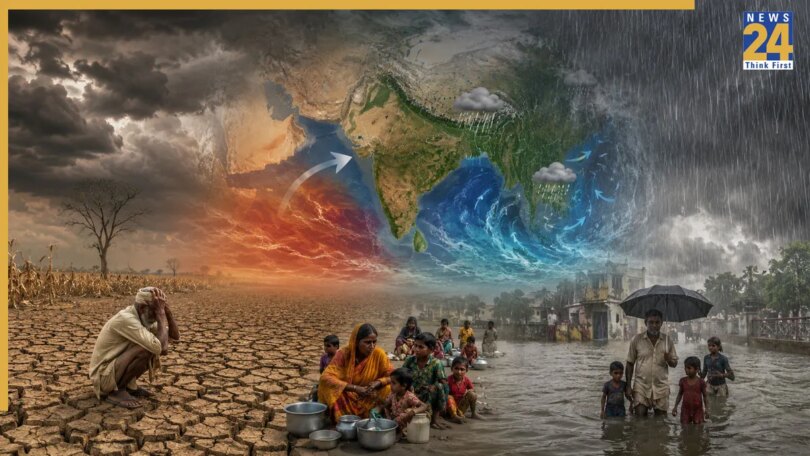
The development of a powerful El Niño event in the Pacific Ocean is gaining momentum. Recent observations from NASA’s Sentinel-6 Michael Freilich satellite have detected unusually high sea levels near the equator, a sign that large amounts of heat are building up beneath the ocean surface. Scientists say that when ocean temperatures rise above normal levels in parts of the Pacific Ocean and sea levels increase, it is a key indicator of El Niño conditions.
Why Is the Sea Level Rising?
According to experts, warmer water expands and takes up more space than cooler water. As a result, areas with large amounts of warm water experience a rise in sea level. Data collected by NASA shows that significant heat is accumulating beneath the ocean surface. The agency also released a map based on satellite observations from June 8, highlighting regions where sea levels are higher than normal.
The map uses red to show above-average sea levels, white for normal conditions, and blue for below-average levels.
Scientists Compare It to the Powerful 1997 El Niño
Researchers say current conditions in the western Pacific Ocean resemble those seen before the powerful 1997 El Niño event, often referred to as the “Godzilla El Niño.” Scientists believe the current El Niño is continuing to strengthen and could have major impacts on global weather patterns in the coming months.
The satellite has also detected large warm-water waves, known as Kelvin Waves, moving across the Pacific Ocean. These waves can travel hundreds of miles and often contribute to the development of stronger El Niño conditions.
What Is El Niño?
El Niño occurs when the central and eastern Pacific Ocean become significantly warmer than normal. During this process, trade winds weaken or even reverse direction, allowing warm water to spread across a larger area of the Pacific. The US National Oceanic and Atmospheric Administration (NOAA) officially reported the onset of El Niño on June 11.
Global Impact of El Niño
El Niño affects weather patterns around the world. It can alter rainfall distribution, increase temperatures, and trigger extreme weather events in different regions. Meteorologists say this could become one of the strongest El Niño events in more than a century.
Common effects include:
- Drought conditions in parts of Southeast Asia, Australia, India, and Africa.
- Heavier rainfall in parts of East Africa, South America, and the southern United States.
- Higher global temperatures and an increased risk of heatwaves.
- Changes in monsoon patterns and agricultural conditions.
How Will It Affect India?
Experts warn that India could experience significant impacts if El Niño continues to strengthen. The phenomenon is often linked to weaker monsoon rainfall, which can affect agriculture, water supplies, and overall economic activity. With India already experiencing high temperatures, a weaker monsoon could add further pressure on crops and rural incomes. Given the importance of the monsoon to India’s economy, any major disruption could have broader economic consequences.
How Will It Affect Pakistan?
Pakistan could also face noticeable impacts from the developing El Niño.
Historically, El Niño has been associated with:
- Weaker-than-normal monsoon rainfall.
- Warmer winter temperatures.
- More frequent and intense heatwaves during spring and summer.
- Increased pressure on water resources and agriculture.
Meteorologists say Pakistan may need to prepare for hotter conditions and possible rainfall shortages if the El Niño event continues to strengthen in the months ahead.
What Happens Next?
Scientists will continue monitoring ocean temperatures, sea levels, and atmospheric conditions over the Pacific Ocean. If warming continues at the current pace, the world could experience a strong El Niño event capable of influencing weather patterns across multiple continents.
For now, researchers say the signs point to a strengthening system that could have far-reaching effects on temperatures, rainfall, agriculture, and economies around the globe.
First published on: Jun 23, 2026 06:37 PM IST
Get Breaking News First and Latest Updates from India and around the world on News24. Follow News24 on Facebook, Twitter.
End of Article
Related Story