
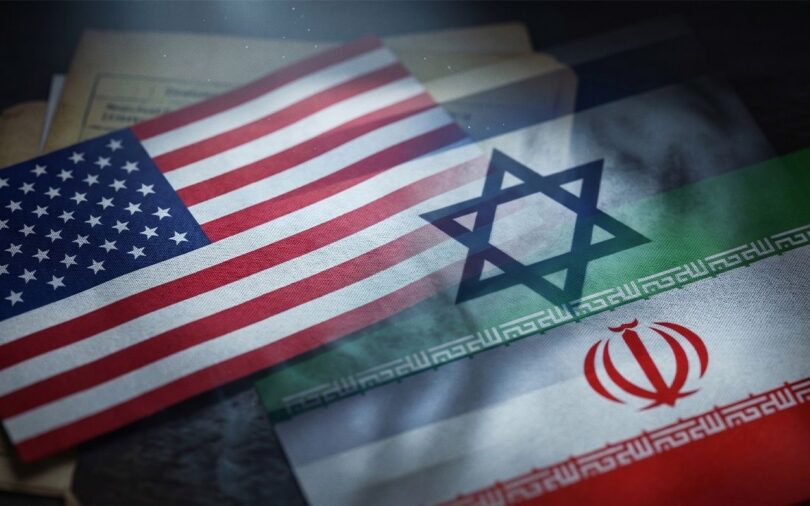
In normal circumstances, nations at war eventually come to the same table—first to negotiate a ceasefire, then to hammer out a political settlement that addresses the roots of their conflict.
But in the Iran war, there is a striking anomaly: Israel, a principal party to the fighting and a country many believe played a decisive role in shaping Washington’s decision to confront Tehran, is absent not only from ceasefire negotiations but also from the broader peace talks between the United States and Iran.
“For obvious reasons, any talks between Iran and Israel could be interpreted as direct or indirect recognition, and therefore would not be accepted by Iran. Sitting at the same table is out of the question,” Gokhan Batu, an Ankara-based expert on Israeli and Levant politics, tells TRT World.
Yet political history offers examples that complicate this logic.
There have been instances in which parties that did not formally recognise one another still negotiated and reached agreements. In fact, in most conflicts, all warring sides are ultimately represented, whether directly or indirectly, in both negotiations and final settlements.
During the Korean War, although Washington did not recognise the China-backed North Korean government, American military representatives nonetheless sat down with their counterparts and signed an armistice in the early 1950s.
A Chinese general was also among the signatories of the 1953 Korean Armistice Agreement, which remains in force today despite the lack of a formal peace treaty.
Yet even since then, the United States has not fully recognised North Korea and still lacks formal diplomatic relations with Pyongyang.
In general political practice, when warring sides come together, even at a purely functional level, to agree to a cessation of hostilities, it signals a mutual willingness to end the conflict and to adhere to the terms of a ceasefire or eventual peace.
“Israel’s non-participation in US-Iran negotiations gives a political leverage to Tel Aviv to say that ‘We are not stopping to attack Iran because we are not party to this process’,” Kadir Temiz, director of Orsam, an Ankara-based Turkish research center, tells TRT World.
If Israel continues its attacks against Iran and its allies, such as Hezbollah in Lebanon, while remaining outside the пеgotiation framework, it risks reinforcing a perception in Tehran that engagement with Washington cannot yield meaningful outcomes, according to Temiz.
Related
More of the same war
From this perspective, Israel’s absence from ceasefire and peace talks appears less accidental than deliberate, rooted in its pro-war posture and its potential to disrupt fragile diplomatic processes, according to experts.
“If the US and Iran really aim to reach an agreement, the pro-war Netanyahu government’s presence in talks is not in the best interest of both states for both political and technical reasons, On the other hand, for Israelis, who see their involvement in a process they existentially oppose, negotiating with Iranians rather than fighting them doesn’t seem reasonable,” Batu tells TRT World.
Other experts echo this view, arguing that Israeli participation might not facilitate progress but instead complicate an already delicate process and heighten tensions in high-stakes negotiations between the two adversaries.
“Israel, which triggered the Iran war, would act like a spoiler, a political actor who is trying to make things more chaotic to prevent the realisation of a smooth negotiation ground,” says Temiz.
If Israel prefers a continuation of the conflict, the question then becomes whether it will seek to undermine the current ceasefire process, one that Trump has extended without a clear deadline, citing Pakistan’s mediation efforts.
“Yes, Israeli lobbying efforts are already underway in that direction, but the situation in the Gulf is quite problematic. Of course, Israel isn’t the sole determining factor, although its influence is undeniable,” Batu responds, seeing an increasing likelihood that tensions might escalate into another round of fighting.
Temiz, for his part, sees only a slim chance of a lasting agreement between Washington and Tehran, arguing that Israel has shown little intention of ending the war, an outlook that suggests a prolonged phase of military confrontation.
“Tel Aviv doesn’t want a return to the pre-war status quo”, which allows the current Iranian state to continue its influence internally and externally across the Middle East, continuing its nuclear programme, according to Batu.
In this reading, the Netanyahu government appears to calculate that such a moment may not come again, that Israel may not have another opportunity to wage what Batu describes as “a third war on Tehran,” given the strain such a conflict would place on both the region and the wider international system.
He points to the 12-day war in June and the subsequent escalations, which he characterises as a “40-day war”, as evidence of how quickly the situation has already intensified.