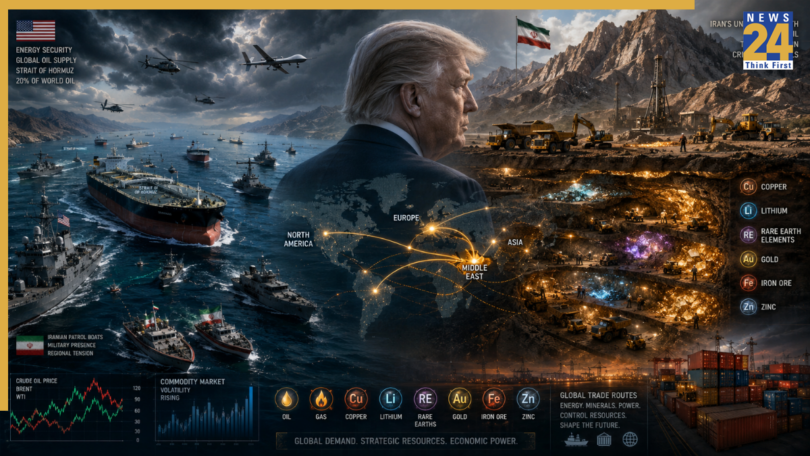
The conflict between the United States and Iran is often explained through oil exports and the Strait of Hormuz, one of the world’s busiest energy shipping routes. However, experts say another major factor may be Iran’s enormous reserves of strategic minerals that are becoming increasingly important for electric vehicles, clean energy, defence technology and advanced manufacturing. As global competition for critical minerals intensifies, Iran’s underground resources have drawn renewed international attention.
Why are Iran’s mineral reserves attracting global attention?
Iran is among the world’s richest countries in terms of natural resources. According to reports cited by Tehran Times, the country possesses around 15% of the world’s total mineral reserves and is home to more than 68 different types of minerals. Its estimated natural resource wealth is valued at nearly $27.5 trillion, placing Iran among the world’s leading resource-rich nations.

While oil and natural gas remain Iran’s biggest economic assets, experts believe its untapped mineral wealth could become even more valuable in the coming decades as industries shift toward electric mobility, renewable energy and high-tech manufacturing.
Lead, zinc, lithium and copper make Iran strategically important
Iran holds some of the world’s largest reserves of lead and zinc, with more than 220 million tonnes of proven deposits. Some estimates suggest the country may possess one of the world’s largest zinc reserves, making it a major player in the global supply chain. Lead is widely used in batteries, defence equipment and radiation protection, while zinc is essential for steel production, batteries and electric vehicles.

The country also has around 2.6 billion metric tonnes of copper reserves, representing nearly 5% of global copper resources. Copper is a critical component in electrical wiring, renewable energy infrastructure and electronic devices.
In recent years, Iran also announced the discovery of approximately 8.6 million tonnes of lithium, a mineral considered the backbone of electric vehicle batteries and energy storage systems. In addition, the country has uranium reserves, large iron ore deposits and rare earth elements, including titanium, which are vital for aerospace, electronics and advanced defence technologies.
Sanctions have slowed mining despite huge potential
Despite possessing vast mineral resources, Iran has struggled to fully develop its mining sector due to long-standing international sanctions. Restrictions have limited access to advanced mining equipment, foreign investment and modern extraction technology.
Even so, Iran has strengthened mineral exports to Asian markets, particularly China. Reports indicate that much of Iran’s zinc concentrate exports now head to China, helping Tehran generate revenue despite Western sanctions. Experts also believe significant mineral reserves remain undiscovered because large-scale deep underground exploration has yet to be carried out across many regions.
Why the mineral race matters beyond the Middle East
Analysts say the growing global demand for critical minerals is reshaping geopolitics. These resources are essential for manufacturing electric vehicles, batteries, solar panels, semiconductors, defence systems and clean energy technologies. As countries seek to reduce dependence on a single supplier, access to alternative mineral-rich regions has become increasingly important.
The Center for Strategic and International Studies (CSIS) has highlighted the strategic value of critical minerals in the global energy transition, while European geological agencies have warned that instability in the Middle East could disrupt not only oil markets but also mineral supply chains.
Although oil and the Strait of Hormuz remain central to US-Iran tensions, experts believe Iran’s vast reserves of lithium, copper, zinc, lead and other critical minerals add another strategic dimension to the rivalry. As the global race for clean energy resources accelerates, these underground reserves are likely to play an increasingly important role in international economic and geopolitical competition.
First published on: Jul 09, 2026 11:49 PM IST
Get Breaking News First and Latest Updates from India and around the world on News24. Follow News24 on Facebook, Twitter.
End of Article
About the Author

Sagar Puri
Sagar Puri is a seasoned Senior Sub-Editor with over four years of newsroom experience, bringing sharp editorial judgment and an eye for detail to every story he handles. Over the years, he has worked across a diverse range of beats, including sports, education, news desk, entertainment, and lifestyle, giving him a well-rounded understanding of the digital news ecosystem.
Read MoreRelated Story