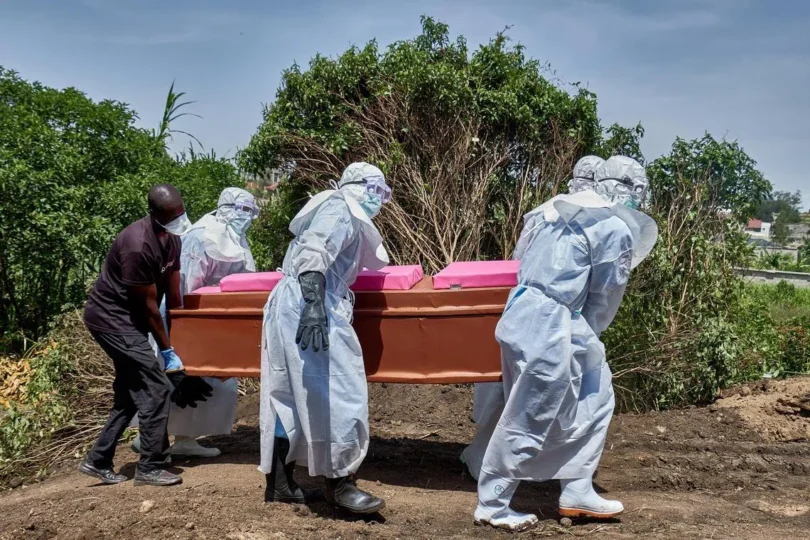
WASHINGTON – Recent outbreaks of Ebola and hantavirus infections are reminders that when such rare diseases flare up, they have the potential, in our interconnected world, to spread beyond their points of origin. While neither of these deadly menaces is thought likely to provoke a global epidemic, they have stoked anxiety about the ability of the US to respond to such a threat.
The fundamentals of pandemic preparedness include maintaining a robust public health infrastructure, including a strong surveillance system to detect threats early; investing in research to facilitate the quick development of new treatments and vaccines; and building public trust in health officials. On each of these fronts, health experts say, steps taken by President Donald Trump’s administration have weakened the ability of the US to respond to a new health emergency.
“We’re much less prepared than we were during the Covid-19 pandemic, and we didn’t perform well then,” said Lawrence Gostin, faculty director for Georgetown University’s O’Neill Institute for National and Global Health Law. In the event of a new pandemic, he said: “I would expect us to perform worse.”
White House spokesman Kush Desai disputed the idea that US capacities had been diminished. He pointed to US actions in response to the ongoing Ebola outbreak in central Africa, including deploying financial aid and materiel, airlifting American citizens out of the region, and invoking restrictions on travel from there.
While acknowledging US contributions to the Ebola response, health experts say that the challenges of containing the outbreak have been exacerbated by Trump administration policies undermining public health efforts abroad, where pandemic threats can emerge.
In the wake of the Covid-19 outbreak, during the administration of then President Joe Biden, the White House Office of Pandemic Preparedness and Response Policy (OPPR) was created in mid-2023 to lead and coordinate efforts. In addition, the National Security Council’s (NSC) biosecurity directorate, which had been dissolved during Trump’s first term, was re-established and charged with monitoring biological threats for the White House.
The second Trump administration has neutered the OPPR by leaving it vacant. The same goes for the NSC’s biosecurity directorate, whose last director, Gerald Parker, resigned in mid-2025. As a result, there is no longer a designated team coordinating readiness for and responses to pandemics among US government agencies or monitoring such threats for the White House.
The administration has weakened the US Centers for Disease Control and Prevention, which has a global presence and is charged with doing the actual work of tracking emerging disease threats worldwide. It’s also responsible for issuing guidance on such matters as vaccination and infection-control practices, as well as coordinating communication between state and local health departments.
The CDC’s been hard-hit by the Trump administration’s drive to shrink the federal government’s payroll. Through layoffs and voluntary departures, the agency has lost some 3,000 people, about a quarter of its staff, including many long-tenured scientists, according to the union representing current employees in Atlanta, the CDC’s headquarters.
Since Department of Health and Human Services Secretary Robert F. Kennedy Jr in August 2025 fired the first and only permanent CDC director confirmed by Congress under this administration, the agency has been headed by a rotating cast of acting directors.
The US Agency for International Development, which had been the world’s largest foreign aid agency, has been dismantled. Some of its programs have moved under the State Department, but the overseas staff who tracked and treated diseases on the ground were defunded.
In January 2026, the US officially withdrew from the World Health Organization, the United Nations body dedicated to public health efforts, claiming the group mishandled the Covid-19 pandemic and lacked independence from the “inappropriate political influence” of member states. By withdrawing personnel from and ending collaboration with the WHO, the US cut itself off from the group’s function as a central clearinghouse for outbreak data.
In an attempt to fill this gap, the Trump administration announced that, under its America First Global Health Strategy, it would require other countries to notify the US of an outbreak within one day of detection. Global health experts say that in addition to undermining existing systems, this requirement will prove difficult for low-income countries to meet. “These capabilities cannot simply be rebuilt overnight,” said Krutika Kuppalli, an infectious disease physician at UT Southwestern Medical Center.
The loss of its biggest donor was a blow to the WHO. The US contributed US$1.3 billion, or about 12 per cent, of the WHO’s 2022 to 2023 budget of US$10.4 billion. The US withdrawal and the disruptions at USAID and the CDC have likely hindered the ongoing Ebola response, according to experts.
The Trump administration also terminated funding for the Centers for Research in Emerging Infectious Diseases in 2025. The network was launched in 2020 under the National Institutes of Health during the first Trump presidency in an effort to prevent future pandemics by collecting and characterising pathogens that could jump from animals to people. About 75 per cent of novel pathogens that sicken humans come from animals, making these so-called zoonoses a huge pandemic concern.
With an initial investment of US$5 billion, the Biden administration created Project NextGen to coordinate government and private-sector efforts to advance the next generation of treatments and vaccines for Covid-19 as well as other disease threats.
It established the Antiviral Drug Discovery Centers for Pathogens of Pandemic Concern in mid-2022, committing US$577 million to develop antiviral drugs for coronaviruses and other especially worrisome viral families. The Trump administration terminated funding for the program in 2025. Kennedy espouses the idea that boosting your immune system – through diet and exercise – can ward off diseases. During the Covid-19 pandemic, he also touted unproven therapies to treat the disease.
Trump’s administration also terminated several awards under Project NextGen for efforts to make improved Covid-19 vaccines. Scientists say such vaccines could reduce the number of deaths from the disease, which from June 2024 to June 2025 claimed at least 34,000 lives in the US.
A chunk of NextGen funding – US$500 million – has been channelled toward a project called Generation Gold Standard, an effort to devise vaccines to protect against multiple strains of flu and coronaviruses. Such so-called universal vaccines have long been a goal of vaccinologists. However, the award was criticised by scientists who said the specific vaccine platform it’s funding doesn’t appear to be especially promising.
At the same time, the HHS has cancelled 22 contracts worth nearly US$500 million for work to advance vaccines using messenger RNA, the technology behind the first Covid-19 vaccines to demonstrate efficacy and the ones that proved the most effective.
Vaccines that use mRNA can be manufactured more quickly than traditional ones. And once such a vaccine proves effective, in theory researchers can quickly tweak it to combat a different virus by changing the genetic code they put into the mRNA. That can make the technology particularly valuable in a pandemic.
Kennedy has criticised Pfizer and Moderna, makers of mRNA Covid-19 vaccines, for the speed with which they developed the shots and questioned their safety. He has said he doesn’t believe mRNA technology is an effective tool for respiratory diseases, such as Covid-19 and flu, and said the 22 contracts were cancelled based on “the science.”
Public trust in US government health authorities had already been damaged before Trump took office a second time. In surveys conducted by the nonprofit health policy research organisation KFF, the share of respondents who said they trusted the CDC as a source of information went from 85 per cent in March 2020 at the start of the Covid-19 pandemic to 67 per cent six months later to 63 per cent in 2023.
One factor contributing to falling trust was the perception that during the pandemic, experts provided conflicting recommendations on how to respond to it. As official guidance changed in response to the evolving understanding of a novel disease, health officials often failed to convey that they were learning as they went along. Also, many Americans thought the recommendations were too burdensome and that authorities overreacted to the threat Covid-19 posed, for example by keeping schools closed despite evidence that they did not contribute meaningfully to the spread of the disease.
Since Trump returned to the presidency, trust in public health authorities has taken a further hit, according to polls. For example, in the KFF survey, the share of respondents who said they trust the CDC as a source of information fell to 47 per cent this past January. Kennedy’s role in the administration is a widespread cause of concern. The share of respondents who said he provides trustworthy information on public health was just 38 per cent in an Annenberg Public Policy Center survey conducted in February.
Kennedy, who has falsely claimed that vaccines cause autism, fired every member of a federal committee charged with deciding which vaccines are covered by insurance or offered for free under the Vaccines for Children programme. He replaced them with new members, many of whom are critics of vaccinations.
Breaking with tradition, Kennedy’s department in January circumvented the committee to unilaterally remake the government’s recommended vaccination schedule for children. Both moves are now tied up in the court system, and the future of the committee remains uncertain. BLOOMBERG