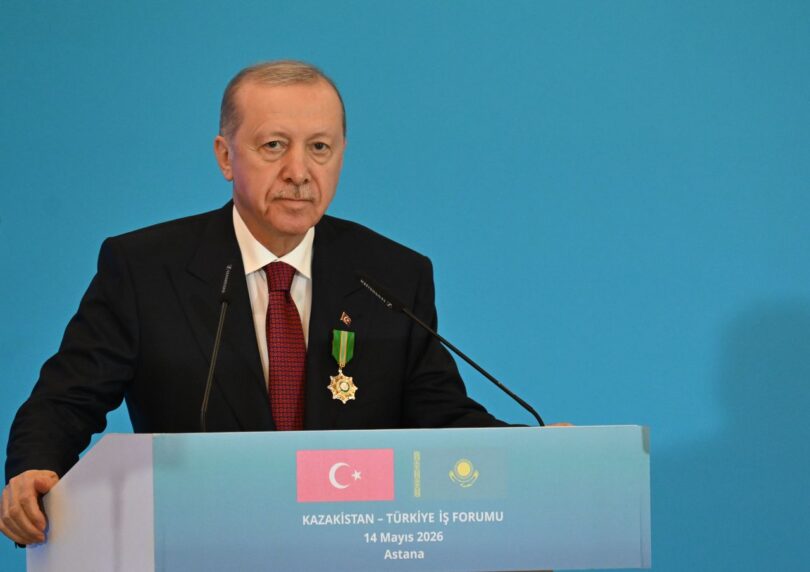
Turkish President Recep Tayyip Erdogan has said that Israel is “trampling on humanity’s shared values through the crimes against humanity it has committed.”
In a post on social media, Turkish Communications Director Burhanettin Duran said on Thursday that Erdogan had written an article titled “The Key to Peace in Eurasia: The Turkic World” for Kazinform.
The article was published following Erdogan’s visit to Astana for the sixth meeting of the Türkiye-Kazakhstan High-Level Strategic Cooperation Council.
Erdogan said regional conflicts and crises today constitute comprehensive challenges to global security, economic prosperity, and stability.
He noted that the global system is undergoing a serious stress test in the face of new asymmetric risks arising from geopolitical rivalry, disruptions in energy supply security, and related financial volatility.
Erdogan also underlined that the major transformation driven by artificial intelligence has further deepened the fragility of the global system.
“Indeed, as we have long maintained, these challenges lay bare the inadequacies of the current international system and global governance mechanisms as well as the pressing need for reform,” he said.
Recalling his address to the United Nations General Assembly in 2014, Erdogan highlighted the inequities embedded within the global system, saying the message that “the world is bigger than five” carries even greater relevance today.
He said the humanitarian catastrophe in Gaza has laid bare the shortcomings of the existing international order.
Erdogan said Türkiye believes global and regional crises can only be resolved through an order based on “enforceable rules,” stressing that Ankara continues to take responsibility through peace diplomacy, mediation efforts, and “trust-based dialogue” to promote global peace and prosperity.
He wrote that stronger bilateral, regional, and global cooperation is essential for a “fairer, more inclusive, and stable” international order, emphasising that disputes should be addressed through “regional ownership” and collaboration with neighbouring countries and organisations, particularly the Organization of Turkic States.