
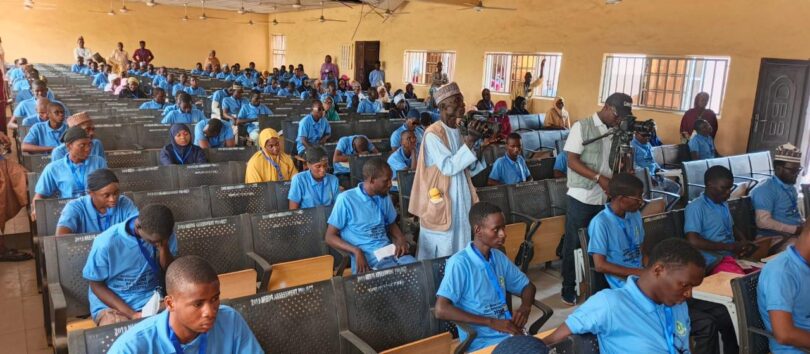
The Joint Admissions and Matriculation Board (JAMB) has commenced the 2026 Unified Tertiary Matriculation Examination (UTME) for candidates with special needs, as part of efforts to promote inclusive access to tertiary education in Nigeria.
The examination, organised under the board’s Equal Opportunity Group (JEOG), is being conducted simultaneously across 11 specialised centres nationwide, with candidates examined under conditions designed to suit their specific needs.
SolaceBase reports that at the Kano centre, held at the Bayero University Kano School of Continuing Education, the exercise drew 135 candidates from Kano and neighbouring states, making it the centre with the highest number of participants this year.
The Coordinator of the JEOG Kano Centre, Prof. Muhammad Yahuza Bello, disclosed this while addressing journalists on Monday, describing the programme as “another landmark in inclusive education.”
According to him, about 530 candidates with special needs are sitting for the examination nationwide under conditions tailored to their requirements.
Read Also:JAMB apologises for delay in results release, gives reason
Bello explained that candidates who cannot participate in the conventional computer-based test due to disabilities—including visual impairment, albinism, Down syndrome and autism—are examined using adapted methods in controlled environments.
He quoted the Chairman of JEOG, Prof. Peter Okebukola, as saying the initiative goes beyond examinations, reflecting Nigeria’s broader commitment to inclusivity in education.
Read Also:Jigawa Local Governments receive ₦158.8bn as federal allocations in 2025
“Our goal is to eliminate barriers to education. By tailoring the UTME to accommodate candidates with disabilities, we are not just conducting an examination; we are sending a message that every Nigerian matters,” Oloyede stated.

The JEOG programme features specialised centres equipped with facilities such as Braille machines, slates, styluses and typewriters, alongside trained personnel, including scribes and invigilators skilled in handling candidates with disabilities.
Despite these adjustments, Bello emphasised that the examination maintains the same standards as those written by other candidates.
He noted that the initiative has recorded measurable progress, with about 34 per cent of participating candidates securing admission into tertiary institutions over the years—an estimated 1,700 beneficiaries.
Read Also:Kaduna LGAs receive N172 billion as federal allocations in 2025
Highlighting success stories, Bello cited Miss Zainab Ibrahim, a former JEOG candidate now in her final year studying Dietetics and Nutrition at Bayero University Kano, as an example of the programme’s impact.
Read Also:UTME: JAMB releases results for second, third days of examination
The Kano centre, one of the pioneer centres established in 2017, serves candidates from Kano, Jigawa, Katsina, Kaduna and Zamfara states.
Additional centres in Bauchi, Birnin Kebbi and Yola were later created to reduce travel burdens for candidates.
According to the group, JAMB is providing free accommodation and feeding for candidates during the examination period, alongside transportation support.
The board is also refunding registration fees to candidates who declared their disabilities and met basic academic requirements.
Read Also:Sokoto neglects Primary Healthcare, disburses just 5% of capital budget in 2025
Bello expressed appreciation to the Vice-Chancellor of Bayero University Kano, Prof. Haruna Musa, for supporting the initiative, including the establishment of a special ICT centre for students with special needs.
He added that the initiative, introduced in 2017 by the JAMB Registrar, Prof. Is-haq Oloyede, aims to ensure that “candidates with disabilities are not excluded from accessing higher education opportunities.”