
By Aminu Abubakar
Local government councils in Katsina State received a total of ₦208.6 billion in statutory allocations in 2025, with disbursements rising steadily through the year and peaking in the final quarter, an analysis of monthly data has shown.
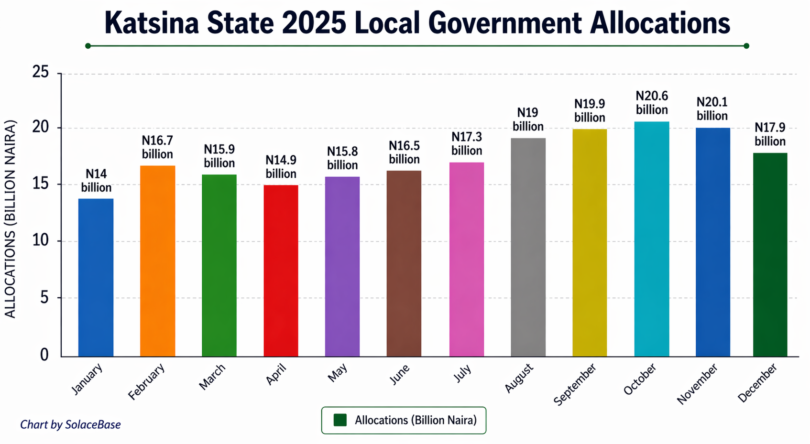
The breakdown reveals that the state’s 34 local government areas started the year on a modest note, receiving ₦14 billion in January — the lowest monthly inflow recorded during the period. Allocations, however, followed a generally upward trajectory, culminating in a peak of ₦20.6 billion in October.
The figures point to a clear improvement in monthly inflows, particularly from mid-year onward, suggesting stronger federal revenue performance and more robust disbursements to the third tier of government.
After January’s ₦14 billion, allocations rose to ₦16.7 billion in February, before easing slightly to ₦15.9 billion in March. The downward movement continued into April at ₦14.9 billion, but the trend reversed in May with an increase to ₦15.8 billion.
By June, allocations had climbed to ₦16.5 billion, setting the stage for a more pronounced surge in the second half of the year.
Read Also:Despite calls for prudence, Gov Radda spends N595m on foreign trips, another N902m on local transport in 9 months
From July, the upward momentum became more evident. Councils received ₦17.3 billion in July, ₦19 billion in August, and ₦19.9 billion in September — marking a period of sustained fiscal expansion.
The final quarter proved the strongest stretch. October recorded the highest monthly allocation of the year at ₦20.6 billion, followed by ₦20.1 billion in November, before easing to ₦17.9 billion in December.
Despite the slight dip at year-end, December’s figure remained significantly higher than allocations recorded at the beginning of the year.
On average, monthly allocations stood at about ₦17.4 billion, underscoring the scale of resources channelled to grassroots administration across the state.
A quarterly breakdown further highlights the trend. The first quarter (January–March) accounted for ₦46.6 billion, while the second quarter rose marginally to ₦47.2 billion.
A sharper increase emerged in the third quarter, where allocations jumped to ₦56.2 billion. The final quarter outperformed all others, reaching ₦58.6 billion — the highest quarterly total recorded in 2025.
In effect, more than half of the total annual allocation was received in the second half of the year, reinforcing the strength of late-year disbursements.
Overall, monthly allocations grew by about 47 percent between January and October, rising from ₦14 billion to ₦20.6 billion. This trajectory likely reflects broader gains in federal distributable revenue, including oil receipts, tax collections, and other income streams shared through the Federation Account Allocation Committee (FAAC).
Read Also:Jigawa Local Governments receive ₦158.8bn as federal allocations in 2025
Analysts say the steady increase in allocations could have far-reaching implications for grassroots governance, particularly in key sectors such as primary healthcare, rural infrastructure, basic education, sanitation, and local security.
As constitutionally mandated providers of services closest to the people, local governments are expected to translate these increased inflows into visible development outcomes — a responsibility that also brings heightened scrutiny over project execution and financial accountability.
The strong performance in the third and fourth quarters suggests councils had greater fiscal capacity in the latter part of the year, potentially enabling increased spending on capital projects, salaries, and social intervention programmes, depending on how funds were managed.
October’s ₦20.6 billion allocation stands out as the strongest single-month performance, exceeding the annual average by more than ₦3 billion. November also remained above the ₦20 billion threshold, reinforcing the robust revenue trend before the December moderation.
Even with the drop to ₦17.9 billion in December, allocations remained higher than most figures recorded in the first half of the year.
The pattern also indicates improved stability in federal disbursements after mid-year, which may have enhanced planning certainty for local authorities in implementing budgets.
However, fiscal observers caution that increased allocations do not automatically translate into improved living conditions unless matched with transparency, accountability, and effective service delivery.
For residents across Katsina’s local government areas, the key question remains whether the funds were deployed toward tangible improvements in infrastructure and essential services. Issues such as road maintenance, access to clean water, healthcare delivery, and school infrastructure are likely to shape public perception of council performance.
Read Also:How high-interest loans, rising debt service test Katsina’s revenue, fiscal outlook