New posts
10:46
Heavy Security, Airspace Curbs Mark Start of Khamenei Funeral Procession
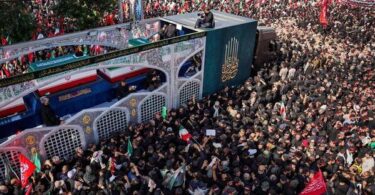
People gather along a street during the funeral procession of late Iranian Supreme Leader Ayatollah Ali Khamenei in Tehran on July 6.
Iranian authorities imposed extensive security measures across Tehran on July 6, including the closure of the capital’s airspace, as public funeral ceremonies for the late Supreme Leader Ayatollah Ali Khamenei got underway.
A procession across Tehran was expected to last up to 12 hours before further ceremonies in Qom and Iraq’s Shi’ite holy cities, culminating in Khamenei’s burial in Mashhad on July 9. Temporary, localized flight restrictions will also be in place from July 7 until the burial two days later.
With officials preparing for crowds reminiscent of the 1989 funeral of Ayatollah Ruhollah Khomeini, state media showed large crowds accompanying Khamenei’s coffin through the capital after two days of lying in state at Tehran’s Grand Mosalla prayer complex.
Organizers also appeared intent on avoiding a repeat of a deadly crush that marred Khomeini’s funeral, where crowd surges killed more than 10 people and injured over 10,000.
Massive concrete barriers were erected around Khamenei’s coffin during the initial ceremonies, reflecting heightened concern over crowd control.
The ceremonies are being presented by Iran’s leadership as a display of continuity and resilience following the five-week conflict with Israel and the United States that began with Khamenei’s killing during US-Israeli air strikes on February 28.
Officials have repeatedly portrayed the turnout as evidence of national unity despite the war, while the event also comes after massive anti-government protests earlier this year that ended in a brutal clampdown.
Attention has remained focused on Khamenei’s successor, his second son, Mojtaba Khamenei, who has still not appeared in public since being appointed supreme leader and is reported to have been wounded in the same strikes that killed his father.
No known audio or video recordings of him have been released in the intervening months, raising questions about his health and his ability to carry out his duties as supreme leader. Ali Khamenei’s three other sons, who have all remained out of public view since the outbreak of the war, have been attending funeral proceedings.
Also notable was the attendance of the Islamic Revolutionary Guards Corps (IRGC) commander in chief Ahmad Vahidi, who only reemerged publicly for the first time in months when paying his respects at Khamenei’s coffin on July 3.
He had kept a low profile since the conflict began amid concerns that senior Iranian commanders could be targeted for assassination. Esmail Qaani, the rarely seen head of the IRGC’s Quds Force, which oversees Iran’s foreign military and covert operations, also made an appearance on July 6.
However, none of Iran’s surviving former presidents, several of whom had strained relations with Ali Khamenei, were seen at the ceremonies.
Delegations from Hamas and Hezbollah also attended, underlining Tehran’s longstanding ties with armed groups in the Middle East.
Hamas is designated as a terrorist organization by the United States and the European Union. Hezbollah is also designated as a terrorist organization by Washington, while its military wing is listed by the European Union.
With reporting by AFP and dpaShare
Copy link
Facebook
X (Twitter)
LinkedIn
Email
Share
00:47
OPEC+ Agree To Increase Output As Strait Of Hormuz Gradually Reopens
The OPEC+ grouping has agreed to further increase output targets beginning in August in an effort to add to world supplies at a time when oil prices are declining due to the gradual reopening of the Strait of Hormuz.
The informal oil-producing group agreed during an online meeting on July 5 to increase quotas by 188,000 barrels a day on top of similar increases already set for June and July.
Ministers from Saudi Arabia, Russia, Iraq, Kuwait, Kazakhstan, Algeria, and Oman held virtual talks and “decided to implement a production adjustment” starting in August, an OPEC statement said.
OPEC+ consists of Saudi Arabia, Russia, Iraq, Kuwait, Kazakhstan, Algeria, and Oman.
The seven core members of OPEC+ have hiked their output quotas from April through July by almost 800,000 barrels a day.
However, the increase has largely been symbolic until now because of the US-Israeli war with Iran, which closed the strait to tanker traffic for some key OPEC+ members, including Saudi Arabia, Kuwait, and Iraq.
Daily global oil demand is around 100 million barrels.
The group, did not comment on current geopolitical developments, is to meet again on August 2.
With reporting by Reuters, AFP, and dpaShare
Copy link
Facebook
X (Twitter)
LinkedIn
Email
Share
19:48
5.7.2026
Trump To Discuss Iran Maritime Security At NATO Summit; US Expects Allies To Bolster Role In Middle East
Aircrafts fly in formation over the White House in Washington D.C., US.
WASHINGTON US President Donald Trump will use this week’s NATO summit in Turkey to discuss security challenges in the Middle East, including the protection of maritime traffic through the Strait of Hormuz and engagement with Syria’s new leadership, while pressing allies to expand their military capabilities, senior US officials said on July 5.
The officials said Trump would hold bilateral meetings with Turkish President Recep Tayyip Erdogan and Syrian President Ahmed al-Sharaa on the sidelines of the summit in Ankara, underscoring Washington’s growing diplomatic engagement with Damascus following political changes in Syria.
Speaking during a White House preview call ahead of the summit, officials said the security of the Strait of Hormuz, through which roughly a fifth of global oil export passes, was expected to be a key topic during the summit given tensions involving Iran and the region’s strategic importance.
A senior official said several NATO allies had already indicated their willingness to contribute capabilities to maritime security efforts but argued many still lacked sufficient naval assets for a meaningful operation.
“We’ve had a lot of allies raise their hand and offer to participate with their capabilities, but… many of them don’t have the necessary ships or assets to contribute to a meaningful maritime effort,” the official said.
The comments suggest the US administration wants European allies to assume a greater role in safeguarding critical sea lanes in the Gulf while the US focuses resources on broader global security priorities.
The White House said Trump would continue urging NATO members to increase defense spending and strengthen military capabilities, arguing that more capable allies would be better positioned to contribute to operations ranging from European security to maritime missions in strategically important regions such as the Gulf.
Share
Copy link
Facebook
X (Twitter)
LinkedIn
Email
Share
15:28
5.7.2026
Tehran Says Maritime Trade Between Iran And Qatar Has Resumed
Iran’s official IRNA news agency reported on on July 5 that Iran and Qatar have resumed maritime trade after a five-month suspension.
Citing Iran’s commercial attache in Doha, IRNA said Qatar’s Al Ruwais Port has reopened to Iranian goods.
Citing Iran’s commercial attache in Doha, IRNA said Qatar’s Al Ruwais Port had reopened to Iranian cargo.
IRNA said the port resumed accepting Iranian cargo “after nearly five months,” following what it described as “sustained efforts by the Iranian Embassy in Doha and coordination with the relevant Qatari authorities.”
The news agency did not provide figures on the volume of trade or cargo moving along the route.
Qatar was targeted by Iran’s Islamic Revolutionary Guards Corps during both the 12-day Iran-Israel war in 2025 and the more recent joint US-Israeli war against Iran, which began in February.
Despite this, Doha later joined Pakistan in facilitating the signing of a framework cease-fire agreement between Iran and the United States.
With reporting by RFE/RL’s Radio FardaShare
Copy link
Facebook
X (Twitter)
LinkedIn
Email
Share
15:14
5.7.2026
Khamenei Funeral Underscores Central Asia’s Delicate Balancing Act
A number of foreign dignitaries take part in a farewell ceremony for the late Iranian Supreme Leader Ayatollah Ali Khamenei on July 3.
Tajik President Emomali Rahmon and former Turkmen President Gurbanguly Berdymukhammedov, still widely regarded as the country’s de facto leader, were among the foreign dignitaries attending funeral events for Iran’s late Supreme Leader Ayatollah Ali Khamenei in Tehran.
But while Iranian state media portrayed the international turnout as evidence of Khamenei’s stature abroad, the varying levels of representation from Central Asia told a more nuanced story.
Tajikistan and Turkmenistan sent their most senior leaders, while Kazakhstan, Uzbekistan, and Kyrgyzstan were represented by parliamentary speakers.
I think that the difference in the hierarchy of Central Asian states represented at the funeral can be explained by the differences in the relationships that those Central Asian countries have with Iran, saidTemur Umarov, a fellow with the Carnegie Russia Eurasia Center who is an expert on China and Central Asia.
Umarov said Tajikistan and Turkmenistan are closer to Iran not only geographically, but also economically.
Turkmenistan depends on Iran for connectivity, trade, imports, and access to wider markets, while Tajikistan has closer security ties with Tehran, including cooperation through an intergovernmental military-security committee and areported Iranian drone production facilityin Tajikistan.
For Turkmenistan, that dependence was exposed during the US-Iran war, when disrupted trade and suspended gas-swap arrangements contributed to shortages, rising prices, and inflation.
For Tajikistan, ties with Iran combine a shared Persian linguistic and cultural heritage, economic links, and security cooperation. Tajik is a variety of Persian, and the two countries have long promoted cultural and educational exchanges alongside expanding trade and defense ties.
Kazakhstan, Uzbekistan, and Kyrgyzstan appeared to take a more cautious approach.
All three see Iran as a useful gateway to the Persian Gulf and global markets, but none relies on Tehran to the same extent for trade, connectivity, or security.
By sending parliamentary speakers, analysts say this allowed the three countries to acknowledge Irans importance without the symbolism of a presidential visit, especially as Kazakhstan and Uzbekistan have been courting US investment and closer ties with the Trump administration.
The differing levels of representation illustrated a broader regional strategy: maintaining pragmatic relations with Iran while avoiding the appearance of aligning too closely with Tehran in its confrontation with Washington.
Tajik journalistKhursand Khurramovsaid Rahmons attendance showed Dushanbes desire to preserve Iran as an important regional partner, but not necessarily to embrace Tehrans foreign policy.
Rahmons participation in the mourning ceremony is a diplomatic gesture and an element of interstate protocol, he said, rather than political support for Tehrans foreign policy course.
With reporting by RFE/RLs Tajik ServiceShare
Copy link
Facebook
X (Twitter)
LinkedIn
Email
Share
11:18
5.7.2026
Cargo Ship Reports Attack Off Yemen
United Kingdom Maritime Trade Operations (UKMTO), a shipping security monitor, said on July 5 that it had received a report that a cargo vessel was under attack by unknown armed assailants about 30 nautical miles southwest of Yemen’s Red Sea port of Al Hudaydah.
The vessel triggered a distress alert, and authorities are investigating. UKMTO advised ships transiting the area to exercise caution and report any suspicious activity.
The incident comes as tensions remain elevated across the region following the US-Israeli war against Iran.
While commercial shipping has resumed through the Strait of Hormuz under a fragile cease-fire, security risks remain high both there and in waters off Yemen, where merchant vesselshave faced repeated attacksand attempted boardings in recent days.
Share
Copy link
Facebook
X (Twitter)
LinkedIn
Email
Share
10:37
5.7.2026
Khamenei Funeral Prayers Held Without Mojtaba; Other Sons Attend
The sons of late Iranian Supreme Leader Ali Khamenei, Meysam (left), Masud (center), and Mostafa) attend funeral prayers for their father on July 5.
Iranian Supreme Leader Mojtaba Khamenei was absent as funeral prayers for his father and predecessor, Ayatollah Ali Khamenei, were held early on July 5, more than four months after he was killed during US-Israeli strikes at the outset of the war in the Middle East.
The prayers were led by Grand Ayatollah Ja’far Sobhani, one of Iran’s most senior Shi’ite clerics.
Mojtaba, who has been widely described by Iranian media as an ayatollah and was named supreme leader shortly after his father’s death, was absent from the ceremony despite the tradition that each successor leads the funeral prayers for his predecessor — a role analysts see asreinforcing the legitimacyof the succession.
He has not been seen in public since he was reportedly injured in the same attack that killed his father on February 28, and no known audio or video recordings of him have been released in the intervening months, raising questions about his health and his ability to carry out his duties as supreme leader.
The Iranian authorities are likely to justify his absence from his father’s funeral on security grounds. However, the attendance of virtually all of the Islamic republic’s senior officials suggested the authorities were confident enough in the security arrangements despite the possibility of an Israeli or US attack.
Those present included the heads of the three branches of government, commanders of the Islamic Revolutionary Guard Corps (IRGC), and senior officers of the IRGC’s overseas Quds Force, which oversees Iran’s foreign military and covert operations.
On July 3, US President Donald Trump said Washington hadgiven Tehran “a week off”for the funeral proceedings before the resumption of indirect negotiations with Iran on implementing a framework peace agreement.
Ali Khamenei’s three other sons — Mostafa, Masud, and Meysam — all of whom had remained out of public view since the outbreak of the war, were present beside their father’s coffin on July 5.
With reporting by RFE/RL’s Radio FardaShare
Copy link
Facebook
X (Twitter)
LinkedIn
Email
Share
23:37
4.7.2026
Iranian Ambassador Insists ‘Service Fees’ Will Be Charged For Hormuz Passage
The Iranian ambassador to China insisted that fees would be charged to ships transiting the important Strait of Hormuz, but he indicated “friendly” nations would receive special treatment.
The comments on July 4 are likely to raise the ire of most of the nations that use the crucial waterway to transport oil and gas products.
Washington has insisted that no tolls or fees will be charged to ships transiting the strait despite suggestions by Tehran that it would charge fees for services to ensure safe passage by vessels in the international waterway.
SEE ALSO:
As Iran Tests Hormuz And Attacks The Gulf, A Former US Ambassador Says Trust Is Gone
An interim deal reached between the US and Iran to end their war set out that commercial ships would transit the strait free of charge for 60 days, although it remains unclear what would happen after that period.
Speaking at the World Peace Forum in Beijing, Iranian Ambassador Abdolreza Rahmani Fazli said Tehran was working in “collaboration and cooperation” with Oman on “new arrangements” for the waterway.
“As a country where the Hormuz is part of its territorial waters, we will definitely charge service fees,” Azli said in translated remarks — insisting that such fees would not be a “toll.”
“These new arrangements will be concerning guaranteeing the security of passage through the Straits of Hormuz, supervision of the passage of the vessels…and also guaranteeing and dealing with the environmental consequences of the massive number of ships,” he said.
“We will definitely consider special treatment for the countries that were friendly to us and specially stood by us during the hard times,” he added.
Prewar, some 20 percent of the world’s crude oil and liquefied natural gas supplies flowed throughl the strait, but the waterway was all but shut down by Iran during the Middle East war, sending energy prices soaring.
With reporting by AFPShare
Copy link
Facebook
X (Twitter)
LinkedIn
Email
Share
16:25
4.7.2026
Iran Names New Commander Of Revolutionary Guards Navy
Iranian media have published a statement by the Islamic Revolutionary Guards Corps (IRGC) Navy marking the funeral of the Islamic republic’s late supreme leader, in which Ali Azmaei has been identified as the force’s new commander.
The previous commander of the IRGC Navy was Alireza Tangsiri, whom Israel said was killed in an air strike on March 26 during the recent conflict in the Middle East. Iran’s armed forces confirmed his death several days later.
Israeli Defense Minister Israel Katz had described Tangsiri as being directly responsible for mine-laying operations and efforts to block the Strait of Hormuz.
The IRGC had not previously announced Azmaei’s appointment as commander. He had served as deputy commander of the IRGC Navy under Tangsiri.
In the course of the 40-day US-Israeli war with Iran, dozens of senior political leaders and military commanders of the Islamic republic were killed, including former Supreme Leader Ayatollah Ali Khamenei.
With reporting by RFE/RL’s Radio FardaShare
Copy link
Facebook
X (Twitter)
LinkedIn
Email
Share
14:39
4.7.2026
Still No Sign Of Supreme Leader As Iran Kicks Off Funeral Rites For Khamenei
Mourners gather at Tehran’s Grand Mosalla prayer grounds to pay their final respects to Iran’s slain supreme leader, Ayatollah Ali Khamenei, at the start of his funeral ceremonies on July 4.
Iran has begun six days of funeral ceremonies for the late Supreme Leader Ayatollah Ali Khamenei under heavy security, but the absence of his son and successor, Mojtaba Khamenei, has become one of biggest unanswered questions surrounding the event.
The new supreme leader has not been seen in public since he was reportedly injured in the US-Israeli strikes that killed his father in February.
With state media are portraying the funeral as a demonstration of national unity and resilience after the recent conflict in the Middle East, analysts told RFE/RL’s Radio Farda that Mojtaba Khamenei’s appearance would carry symbolic weight because, by tradition, the new supreme leader leads prayers for his predecessor, reinforcing the legitimacy of the succession.
Read morehere
Share
Copy link
Facebook
X (Twitter)
LinkedIn
Email
Share
Load more