Tehran was draped in mourning on Friday as Iran launched a week-long state funeral for Ayatollah Ali Khamenei, four months after he was killed in a joint US-Israel airstrike. Several members of his family, including his daughter, son-in-law, infant granddaughter and daughter-in-law, also died in the strike.
Khamenei, who served as Iran’s Supreme Leader from 1989 until February 28 this year, will be laid to rest with full state honours in Mashhad on July 9 (Thursday). Before the burial, his remains will be taken through Qom, Najaf and Kerbala, key Shiite religious centres in Iran and Iraq.
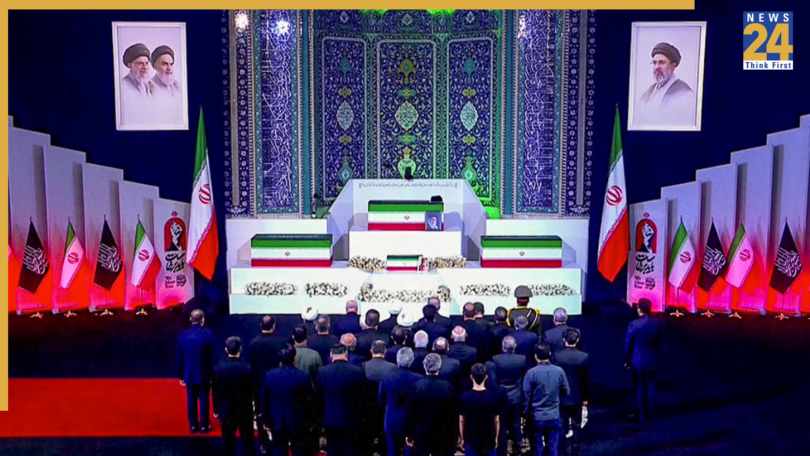
After the coffins of Khamenei and his family were displayed, they were moved to Tehran’s Great Prayer Hall, where thousands of mourners and senior political leaders gathered to pay their respects.
Iranian President, Parliament Speaker, Foreign Minister and other top officials were seen in tears before the coffin, while military commanders stood in salute. Among them was the newly appointed Revolutionary Guards chief Ahmad Vahidi, making one of his first public appearances since taking charge amid concerns over assassination threats.
Emotional Farewell for Khamenei
The funeral ceremony became a deeply emotional display, with grieving supporters weeping, chanting and beating their chests in keeping with Shiite mourning traditions. At the same time, Iran’s leadership carefully projected an image of unity and resilience at a time of regional tensions and domestic challenges.
The coffins were placed on a white stepped platform beneath an ornate arch, surrounded by Iranian national flags and black mourning banners, blending religious symbolism with state authority.
A black turban, traditionally worn by clerics who claim descent from the Prophet Muhammad, rested on Khamenei’s coffin alongside a folded chequered scarf, a symbol associated in Iran with the Islamic Revolution and solidarity with the Palestinian cause.

The symbolism reflected Khamenei’s dual role as both Iran’s political leader and one of Shiite Islam’s highest religious authorities. Under Iran’s theocratic system, the Supreme Leader is considered not only the head of state but also the earthly representative of Shiite Islam’s Twelfth Imam.
His death in what Iran describes as an enemy strike has further strengthened the narrative of martyrdom, a central theme in Shiite history. Across Tehran, black mourning flags hanging from buildings and streets evoke the memory of Imam Hossein, whose seventh-century martyrdom remains one of the most significant events in Shiite Islam.

Mojtaba’s Absence Raises Questions
One of the most talked-about aspects of the funeral was the absence of Khamenei’s son, Mojtaba Khamenei, from the public ceremonies.
Iranian officials said he stayed away due to heightened security concerns as the country remains on alert over possible attacks. However, his absence has also fuelled speculation about both his health and his future political role.
Speaking to India Today before leaving New Delhi for Tehran, Ayatollah Hakim Elahi said the decision was purely based on security considerations during a period of elevated tensions with Israel.
Mojtaba, who is widely believed to have assumed many of the Supreme Leader’s responsibilities following his father’s death, was reportedly injured in the same airstrike. Since then, he has not appeared publicly, with only pre-recorded messages aired on Iranian state television.
Diplomatic Presence at Funeral
The funeral has drawn political and religious leaders from countries that maintain close ties with Tehran, including India and Pakistan.
Although Iran had invited Prime Minister Narendra Modi, India was represented by Bihar Governor Syed Atta Hasnain and Minister of State for External Affairs Pabitra Margherita, who conveyed condolences to Khamenei’s family on behalf of the Indian government.
An interfaith delegation led by Congress leader Salman Khurshid and former Jammu and Kashmir Chief Minister Mehbooba Mufti also paid tribute to the late Iranian leader.
Pakistan was represented by Prime Minister Shehbaz Sharif and Army Chief Asim Munir, both of whom participated in the funeral prayers.
A notable moment came when an emotional Iranian President Masoud Pezeshkian welcomed the Pakistani delegation alongside Foreign Minister Abbas Araghchi and Parliament Speaker Mohammad Bagher Ghalibaf.
Leaders from Russia and China, two of Iran’s closest strategic partners, are also expected to attend the funeral ceremonies.
In another symbolic gesture highlighting Tehran’s regional alliances, members of the family of late Hezbollah chief Hassan Nasrallah were present to pay their respects.
The Political Messaging
Islamic tradition generally calls for burial within 24 hours of death. However, Khamenei’s funeral was postponed because of security concerns during the conflict and rescheduled following last month’s temporary ceasefire.
Following a major procession through central Tehran on Monday, Khamenei’s remains will travel to Qom on Tuesday before ceremonies continue in Iraq’s holy cities of Najaf and Kerbala on Wednesday.
The final burial will take place on Thursday in Mashhad, near the shrine of Imam Reza, one of Shiite Islam’s holiest sites.
While the week-long ceremonies reflect genuine mourning among Khamenei’s supporters, analysts say they have also been carefully orchestrated to reinforce the late leader’s legacy at a time of internal political pressures and mounting external challenges.
Despite the scale of the public mourning, many observers believe support for Iran’s clerical establishment has weakened in recent years due to economic hardship, international sanctions and prolonged domestic unrest.
For now, however, global attention remains focused on Tehran, where the Iranian state is using Khamenei’s farewell not only as a tribute to its longest-serving leader but also as a powerful display of political unity, religious symbolism and national resilience.
First published on: Jul 04, 2026 12:06 AM IST
Get Breaking News First and Latest Updates from India and around the world on News24. Follow News24 on Facebook, Twitter.
End of Article
Related Story