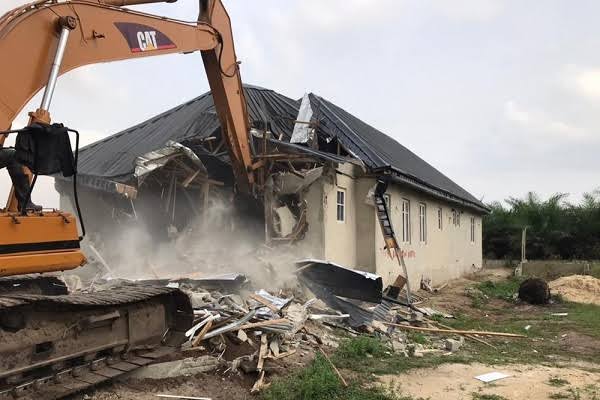
(Demolishing Illegal Buildings. Photo by Nation News)
The Lagos State Government has announced plans to demolish illegal structures obstructing drainage channels and canal right of way in Lekki as part of efforts to tackle flooding and enforce environmental regulations.
A statement by the state government said the exercise will affect illegal structures along Agungi, Ajiran and Ikota, stressing that no individual or developer would be spared if found to have encroached on drainage channels.
The Commissioner for the Environment and Water Resources, Tokunbo Wahab, made this known after inspecting major drainage infrastructure and flood control projects in Lekki, Agungi, Ikota and Ajiran.
The inspection followed repeated reports of flooding in Agungi despite the completion of major drainage projects in the area more than two years ago.
During the inspection, Wahab said officials discovered a major obstruction responsible for the persistent flooding in Ajiran, where a land-owning family had blocked the Ajiran outfall channel.
According to him, the family illegally blocked the outlet of a primary drainage channel that empties into the Lagos Lagoon, preventing stormwater from flowing out of the community.
He explained that the drainage system was designed to discharge floodwater naturally into the lagoon through gravity, adding that the blockage had seriously reduced its effectiveness.
He noted that the outlet into the lagoon had been deliberately blocked, stressing that without opening that channel, water cannot leave the area, and that the government had therefore directed its immediate reopening in the overriding public interest.
The commissioner stressed that although the government respects legitimate land ownership and Certificates of Occupancy, no one has the right to obstruct public drainage infrastructure or natural waterways.
He maintained that no one is above the law, noting that having title to land does not give anyone the authority to close a drainage channel or water body that serves thousands of residents, and that the government was not taking anyone’s land but simply restoring the channel to allow water flow into the lagoon.
Wahab explained that Agungi and Ajiran rely on a dedicated drainage channel that conveys stormwater through Chevron Drive into the Lagos Lagoon.
He warned that blocking drainage channels exposes residents to severe flooding despite the government’s huge investment in drainage infrastructure, noting that the resulting flooding often leads to the government being blamed for inadequate infrastructure, even though taxpayers’ money is used to construct and maintain these channels.
He urged residents not to worsen the situation by blocking them, vowing that the government would continue to open up blocked drainage channels wherever they are found in the overriding public interest.
The commissioner also inspected Megamond Estate in Ikota, where he said developers had illegally reclaimed part of the Ikota River and commenced construction without obtaining the required environmental and drainage approvals, adding that some of the developments exceeded the approvals earlier granted by the state government.
According to him, enforcement and abatement notices had already been issued to the developers but were ignored, and he warned that all illegal structures erected on reclaimed drainage alignments without approval in the estate would be removed from the following morning, stressing that the action would send a clear message that Lagos will not tolerate encroachment on drainage channels or public infrastructure.
Wahab said investigations confirmed that no application or approval had been granted for the development in question, adding that enforcement would begin without delay.
He reiterated that every development involving wetlands or water-related projects must comply with environmental regulations before construction begins, explaining that developers must obtain an Environmental Impact Assessment (EIA) and, where necessary, Wetland Clearance from the Ministry of the Environment and Water Resources before carrying out any reclamation or construction.
He noted that the Environmental Impact Assessment helps determine the likely impact of proposed developments on the environment and identifies measures to reduce any negative effects, adding that the ministry operates an integrated approval process in collaboration with the Office of Drainage Services and other relevant departments to ensure drainage, environmental and wetland issues are properly addressed before approvals are granted.
Wahab lamented that many developers deliberately ignore these legal requirements by beginning reclamation and construction before seeking approval afterwards, maintaining that the government would continue to remove illegal reclamations and developments that violate environmental laws regardless of whose interests are affected, stressing that such practices are unfair to the system, unfair to law-abiding residents and unacceptable because they compromise public safety.
The commissioner also appealed to residents to support the government’s efforts by reporting environmental violations, encouraging Lagosians to speak up when they notice irregularities, noting that the illegal activities uncovered during the inspection came to light through whistleblowers whose reports were investigated, verified and acted upon immediately.
He stressed that residents have a critical role to play in protecting drainage infrastructure.
Wahab assured residents that the Lagos State Government would continue to protect lives, property and public infrastructure through strict enforcement of environmental laws and sustained investment in resilient drainage infrastructure.