The Lagos State Government has intensified efforts to expand digital learning across public and private schools, urging school proprietors and administrators to embrace the Nigeria Learning Passport (NLP) as a key tool for improving educational outcomes and preparing learners for the demands of the digital age.
The Commissioner for Basic and Secondary Education, Mr. Jamiu Tolani Alli-Balogun, made the call on Wednesday during an orientation, sensitisation and monitoring session on the Nigeria Learning Passport held at the Education Resource Centre (ERC), Ojodu, Lagos.
Addressing private school owners and administrators, Alli-Balogun said the state government was determined to deepen the adoption of technology-driven learning solutions as part of its broader education reform agenda.
According to him, the Nigeria Learning Passport has become a critical platform for ensuring uninterrupted access to quality education, particularly in an era where learning must extend beyond the traditional classroom.
“The disruptions of recent years, from pandemics to security challenges, taught us one important lesson: learning must continue anywhere and at any time,” he said.
“The Nigeria Learning Passport is our response to that challenge. It provides learners and teachers with access to quality educational resources both online and offline, ensuring that education remains accessible regardless of circumstances.”
The commissioner noted that the platform, developed through a partnership involving the Federal Ministry of Education, UNICEF and Microsoft, offers more than 20,000 curriculum-aligned learning materials in various formats, including videos, audio content, simulations, games and emerging technology courses such as Artificial Intelligence.
He disclosed that Lagos State, which officially launched the platform in September 2022, has emerged as the leading state in the country in its implementation.
According to him, UNICEF recognised Lagos as the best-performing state on the initiative after it recorded more than 200,000 enrolled users by the end of 2025, including learners, teachers, administrators and parents.
He added that more than 5,000 education stakeholders had been trained on the platform, while its usage had spread across all public schools and several private institutions in the state.
“Education transformation in Lagos cannot be complete without our private school partners. More than 60 per cent of learners in the state are in private schools, making your participation critical to the success of this initiative,” Alli-Balogun said.
The commissioner urged school proprietors to move beyond seeing the platform as a government programme and instead view it as a strategic asset capable of transforming teaching and learning.
He encouraged schools to appoint dedicated “NLP champions” to drive adoption, train teachers on the platform’s features and closely monitor learner engagement using the data tools available on the system.
“A tool is only as effective as the people using it. When teachers become confident in using the platform, the quality of teaching and learning in our classrooms will improve significantly,” he said.
Alli-Balogun also stressed the importance of data-driven decision-making in schools, noting that the platform enables administrators to track student progress in real time, identify learning gaps and provide targeted interventions.
He assured private school operators that the state government was committed to supporting them in addressing challenges related to connectivity, devices and content accessibility.
“The Ministry is not here to police private schools. We are here to ensure that every child in Lagos, whether in a public or private school, has access to quality learning opportunities,” he said.
Describing the Nigeria Learning Passport as a vital instrument for educational equity, Alli-Balogun said the initiative would help standardise learning quality, expand access to education and equip young people with skills required for the Fourth Industrial Revolution.
He commended UNICEF for its continued partnership with the state government in advancing digital learning and called on stakeholders to move beyond awareness to active implementation.
“The Nigeria Learning Passport gives us a rare opportunity to expand access, standardise quality and prepare our children for the future. Together, we can build a Lagos where every learner has quality education at his or her fingertips,” he said.
Also speaking, Director of Policy, Planning, Research and Statistics in the Ministry of Basic and Secondary Education, Mr. Martins Opeyemi, said the platform was specifically designed to improve learning outcomes among young Nigerians through technology-driven education.
Opeyemi explained that although the Nigeria Learning Passport had been available in Lagos for the past four years, its adoption in secondary schools had yet to reach the desired level, necessitating the sensitisation programme for private school operators.
“The Nigerian Learning Passport contains over 20,000 learning resources and subjects tailored to the national curriculum. Lagos State has been at the forefront of using the platform, particularly for examination preparation, but we want more secondary school students to take advantage of it,” he said.
He added that resource persons from Abuja were participating in the programme to provide practical guidance on how schools could maximise the platform’s benefits.
In his remarks, Chairman of the Lagos State Parents Forum, Mr. Ganiyu Olatunbosun, commended the state government for extending the initiative to private schools after its successful implementation in public institutions.
“Most of our public schools have already benefited from this programme. It is difficult to find a child in a public school who has not enjoyed its benefits. We thank the commissioner for ensuring that private school students are also given this opportunity,” he said.
Olatunbosun urged parents, school owners and education stakeholders to make the necessary sacrifices to ensure children succeed academically in an increasingly technology-driven world.
Also addressing participants, the Coordinating Director, Office of Education Quality Assurance, District II, Mr. Oduguwa Ayotunde, described the Nigeria Learning Passport as a transformative innovation capable of overcoming barriers to education.
According to him, the platform ensures that learning continues regardless of circumstances, including insecurity and other disruptions that may prevent physical classroom attendance.
“With the Nigerian Learning Passport, you can learn anywhere. Any challenge that hinders conventional learning does not affect the platform. Since its launch in 2022, it has recorded significant success across public schools in Lagos State, which is why we are now introducing it more aggressively to private schools,” he said.
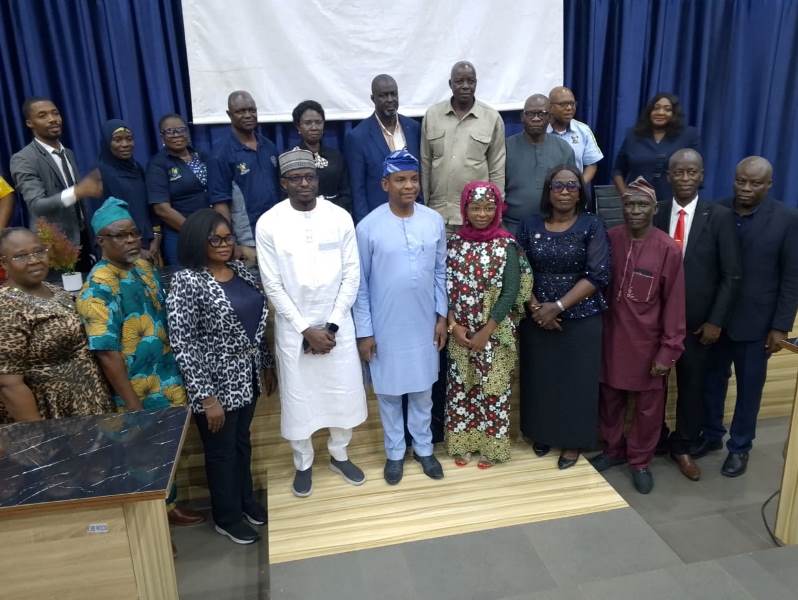
The session brought together private school proprietors, school heads, education administrators, parents and development partners to deepen awareness of the platform and strengthen its adoption across the state’s education sector.