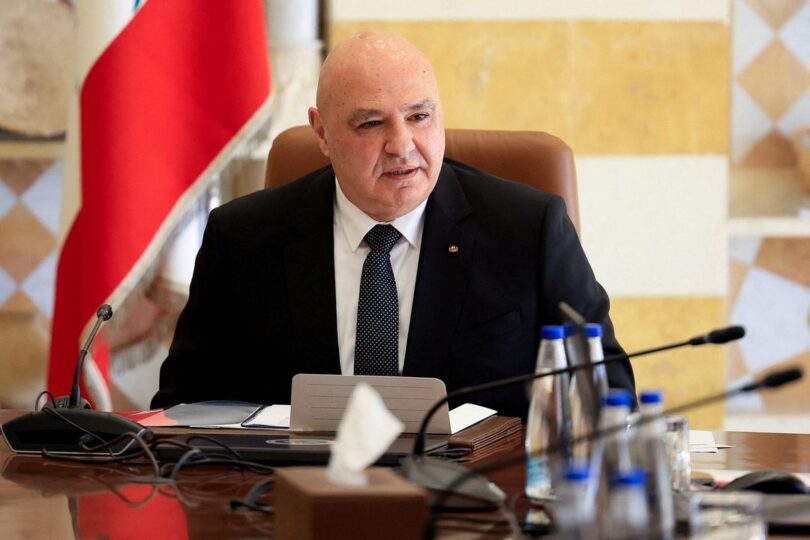
Salam made the remarks during a visit to Zawtar al-Gharbiyeh in the Nabatieh district of southern Lebanon, a day after Lebanese army units began deploying in the town under the first phase of a framework agreement, according to a statement from the Prime Minister’s Office.
Salam was accompanied by Defence Minister Michel Menassa, Army Chief of Staff Hassan Audi, Higher Defence Council Secretary-General Mohammed al-Mustafa and other senior officials.
“This is a national moment that carries significant political and moral dimensions, because it represents the beginning of the Israeli withdrawal from our land,” he said.
Related
During the visit, Salam raised the Lebanese flag in the town square.
“What we are witnessing today is merely a beginning, but we are determined and steadfast, and we will continue to mobilise all our political and diplomatic efforts to secure the complete withdrawal from all Lebanese territories,” he added.
“The Lebanese Army and security forces are present to protect our returning people, and in parallel with completing the army’s deployment, we will continue to open roads, clear rubble and secure basic services, enabling our people to return safely and with dignity to their homes and villages,” Salam said.
On June 26, Lebanon and Israel signed a framework agreement providing for a phased Israeli withdrawal from all occupied Lebanese territory, but it does not include a timetable for the withdrawal.
Instead, it links completion of the process to the Lebanese army assuming full security responsibility in areas vacated by Israeli forces and the disarmament of armed groups, including Hezbollah.
According to official Lebanese figures, Israeli attacks in Lebanon have killed 4,328 people and injured 12,230 others since March 2.
Israel continues to occupy parts of southern Lebanon, some of which have been held for decades and others seized during the war between October 2023 and November 2024.