
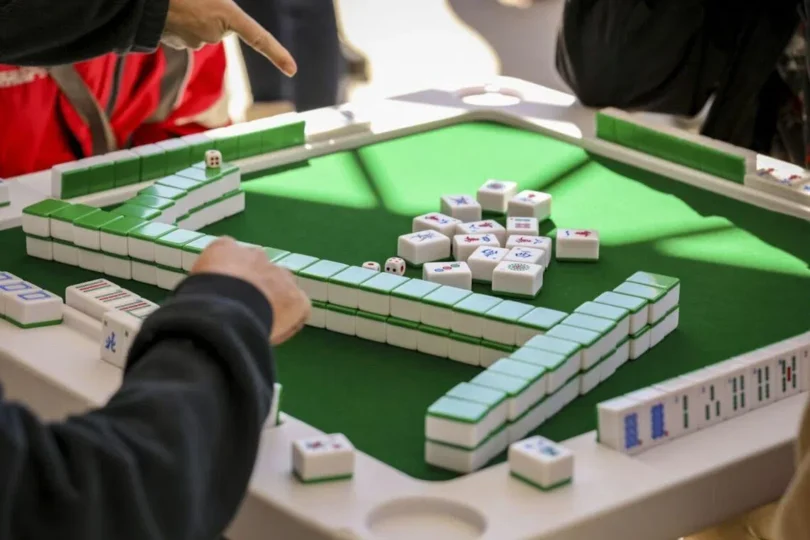
On a Wednesday night at Beverly Hills’ newest members-only club, Gravitas, the usual scene of dimly lit dinner tables laden with wine and caviar has been replaced by hundreds of clinking tiles. Inside, more than 50 members and guests have gathered to play an ancient game that has taken over the town: mahjong.
“The world is looking very bleak right now,” says Ms Christina Huntington, 48, after she plays – and wins – her first round. “I just wanted to do something fun.”
Everyone seems to be talking about mahjong these days. The co-host of Dax Shepard’s Armchair Expert podcast is obsessed. So are Meghan Markle and Julia Roberts. A Hallmark rom-com airing in May, called All’s Fair In Love & Mahjong, follows a small-town nurse who falls in love while teaching the game. The colourful tiles even made an appearance in Icelandic pop star Laufey’s latest music video.
From London to Mumbai, mahjong events are popping up in major cities around the globe, with searches for the game up 18-fold from 2023 to 2025 and mahjong-related events growing 45-fold from 2021 to 2025, according to Eventbrite.
New York’s Green Tile Social Club has thrown events in partnership with buzzy brands such as Resy and A24. In April, Tinder hosted a mahjong date night at a bar in Los Angeles’ Chinatown.
Mahjong is an old game, born in the mid-1800s near Shanghai. From there, it quickly spread throughout China and other Asian countries, all forming their own regional variants.
Its first popularity peak in the US came in the 1920s, when a Standard Oil representative named Joseph Babcock, who discovered it while stationed in Shanghai, started marketing it as an exotic game to White Americans.
His countrymen embraced it so much that they eventually created their own version, today called American Mahjong, complete with a different set of tiles and rules.
“I do think we’re in a moment with echoes of the 1920s,” says mahjong historian Annelise Heinz, an associate professor at the University of Oregon.
“There’s a fascination with and a fear of China that is very obvious and present in American political and consumer culture.”
At Gravitas, long-time mahjong instructor Jennie Jethwani patiently explains the rules of the game to a table of complete beginners, myself included.
Similar to the card game rummy, mahjong involves making pairs and sets of three. Players pick up and discard tiles until they complete their hand.
The game requires a set of 144 tiles, a square table and four players. Winning takes a mix of skill and luck.
After each hand, players knock all the tiles into the centre of the table and shuffle them around, creating a satisfying clinking. A full 16-hand game takes anywhere from two hours for a table of pros to four hours for beginners.
Mr Finnegan Wong-Smith, 28, started going to mahjong nights at Los Angeles bar General Lee’s soon after the Covid-19 pandemic, craving a social life after so many months in isolation.
“I would go by myself to meet new people,” he says. “Mahjong does that well because it puts you across from someone at a table.”
Soon after he joined those informal game nights, the organisers got too busy to continue hosting, so Mr Wong-Smith took up the mantle. He gave the gatherings a name, Mahjong Underground, and worked out a regular schedule with the bar.
Eventually, the weekly game nights at General Lee’s ballooned. Now anywhere from 200 to 250 people will show up on a Monday night to play mahjong, he says.
To accommodate the throngs, Mr Wong-Smith has brought Mahjong Underground to other bars and clubs across LA, from Santa Monica to Atwater Village.
“Finding a time or picking a thing to do – you get decision paralysis,” he says.
Events like Mahjong Underground offer people free, regular meetups, no RSVP required. “Having the option and not the obligation to show up lifts a lot of the burden of planning.”
Attendees range from those simply seeking analog connections to second-generation kids of the Asian diaspora who saw their elders playing daily growing up, Mr Wong-Smith says.
Ms Jaimie Wan, 33, counts herself among that latter category.
“I grew up in a family that played mahjong,” Ms Wan says. “It was always in the background, but I had no interest because I was a kid.”
When Ms Wan moved to Hong Kong in 2020, friends taught her how to play mahjong on nights out clubbing and at house parties.
“I’m realising there’s so much more of my culture – centuries – that I didn’t even touch on until now and I’m discovering for the first time,” she says.
She got hooked and, after moving back to LA in 2024, started playing with Mahjong Underground. Recently, she started her own branch of meetups, called Intergenerational Mahjong, hosted at a senior centre in the predominantly Asian Monterey Park neighbourhood.
Ms Wan lost her grandmother in 2025, and for her, the group is a way for young people – many of whom live far away from loved ones – to connect with and learn from people like their grandparents. The last gathering brought together more than 70 volunteers who spoke 10 languages, according to Ms Wan, and participants ranged from kids to retirees.
“There’s a lot of joy that comes from seeing people make connections across the table, especially people that you wouldn’t expect to meet,” she says. “We’ve kind of created a family here.”
I find myself at Ms Jethwani’s mahjong event in Beverly Hills partly because, like Ms Wan, I grew up around the game but never learnt how to play. The Chinese characters on the tiles were intimidating, and so was the speed at which my aunts and uncles moved them around.
But Ms Jethwani promised there would be other beginners at the event and plenty of instructors to go around, as well as bilingual tiles with Roman numerals printed on them in addition to Chinese.
Ms Jethwani, who runs a company called the Mahjong Master, teaches the game at private clubs, including Gravitas and Soho House, across the city, as well as to clients in their homes. She and her instructors get my table of newbies up to speed quickly, but we still fumble with the tiles, make mistakes and break subtle points of etiquette.
After we make our way through one round in about an hour, she asks if we would like to see the pros play.
The instructors gather and start “washing” the tiles. The game plays out at lightning speed, their hands throwing out and picking up tiles with practised fluidity. Some master mahjong players do not even have to look at their tiles; they can identify them based on feel.
Like many families, mine plays with unique house rules. There are more than 40 variants of mahjong, and my relatives play a variation from Shanghai that has not quite fully made its way to the LA scene, which is dominated by the Hong Kong style.
For some heritage players, mahjong is a way to recover something lost.
Ms Nicole Wong, 39, author of the book Mahjong: House Rules From Across The Asian Diaspora (2025), started documenting her family’s house rules in part to preserve their history and cultural legacy.
Ms Wong’s great-grandfather moved from China to New Zealand decades ago, and the way her family and other Chinese New Zealanders play today is generally considered an older version of the game.
“I think of mahjong styles and histories like food recipes – retained in the diaspora more than the place they’re from,” Ms Wong says. “The people in the diaspora hold tightly to identity even more than the place of origin, which has moved on.”
For Ms Wong and other children of the Asian diaspora, the new wave of interest in the game is a mixed bag.
In 2021, the Mahjong Line, a company selling game sets and accessories in Dallas, faced backlash for offering mahjong sets – which typically retail for less than US$100 (S$127) – online for upwards of US$400, some of them with tiles scrubbed of Chinese characters and references. On their website, marketing language called traditional tiles “all the same”.
“Our initial goal was to design tiles that could be part of the game’s evolution amongst new and younger audiences,” one of the founders wrote in an e-mail to the Today show in 2021.
“It has become clear that we unintentionally re-created an experience shared by many Asian Americans of cultural erasure without using proper attribution and are working to address these issues.”
To Ms Wong, the moment was upsetting because “some of us have to fight really hard to have the way we live life be recognised as legit or valid or a real thing”.
Critics of the new Hallmark movie point out that a promotional poster does not feature any visibly Asian cast or Chinese cultural elements.
“The movie honours the heritage of Mahjong by recognising the game’s Chinese origin and its unique ability to connect cultures, generations and communities,” a Hallmark Media spokesperson said in an e-mailed statement.
The line between cultural appreciation and appropriation is a tricky one, which Ms Jethwani has considered as an Indian who has found herself enmeshed in the game. She says she felt like a bit of an impostor when she started teaching mahjong.
At Gravitas, a copy of Ms Wong’s book sits perched on a table, and Ms Jethwani refers to it while answering questions about the different styles of play.
“Non-Indian people teach yoga. Why can’t I teach mahjong as long as I am teaching it correctly and with respect to its history?” she asks.
For the University of Oregon’s Heinz, who has been a historian of the game since 2008, the question is not whether the current phase of mahjong is a fad – it is how much the style of play and physical sets themselves can change before they lose their connective tissue and become a different game entirely.
“Mahjong has always been a really powerful way to build community,” she says. Because of that, it is “here to stay”. BLOOMBERG