By Ipole AMAJAMA
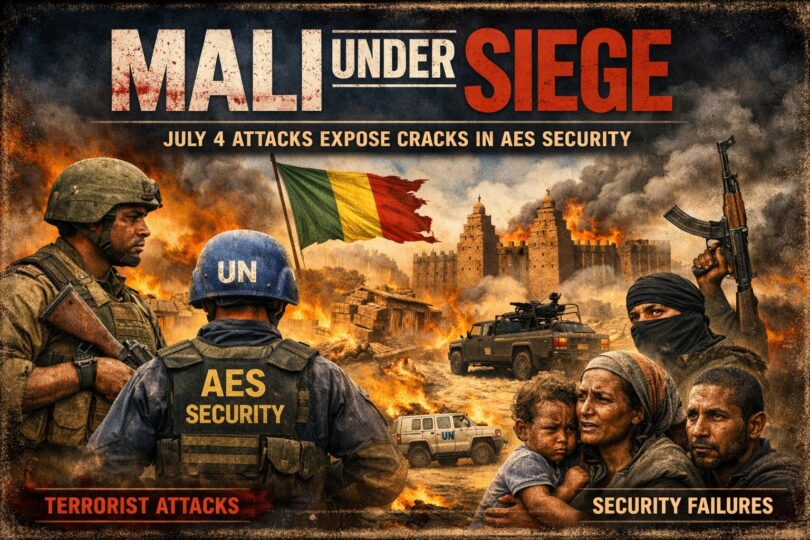
On July 4, 2026, Mali woke to a wave of violence that swept across its northern towns. Jama’at Nusrat al‑Islam wal‑Muslimin, JNIM, and the Front de Libération de l’Azawad, FLA, launched a coordinated offensive that struck at the country’s defensive backbone.
Ten attacks in a single day — from Anéfis and Aguelhok to Gao, Sévaré, Konna, Kaniéroba, Léré, and Kouakourou — revealed not only the insurgents’ growing strength but also the fragility of Mali’s military and its Russian allies.
The choice of targets was deliberate; Anéfis and Aguelhok. The fighting that erupted in these strongholds, key to controlling the Trans‑Saharan route as whoever holds them controls access to central Mali.
Also, at Gao near the airport disrupted logistics and symbolized the insurgents’ reach. Further, the attack on Kaniéroba, the prison known as “the African Alcatraz” was with the clear aim of freeing detained fighters and leaders. The breadth of the operation underscored its strategic intent: dismantle Mali’s defensive locks and pave the way for deeper incursions.
The most dramatic scene of the assault unfolded the following day. On July 5, a convoy of Malian Armed Forces, FAMa, and Africa Corps mercenaries left Gao to reinforce Anéfis. About 100 kilometers out, between Tarkint and Tabankort, they were ambushed.
Two trucks — one loaded with ammunition, the other a fuel tanker — were destroyed. BTR armored vehicles, light support trucks, and even a Mi‑24 helicopter were lost. The convoy was forced to retreat, a humiliating setback that exposed the vulnerability of Mali’s supply lines.
In the aftermath, Africa Corps, the Kremlin’s supposed security architecture on the continent, scrambled to control the narrative. Through social media channels, they claimed the downed helicopter belonged to FAMa, not Russia.
The attempt to shift blame highlighted tensions between the mercenaries and their Malian partners. Meanwhile, the FLA boasted of recovering the helicopter’s machine gun, promising to mount it on one of its vehicles. Such battlefield recoveries are critical: abandoned equipment strengthens insurgent ranks and weakens state forces.
Africa Corps, aware of the danger, deployed FPV drones to destroy abandoned vehicles. Videos circulated showing a VP11 armored vehicle first discovered by assailants, then later struck by drones. Presented as proof of victory, the footage was in fact an admission of weakness — destroying one’s own assets to prevent their capture.
The human toll of the July 4 attacks remains uncertain, but the outcome is clear. Mali and Russia failed to repel the offensive. JNIM and the FLA demonstrated joint striking capability that overwhelmed their adversaries.
The attackers’ advance appears calculated: secure territory east of the “green line,” then prepare for a final offensive to topple the state. The ambush of the convoy dealt a severe blow to morale, leaving both Malian and Russian forces shaken.
This was not an isolated incident. It was the second major demonstration of insurgent superiority in recent months, signaling a dangerous escalation.
The July 4 attacks expose a broader truth: Mali is collapsing. The Alliance of Sahel States (AES) — Mali, Burkina Faso, and Niger — was supposed to provide collective security. Instead, its failure is glaring.
Russian military support, delivered through Africa Corps mercenaries, has proven inefficient and dangerous. Reports of civilian killings and sexual violence by these irregular forces have deepened mistrust. Far from stabilizing Mali, Africa Corps has worsened the crisis.
The juntas ruling AES states must confront their failure. Their isolation from the international community has left them vulnerable, while insurgents exploit the vacuum. It is time to reassess, dismantle military rule, and rebuild ties with regional and global partners.
The Economic Community of West African States, ECOWAS, has long urged Mali and its neighbors to return to democratic governance. ECOWAS is waiting for its “brothers” to rejoin the fold, to seek African solutions collectively.
External partners are also necessary. While no savior will emerge to single‑handedly resolve the crisis, rejecting international support — as the AES has done — is reckless.
Partnerships can provide training, intelligence, and targeted military assistance. Refusing such support leaves Mali isolated and insurgents emboldened.
The failure of Mali’s junta and Africa Corps has created unprecedented opportunities for terrorist groups. JNIM and the FLA are spreading faster than ever, threatening not only Mali but neighboring states.
The July 4 attacks demonstrate their capacity to strike across multiple fronts simultaneously. If unchecked, this insurgent expansion could destabilize the entire Sahel and spill into coastal West Africa. The crisis is no longer confined to Mali; it is a regional security threat demanding collective response.
One lesson stands out: military rule is not a solution to security challenges. Juntas lack legitimacy, they alienate populations, and fail to attract the partnerships necessary for success.
A democracy trusted by its people, committed to sovereignty yet open to cooperation, has a better chance of defeating insurgents. Democratic governance can attract investors, stimulate economic development, and offer hope to youth — reducing the appeal of extremist recruitment. Look at Nigeria with the support it has received from the United States leading to the neutralising in May of Abu-Bilal Al-Minuki, second-in-command of ISIS, in his hideout in Borno state.
The joint military cooperation according to Samaila Uba, director of defence information at Nigeria’s Defence Headquarters (DHQ), have killed several high-value terrorist commanders and no fewer than 200 insurgents in the country’s north-east. Such decisive outcomes are lacking in the AES partnership with Moscow’s AES.
History demonstrates that military support should be sought in specific domains — training, intelligence, logistics — rather than wholesale reliance on mercenaries. Only then can armed forces be given the best chance of success.
As it is evident now, the July 4 attacks mark a turning point. They expose the fragility of Mali’s defenses, the inefficiency of Russian mercenaries, and the failure of the AES experiment. They also highlight the urgency of regional cooperation and democratic renewal.
Mali’s collapse is not inevitable, but recovery requires bold choices: dismantling juntas, re‑engaging with ECOWAS, welcoming external support, and building democratic institutions that can withstand insurgent pressure.
The insurgents have shown their strength. The question now is whether Mali and its partners will learn from failure and chart a new course — or whether July 4 will be remembered as the day the Sahel slipped beyond recovery. Time, as they say, will tell.
Amajama, a social and policy analyst, writes from Abuja and can be reached via [email protected]