
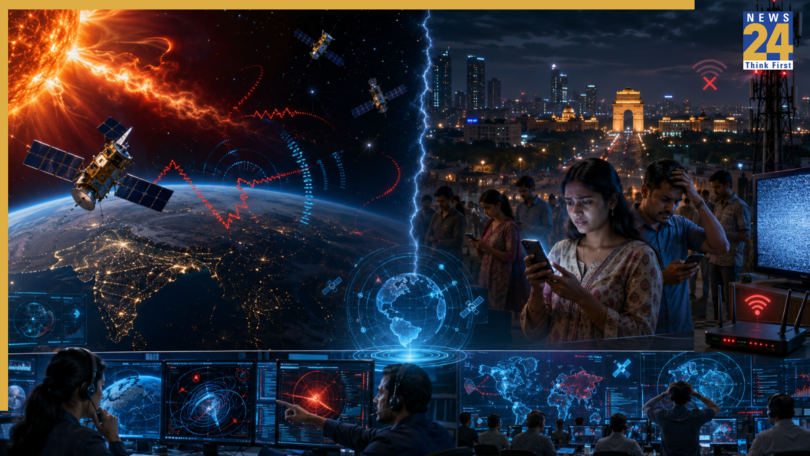
A powerful solar eruption is moving toward Earth, and scientists are closely monitoring its impact. NASA and the US Space Weather Prediction Centre have issued a G3 geomagnetic storm alert for June 8, 2026. The fast-moving coronal mass ejection is expected to arrive on Monday. It is travelling at a speed of nearly 1,400 kilometres per second and may trigger auroras along with temporary disruptions in communication systems.
What Caused the Explosion on the Sun
The eruption originated from a highly active region on the Sun known as Active Region 4461. It produced an M1.8 solar flare, a strong burst of energy caused by magnetic activity. Along with the flare, a dense filament of hot plasma was released into space. This filament was held together by powerful magnetic fields that suddenly became unstable and exploded outward. Scientists say this is one of the fastest solar events recorded this year.
Just when everyone thinks the recent set of solar storm fizzles were all we were going to have this week, WHAM! Region 4461 fires a massive blast and launches a fast moving solar storm towards Earth. Looking closely at the region just before the eruption, a very dense core… pic.twitter.com/DQjOWZANVG
— Dr. Tamitha Skov (@TamithaSkov) June 7, 2026
NASA Issues G3 Storm Alert
NASA and international space agencies are tracking the solar storm closely. The US Space Weather Prediction Centre has classified it as a G3-level geomagnetic storm, which is considered strong. Such storms can affect satellites, GPS systems, aviation routes, and radio communication. The final impact will depend on the direction of the solar magnetic field when it reaches Earth. A brief G4-level storm cannot be ruled out if conditions intensify.
So I think my footage from last night has gone kinda viral 😆
So many questions, here are a few answers…
It was taken at the Aurora Borealis Observatory on Senja in northern Norway.
It was taken on a @SonyAlpha 7sii, which is an amazing camera for astrovideography 😍 pic.twitter.com/D7Z30sO4AP
— Matt Robinson (@Astromackem) November 23, 2020
Will India Witness Auroras in the Night Sky?
Experts say parts of northern India could witness rare auroral activity if the storm is strong enough and skies remain clear. Along with India, regions of Europe, Australia, and North America may also see glowing lights in the night sky. While auroras are usually seen near polar regions, strong geomagnetic storms can push them to lower latitudes. Scientists are watching closely as the event approaches.
Why Scientists Are Closely Watching This Event
Although no major danger to life is expected, space weather events like this can temporarily disturb technology-dependent systems. Scientists continue to monitor the Sun for changes, as the final strength of the storm will only be known shortly before it reaches Earth.
First published on: Jun 07, 2026 11:51 PM IST
Get Breaking News First and Latest Updates from India and around the world on News24. Follow News24 on Facebook, Twitter.
End of Article
About the Author
Sagar Puri
Sagar Puri is a seasoned Senior Sub-Editor with over four years of newsroom experience, bringing sharp editorial judgment and an eye for detail to every story he handles. Over the years, he has worked across a diverse range of beats, including sports, education, news desk, entertainment, and lifestyle, giving him a well-rounded understanding of the digital news ecosystem.
Read More
Related Story