
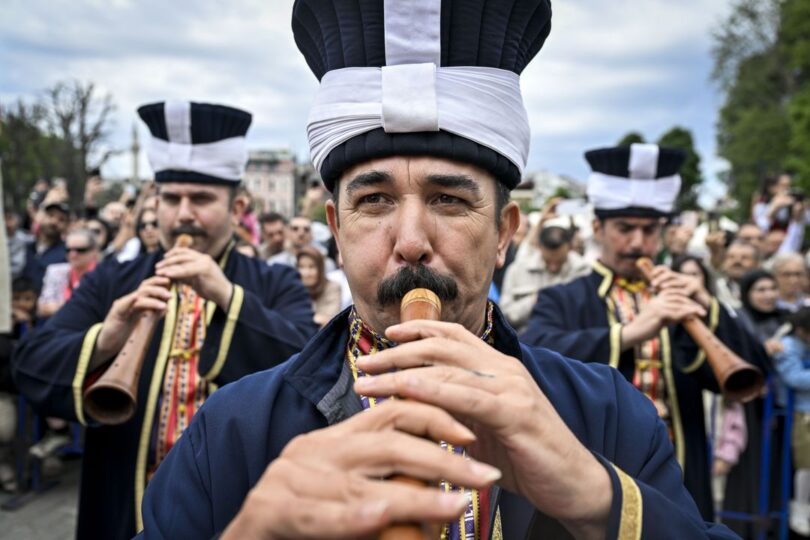
“It is a tremendously powerful march. Throughout history, it impressed both Turks and their enemies — positively for the Turks, negatively for their opponents — creating a sense of awe, majesty and fear.”
Designed for open spaces, armies on the move, state ceremonies and moments of confrontation, the Mehter was never meant to fade into the background. Its instruments — the kos, davul, zurna, nakkare, zil and boru — were built to be heard from afar, carrying across crowds, military camps and battlefields.
Even the rhythm many listeners recognise as “dum tek tek” carries meaning. In Turkish and Middle Eastern percussion traditions, such syllables are used to teach, remember and feel rhythm: “dum” evokes the deep, heavy beat struck at the centre of a drum, while “tek” suggests a sharper sound produced at the drum’s edge or by the clash of cymbals.
“On the battlefield, it also provided communication. It brought our side to courage and effort, while demoralising and frightening the other side,” Caskurlu tells TRT World.
Many societies used drums and instruments in battle, he notes, but Turks turned this into a moving, organised band structure. The Ottoman Empire later refined it into one of its most recognisable military institutions.
Sound beyond borders
“This is not a state that was founded after the Napoleonic revolutions with no past,” Caskurlu says.
“It is a state whose roots go back thousands of years in both Islamic and Turkish history. If soldiering is a profession, if soldiering is a way of life, this is a state that wrote the book on it.”
The summit’s timing made the symbolism even sharper.
NATO leaders gathered in Ankara at a moment when the alliance was debating defence spending, military modernisation, Ukraine, European security and the future of burden-sharing.
Türkiye, positioned between Europe, Asia and the Middle East, has long emphasised its strategic role in the alliance. At this summit, that role was not expressed only through speeches and meetings. It was also expressed through sound.
Associated with the Ottoman military order, it was sidelined during the reforms of Mahmud II after the abolition of the Janissary corps and later replaced by European-style military bands.
Yet the tradition was never fully erased. It was revived in the late Ottoman period and later re-emerged in the Republican era as a powerful symbol of Turkish military heritage.
Caskurlu delves into an archival layer of this story.
The music performed today as Mehter often includes 19th-century marches composed for military bands, while the older Mehter repertoire has been preserved through scholarly and archival work.
One of the key references in this field is Haydar Sanal’s 1964 study, which documented the original repertoire in notation.
In 1978, Kudsi Erguner recorded Mehter music for UNESCO; the recording was later released in France in 1990 under the title Les Janissaires / The Janissaries: Musique Martiale de l’Empire Ottoman, performed by the Ensemble of the Army of the Republic of Türkiye.
Caskurlu notes that Türkiye has used Mehter beyond borders for cultural diplomacy. During NATO missions in Bosnia and Kosovo, Turkish military units performed Mehter concerts, showcasing it as both a military symbol and cultural bridge.
“It has been used as an element of cultural diplomacy,” he says. “Now, one could say that this has been taken to a higher level.”
There is also a European dimension to Mehter’s story. Ottoman military music shaped the European musical imagination for centuries.
The “alla turca” style, associated with the percussive power and marching rhythm of Janissary music, left its mark on European classical music and on military band traditions.
The sound travelled through instruments as much as melody. Cymbals — the Turkish zil — along with bass drums, triangles, and bell-like percussion instruments entered European orchestras and military bands through fascination with the Ottoman-Janissary sound.
Mozart used Turkish-inspired colour and percussion in works associated with the Janissary style, while later European composers drew on alla turca patterns, military rhythm and the dramatic force of marching percussion.
By the time Beethoven composed his Ninth Symphony in 1824, percussion elements once heard as “Turkish” or foreign had already been absorbed into the Western orchestral imagination.
Scholars continue to debate whether Beethoven was directly referencing Ottoman military music or a broader European military style, but the sound world of cymbals, bass drums, bells and marching rhythm had already travelled far from its Ottoman source.
Caskurlu describes Mehter as “the father” of later marching band traditions in Europe. In that sense, the sound that welcomed NATO leaders in Ankara was not only a memory of Turkish military tradition.
It was also part of Europe’s own musical history — a rhythm that had travelled through battlefields, imperial ceremonies, orchestras, military bands and, eventually, modern popular music.
This is what made the reaction to “Ceddin Deden” particularly telling. The march is one of the best-known works in the Mehter repertoire, and its title evokes ancestry and inherited strength.
For some observers, hearing it during the arrival of a Greek leader naturally carried historical echoes.
But Caskurlu suggests that such moments can also be read with a degree of humour within an alliance framework. Türkiye and Greece, after all, share centuries of intertwined musical and cultural memory.
“The power of Mehter lies precisely in that tension. It is ceremonial, but never empty. It is music, but also memory. It is performance, but also protocol.”
At the Ankara Summit, Mehter did what it has done for centuries: announced its presence. This time, the battlefield was diplomacy. The audience was NATO.
The message from Ankara was clear: Türkiye stands within the alliance with its own history, voice and rhythm.