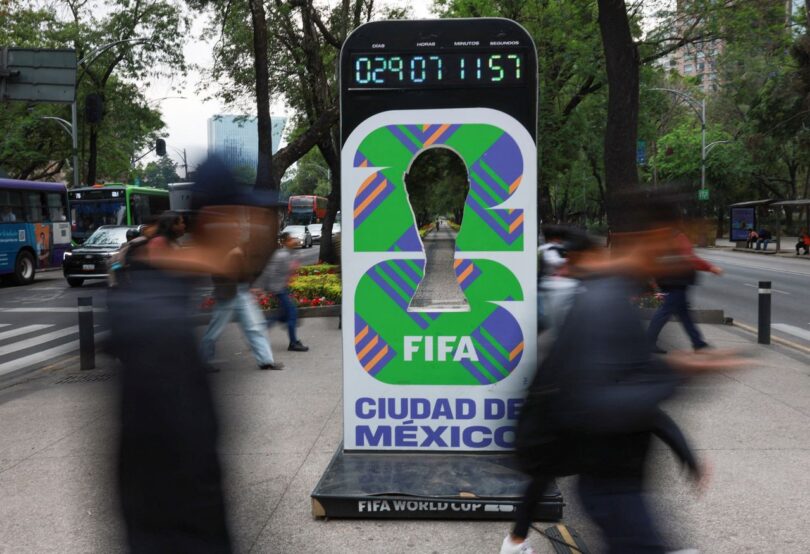
“Unbeatable weather,” “all of Mexico turning green,” and a wave of “passion, goals, and euphoria.”
This is how the country is promoting the arrival of the 2026 World Cup, a football festival promising packed stadiums and street celebrations. Mexico will be one of the main host countries for the tournament, the first to feature 48 teams and to be co-hosted by the United States and Canada.
The country will host 13 matches played in Mexico City, Guadalajara, and Monterrey.
With the World Cup just weeks away, Mexican authorities are presenting the tournament as an economic opportunity and a catalyst for urban modernisation.
The federal government has made multimillion-dollar investments in mobility, security, and infrastructure, while the Mexican Football Federation estimated an economic impact of around $3 billion in Mexico alone.
The Mexican Employers’ Confederation (Coparmex) even raised that figure, citing investments of nearly $8 billion across the three host countries.
But official enthusiasm coexists with growing social discontent. In Mexico City and Guadalajara, protests have emerged from neighbourhood groups, environmentalists, cyclists, business owners, and families seeking refuge, all questioning the allocation of public resources.
They criticise what they consider to be urban price increases, gentrification, and touristification—the transformation of neighbourhoods to attract visitors—and the neglect of issues such as housing, water, transportation, and security.
The debate is not new in Latin America. Brazil experienced massive protests before and during the 2014 World Cup over stadium spending and the precarious state of public services. The mobilisations, which began in 2013, also denounced increases in public transportation fares, urban evictions, and the use of heavy security forces.
During the tournament, thousands of police and military personnel were deployed in the host cities while demands persisted that the football festival did not address the country’s structural problems.
Now, with the countdown underway, an old regional debate is resurfacing in Mexico: whether mega sporting events leave lasting benefits or deepen existing inequalities.
Against a city for tourists
Since late 2025, residents and groups from southern Mexico City have been meeting under the bridge in front of Banorte Stadium to discuss the impacts they say are already accompanying the countdown to the World Cup.
From these meetings emerged the Anti-World Cup Assembly, comprising residents from towns and boroughs such as Santa Ursula, Coyoacan, Tlalpan, and Xochimilco, as well as merchants, cyclists, artists, and environmentalists.
Similar protests, focused on local problems considered ignored and that could be aggravated by the construction and the massive arrival of tourists, have also been registered in Guadalajara and Monterrey, the other host cities of the tournament.
“What we’re seeing isn’t just gentrification, but also this other phenomenon, which is overtourism,” said Lagrimas, a spokesperson for the collective, who prefers to remain anonymous for security reasons, in an interview with TRT Español.
Among her main concerns, she mentioned rising rents, the expansion of short-term rental platforms, and what she fears are imminent evictions.
Related
The assembly holds meetings, paints murals, and organises bike rides and street football games as forms of protest. They have also taken action at the official FIFA clock and in the vicinity of the stadium. “We love soccer, but not FIFA,” Lagrimas says.
According to the group, the effects of the World Cup are already being felt through construction, increased control over public space, and pressure from real estate developers.
They also denounce police surveillance at their demonstrations, actions they describe as evidence that “the only response has been repression.”
Water, the other dispute
For Natalia Laura Trejo, a resident of Coyoacan who lives a block from Banorte Stadium in Mexico City, the main impact of the World Cup in the area isn’t football, but water.
She says the renovations aim to offer a refreshed urban image for visitors, while basic problems remain unresolved.
Trejo, also a member of the Anti-Globalisation Assembly, maintains that behind this new image lies a persistent daily water crisis. In his neighbourhood, he explained, the water supply is rationed, without a fixed schedule, and generally at night, forcing residents to store water in buckets.
“We can’t have water every day,” he stated.
In contrast, he pointed out that Televisa, a long-time co-owner of Banorte Stadium and one of the largest Spanish-language media conglomerates, has a private well near the stadium that extracts approximately 50 liters per second.