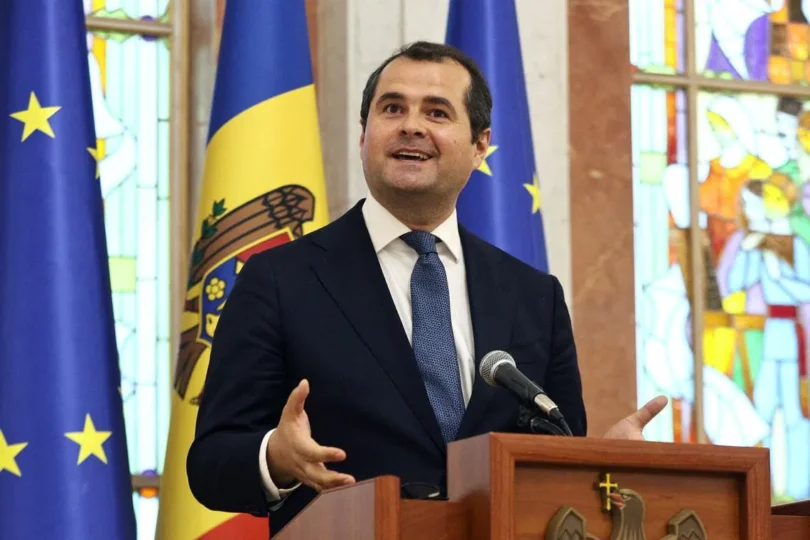
CHISINAU, July 21 – Moldova’s parliament approved a new government led by Prime Minister Vasile Tofan on Tuesday, after he laid out his cabinet’s programme, pledging to revive the economy while keeping the country on its European course.
Moldova, one of Europe’s poorest countries which faces additional uncertainty due to the war in neighbouring Ukraine, recorded a 2.4% rise in gross domestic product last year. Its economy is expected to grow by 2% this year.
“Our program is called ‘The European Economy, an Effective State’. This is the commitment we will work toward, and it is by this commitment that we ask to be judged,” Tofan, a 45-year-old financier, told lawmakers.
President Maia Sandu’s Party of Action and Solidarity (PAS) has a majority in the 101-member parliament, and Tofan’s appointment was voted through by 53 PAS lawmakers. Opposition parties abstained from voting.
The government’s goal is to sign an agreement on Moldova’s accession to the European Union by the end of 2028 and prepare the country to join the bloc by 2030, Tofan said. To achieve this, his cabinet aims to open all negotiation areas with the EU this year.
Moldova has been accepted along with Ukraine as a candidate for EU membership and so far has opened two out of six so-called “clusters”.
TAMING BUDGET DEFICIT
Tofan’s appointment comes after the surprise resignation of his predecessor, Alexandru Munteanu, after only eight months on the job.
On Tuesday, he also vowed to reduce Moldova’s budget deficit, which currently stands at 20 billion lei ($1.1 billion), by two percentage points by 2029.
He said tax reform was also needed and he pledged to cut red tape and to make it easier for businesses to access financing.
Tofan said his government aimed to privatise at least 10 state-owned companies, to stimulate investment in technology and artificial intelligence, to increase exports of high-value-added products, and reduce the size of the shadow economy.
Moldova, nestled between Ukraine and EU member Romania, has a Romanian-speaking majority and a large Russian-speaking minority.
Political power has oscillated for decades between parties supporting closer ties with Europe and those seeking better relations with Moscow. REUTERS