
Common metrics such as total return, win rate, profit factor, maximum drawdown, and Sharpe ratio provide valuable information about how a strategy performed in the past.
The problem is that historical performance tells only one story.
Financial markets are inherently uncertain. Even a strategy with an impressive backtest can experience very different outcomes once it encounters changing market conditions, unexpected volatility, or an unfavorable sequence of trades.
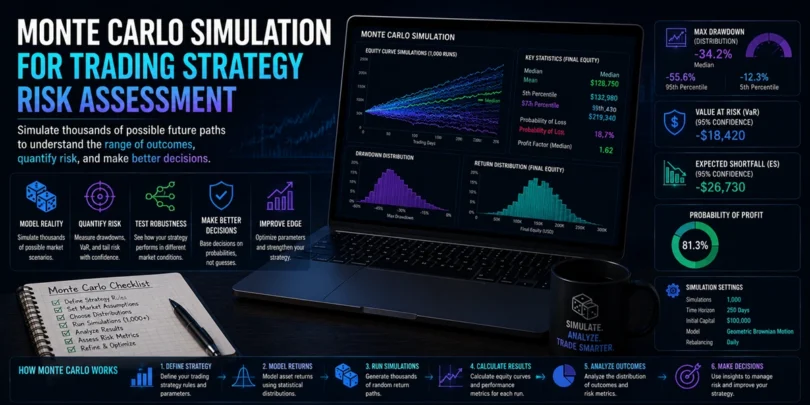
This is why professional traders, quantitative researchers, and portfolio managers increasingly rely on Monte Carlo simulation as part of their risk assessment process.
Rather than focusing on a single historical outcome, Monte Carlo analysis explores thousands of possible scenarios, helping traders understand what could happen—not just what already happened.
Backtesting remains one of the most important tools in strategy development.
Platforms such as MetaTrader 5 provide sophisticated testing environments that allow traders to evaluate Expert Advisors and trading systems using historical market data.
A typical backtest may show:
At first glance, these numbers appear encouraging.
However, every backtest contains one important limitation:
The strategy followed a specific sequence of winning and losing trades. If those same trades had occurred in a different order, the overall experience could have looked very different.
This is where Monte Carlo analysis becomes valuable.
One of the most important concepts in Monte Carlo simulation is sequence risk.
Consider a simple series of trades:
The overall result is positive.
However, if those same trades occurred in a different order:
the final return may remain similar while the path becomes significantly more difficult.
The trader may experience:
The strategy itself has not changed.
Only the sequence has changed.
Monte Carlo simulation explores thousands of these alternative scenarios to estimate how different trade sequences may influence future performance.
Monte Carlo analysis works by generating large numbers of alternative outcomes based on historical strategy behavior.
A simplified process looks like this:
Each simulation represents a plausible alternative version of history.
By repeating this process thousands of times, traders can estimate:
The objective is not to predict the future.
The objective is to understand uncertainty.
Many traders focus heavily on expected returns.
Risk professionals often focus on worst-case outcomes.