
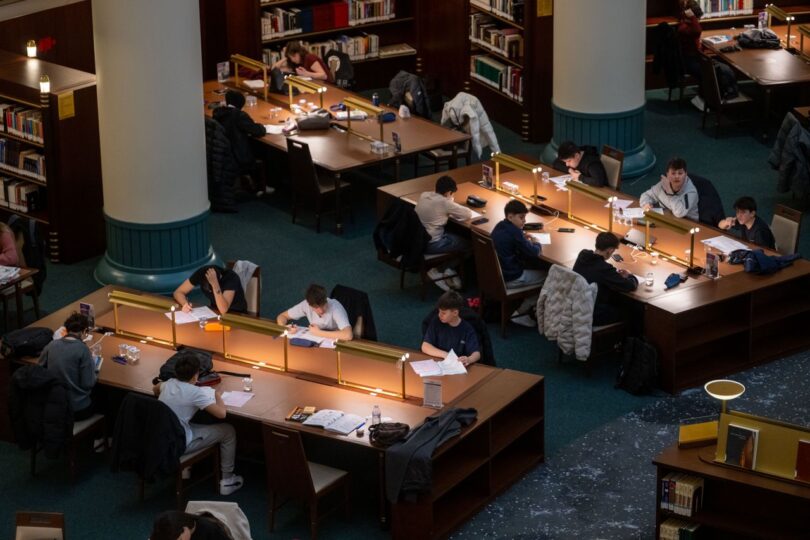
Elif, a Turkish high school student, spends several afternoons a week studying at her local library in Istanbul. For many young users like her, libraries offer something that is increasingly difficult to find elsewhere: a quiet and productive environment.
“At home there are too many distractions, especially phones and television. In the library I can concentrate much better.”
Elif’s experience reflects a broader trend unfolding across Türkiye.
At a time when educators and parents increasingly worry that young people are losing the ability to concentrate amid an endless stream of social media posts, videos and notifications, libraries across the country are experiencing a remarkable resurgence — driven largely by the very generation often accused of having shrinking attention spans.
According to data released by the Turkish Statistical Institute, the number of people using public libraries in Türkiye more than doubled over four years, rising from 15.7 million in 2021 to 39.2 million in 2025, while membership rose by 6.4 percent to more than 7.16 million people. Most strikingly, around 5.5 million of those members were aged 30 or younger, including approximately 2.5 million children and teenagers under the age of 18.
The figures suggest that, despite the dominance of digital entertainment, a growing number of young people in Türkiye are still seeking out spaces dedicated to reading, learning and sustained concentration.
Books and beyond
“Although shorter digital content may reduce attention spans, there remains a large audience that continues to spend hours reading books,” said Taner Beyoglu, Director General of Libraries and Publications at the Ministry of Culture and Tourism. “These people are not only university students but individuals from all age groups and professions.”
Türkiye’s libraries welcomed a record number of visitors in 2025, reflecting a broader transformation that has turned libraries from quiet repositories of books into dynamic centres of learning, culture and community life.
Another high school student from Istanbul, Mehmet, said libraries have become much more attractive than many people realise.
“It’s not just about books anymore,” he said. “There are comfortable study spaces, digital resources and sometimes workshops or events. I meet friends there, study for classes and discover books I wouldn’t normally come across online.”
Redefining the role of libraries
According to data released by the Turkish Statistical Institute, the number of libraries operating across the country reached 45,327 in 2025.
The figures mark the latest milestone in a decade-long effort by the Ministry of Culture and Tourism to redefine the role of libraries in Turkish society.
“Libraries are among the most important institutions for preserving and transmitting the cultural heritage of societies,” said Beyoglu.
“Today, libraries are no longer merely places where books are stored. They have become living centres where research is conducted, creative ideas are developed, artistic activities take place and education and social interaction come together.”
The country’s library network now includes the Presidential Nation’s Library, which is one of the world’s largest and most ambitious library projects with 2.71 million volumes, and the National Library in Ankara, as well as 1,302 public libraries, 557 university libraries and more than 43,000 libraries affiliated with educational institutions across the country.