Nigeria’s telecom operators are entering a new phase of competition, where the fight for the last million subscribers is giving way to a deeper battle for data supremacy, network quality, and infrastructure scale.
With active subscriptions hitting 185.5 million as of March 2026 and teledensity at 85.67%, the market is approaching saturation.
But rather than easing competition, this has intensified it, forcing operators to rethink growth strategies and double down on network investments.
Currently, MTN Nigeria remains the clear industry leader with mobile and internet subscriptions far ahead of its competitors. But Airtel, Globacom, and to some extent, T2, are not resting as they continue to deploy different strategies to increase their share of the market.
As of March 2026, MTN’s active subscriptions stood at 95.7 million, a significant number that gave the largest telecom operator 51.62% share of the entire mobile market.
According to the latest industry data released by the Nigerian Communications Commission (NCC), MTN has gained about 2.6 million subscriptions in the first three months of this year.
Meanwhile, T2 has yet to find its feet despite a network roaming deal signed with MTN last year and the rebranding from 9mobile to T2.
The company’s active subscriptions remain distantly low compared with other operators. As of March 2026, T2 recorded 3.4 million active subscriptions, after gaining 250,331 new subscriptions in three months.
Beyond the subscription figures, industry analysts note that the competition in the telecom industry is transitioning from subscriber acquisition to network superiority.
He noted that rising internet consumption, which hit over 1.42 million terabytes in March, is forcing operators to expand aggressively or risk congestion and churn.
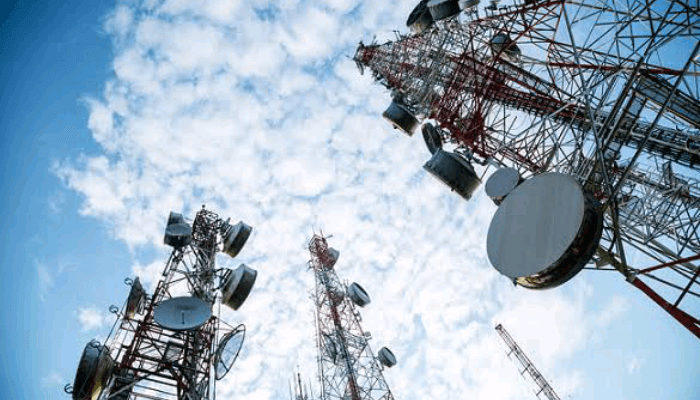
This explains why all major players are prioritising 4G expansion, fibre deployment, and 5G readiness.
Similarly, Airtel has expanded its network footprint by more than 10% over the past year, adding 1,561 new sites and taking its total to nearly 17,200 nationwide.
Three years ago, the network stood at just above 13,000 sites, meaning the company has added more than 4,000 sites in that period to improve capacity and reach.
Responding to questions on the company’s expansion strategy, Airtel Nigeria Chief Executive Officer, Dinesh Balsingh, said the objective is to stay ahead of national demand.
He added that every additional site is designed to absorb traffic in dense urban zones, reduce congestion, stabilise latency and improve signal quality.
While they may not be seen as aggressive as MTN and Airtel in terms of investment in network capacity, Globacom and T2 have also made some bold moves in recent years to show their readiness to increase their share of the market.
As of December last year, Globacom said it had completed a nationwide network infrastructure upgrade, powered by significant new spectrum acquisitions and robust capacity expansion.
The move, activated on December 4, 2025, was described as a strategic commitment by the company to provide a congestion-free, high-speed 4G experience to all Nigerians, setting a new benchmark for connectivity across the country.
By increasing its data-carrying capacity, the network said it could now support greater volumes of traffic at significantly higher speeds, translating directly to lightning-fast downloads and uploads, seamless, buffer-free video streaming, crystal-clear voice and video calls, even during peak hours and consistent, reliable connectivity in all nooks and crannies of the country.
Shortly after its rebranding in August last year, it turned to Chinese infrastructure giant Huawei to rebuild its core network in what it describes as the start of a long-awaited turnaround.
The multi-million-dollar deal marked the company’s first major move in the year. Backed by new investment and a fresh identity, T2 is betting Huawei’s infrastructure will help it claw back ground from larger rivals MTN, Airtel, and indigenous Globacom.
Amid the battle for data dominance, the telecom regulator has also tied competition to service quality through its recent directive asking the operators to compensate subscribers for not meeting its service quality parameters.
The NCC explained that the directive was part of its broader regulatory approach aimed at placing consumers at the centre of Nigeria’s telecommunications ecosystem.
It noted that telecommunications services play a critical role in economic activities, social interaction, and access to digital opportunities.
The regulator added that the compensation policy is designed to complement existing measures to monitor service quality and enforce performance standards across the sector.