
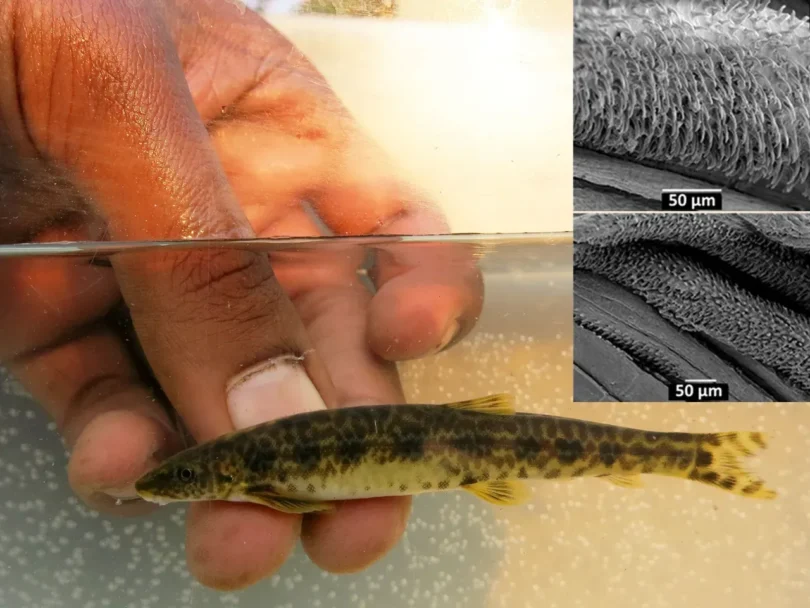
The motivation for such a demanding migration appears to be ecological rather than reproductive.
Seasonal flooding transforms the base of the falls into slower, lake-like conditions—habitats that these fish, adapted to fast-flowing waters, may find unsuitable. Moving upstream offers access to more favourable environments.
The climb may also provide refuge. During floods, predators accumulate at the base of the falls. Ascending the cascade allows the fish to escape predation and exploit habitats with reduced competition.
“The behaviour likely reflects a combination of pressures: habitat change, food availability, and predator avoidance” Vreven explains.
A scientific puzzle
Interestingly, the discovery was not initially driven by curiosity about climbing behaviour. Instead, researchers sought to use the fish as biological markers to estimate the waterfall’s age.
“We were studying the Parakneria fish, using them as tools to date the waterfalls,” Mutambala and Vreven explain.
“We wanted to try to date the falls by using the fish and their genetics. For other fish, it was possible to find differences between those upstream and those downstream. But for the Parakneria, we ran into a difficulty: there was no genetic difference between the fish at the top and those at the bottom.”
That absence of genetic divergence pointed to a missing piece of the puzzle: connectivity. Somehow, fish were moving upstream across what appeared to be an impassable barrier.
The answer, once observed, was as surprising as it was decisive.
Capturing the phenomenon required persistence—and proximity, says Mutambala. The researchers note that the behaviour is nearly impossible to detect from a distance.
“To observe them, we used two types of equipment. One was a camera inside a waterproof box that we placed against the waterfall wall to see them face-to-face. Other recordings were made with a more sophisticated camera with a zoom to keep it away from the water.”
“It wasn’t easy, but we did it,” Mutambala recalls.
Despite its resilience, this remarkable behaviour is vulnerable.
Human alteration of river systems—through water diversion, damming or overuse—could disrupt the delicate conditions that make the climb possible. Migratory species such as Parakneria thysi are particularly sensitive to such changes.
“It’s purely a climatological problem,” Vreven warns.
“For example, at the Lofoi Falls, water is extracted for irrigation. Sometimes the river is entirely diverted for that. That has a much larger impact than just climate change right now. If the falls dry up due to irrigation diversions, this remarkable migration becomes impossible.”
Touristic opportunities
At the same time, the phenomenon may offer an unexpected opportunity.
“This could attract eco-tourism,” Mutambala says. “People usually focus on the ‘Big Five’ animals (elephant, lion, leopard, African buffalo, and rhinoceros), but here we have a ‘climbing’ fish, which is a surprising observation that could generate interest in conservation for a group that is usually ignored.”
For Vreven, the significance of the discovery extends beyond a single species.
“There is power in this kind of observation. For many fish species, we have a name and know they exist, but we don’t know the details of their life history. This discovery again proves there are probably more mysteries around us than we realise.”