
The National Commission for Persons with Disabilities (NCPWD) has charged Ministries, Departments and Agencies (MDAs) to take practical steps to make public service delivery accessible and inclusive for Persons with Disabilities (PWDs). In a statement signed by the Media and Publicity Unit of the National Commission for Persons with Disabilities……
The National Commission for Persons with Disabilities (NCPWD) has charged Ministries, Departments and Agencies (MDAs) to take practical steps to make public service delivery accessible and inclusive for Persons with Disabilities (PWDs).
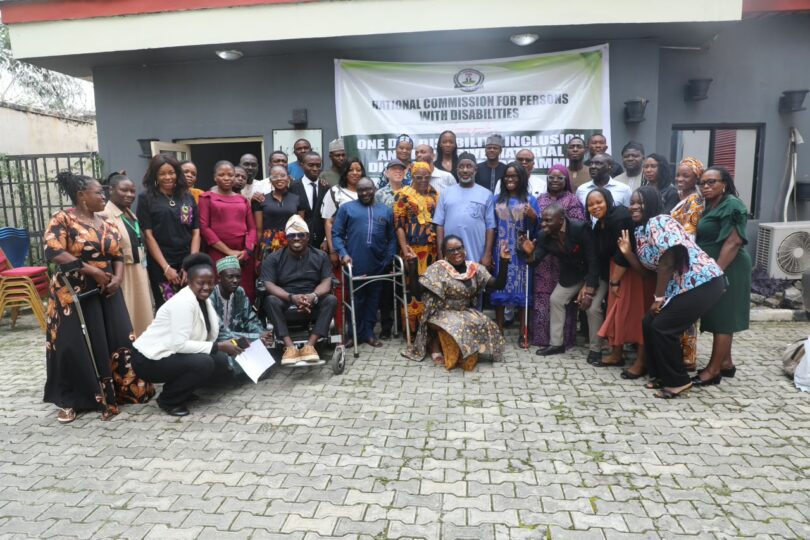
In a statement signed by the Media and Publicity Unit of the National Commission for Persons with Disabilities (NCPWD) on September 28, 2026, the Commission made the call at a Disability Inclusion and Inclusive Materials Distribution Programme held at Jasmine Hotel, Imo State Liaison Office, Abuja, with the theme, “Promoting Disability Inclusion and Accessibility in Public Service Delivery.”
The programme, organised by the Social Integration Department of the Commission, brought together representatives of MDAs, Organisations of Persons with Disabilities, consultants and other stakeholders committed to advancing disability rights in Nigeria.
The Executive Secretary of the NCPWD, Hon. Ayuba Burki Gufwan, represented by the Director, Planning, Research and Statistics, Mr. Aliyu Agwai, commended stakeholders for their commitment to building a society where persons with disabilities can access public services with dignity, equality and without unnecessary barriers.
“The programme goes beyond the distribution of inclusive materials. It is also a platform to increase awareness, share practical knowledge, and strengthen collaboration between the Commission and relevant MDAs,” Gufwan said.
He stressed that meaningful inclusion requires the collective effort of government institutions, professionals and persons with disabilities themselves.
Read Also: First Lady Empowers 9,500 PWDs Nationwide with N1.9Bn Under RHI
“Meaningful inclusion requires the collective effort of government institutions, professionals, and persons with disabilities themselves,” he said.
The Executive Secretary urged participating MDAs to actively engage in discussions, identify accessibility challenges within their institutions and adopt practical, low-cost and sustainable measures to address them.
He said the measures were necessary “to ensure that no one is left behind in public service delivery.”
The technical session, presented by the Commission’s Technical Adviser, Dr. Adebukola Adebayo, featured interactive sessions on disability inclusion, practical demonstrations on the use of inclusive materials and the distribution of accessibility aids to participating MDAs.
The representative of the Federal Ministry of Humanitarian Affairs and Poverty Reduction, Deputy Director Mrs. Realist Rachel Namah, assured the Commission of the ministry’s support towards promoting the rights and wellbeing of persons with disabilities.
Namah also assured that the ministry would support efforts to create an accessible working environment for PWDs.
Similarly, Mr. Nuhu Saleh, Technical Assistant to the Permanent Secretary, Federal Ministry of Women Affairs and Social Development, applauded the Commission for what he described as a significant step towards helping MDAs create accessible and inclusive workspaces for PWDs.
Presenting the materials, Mrs. Gloria Victor, Senior Assistant Chief Community Development Officer, Social Integration Department, urged all MDAs to study and understand the laws, regulations and guidelines established to promote the welfare of persons with disabilities.
“It is imperative for all MDAs to study and understand the laws, regulations and guidelines established to promote the welfare of Persons with Disabilities,” Victor said.
She also encouraged participants to conduct step-down training in their respective offices to ensure wider understanding and implementation of disability inclusion measures.
Items distributed to participating MDAs included the Discrimination Against Persons with Disabilities (Prohibition) Act, 2018; Nigeria Sign Language Dictionary; Persons with Disabilities Regulations, 2023; the Braille version of the Discrimination Against Persons with Disabilities (Prohibition) Act, 2018; and the Nigeria Sign Language Fingerspelling Alphabet Chart, among other inclusive materials.
The programme concluded with the Commission reiterating that partnerships with MDAs remain central to achieving its mandate under the Discrimination Against Persons with Disabilities (Prohibition) Act, 2018.