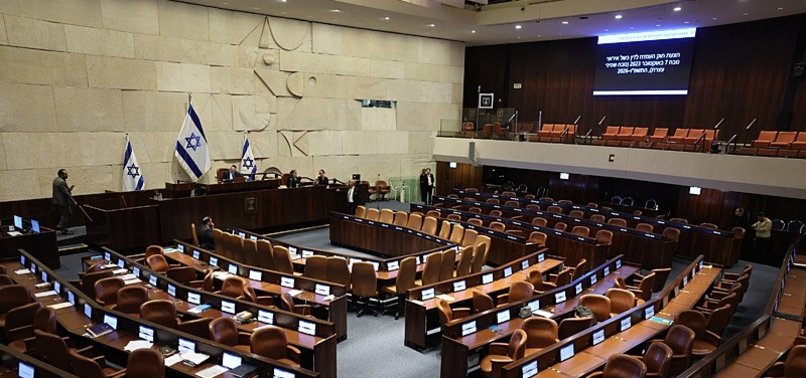
Israel’s ruling coalition on Wednesday submitted a proposal to dissolve parliament to pave the way for early elections as Prime Minister Benjamin Netanyahu came under mounting attack from ultra-Orthodox parties.
The move, initiated by Netanyahu’s right-wing Likud party, came as Netanyahu appeared to be facing a possible collapse of his fractious coalition.
If the bill is approved it would automatically trigger elections to be held after 90 days.
“The 25th Knesset shall be dissolved before the end of its term. Elections will be held on a date… which may not be set earlier than 90 days after the passage of this law,” said the draft of the proposed legislation released by Likud.
It was signed by leaders of the six parliamentary groups in the governing coalition.
According to Israeli media reports, the bill could be put to a vote on May 20. Its passage is widely seen as a foregone conclusion.
Elections could therefore be held from the third week of August, around two months ahead of the original scheduled end of the legislative term on October 27.
Ultra-Orthodox parties accuse Netanyahu of failing to deliver on his promise to pass a legislation that would permanently exempt young men from their community studying in yeshivas, or religious seminaries, from compulsory military service.
Sensing an opportunity amid the turmoil, several opposition parties announced on Tuesday that they intended to introduce their own bill to dissolve the Knesset.
But Likud’s announcement appears to have pre-empted the move, allowing Netanyahu to seize control of the electoral timetable.
Israel’s main opposition leader, Yair Lapid, head of the centrist Yesh Atid party, was swift to respond.
“We are ready Together,” Lapid wrote on X, referring to his new alliance, Beyahad (Together), formed with former premier Naftali Bennett.
Last month, Lapid and Bennett announced they would fight the upcoming election on a joint list.
Bennett and Lapid have been outspoken critics of Netanyahu’s handling of the country’s wars since the Hamas attack on October 7, 2023, with Lapid going so far as to label the recent ceasefire agreed with Iran a “political disaster”.
Netanyahu, a political survivor often described as the phoenix of Israeli politics, is 76 years old and recently revealed that he had undergone surgery for prostate cancer.
He has already confirmed that he intends to run for office again.
Netanyahu has governed Israel longer than any other prime minister — more than 18 years in total since 1996.
He is again seeking another term despite facing a long-running corruption trial.
A political poll by Israel’s public broadcaster KAN published on Tuesday put Likud in first place in voting intentions, with a narrow lead over Beyahad — the joint list of Lapid and Bennett.
However, neither bloc appears capable of forming a government, given the fragmented electorate.
According to the poll, Likud would win 26 seats out of 120 in the Knesset, down from 32 in the outgoing parliament, while Beyahad would secure 25, head of Yashar (Straight) — the centre-right formation led by former military chief Gadi Eisenkot.
Eisenkot is seen as a potential ally of Lapid and Bennett.
Many Israelis blame Netanyahu for the security failure that enabled the unprecedented attack by Hamas.
Since then, he has pledged a “total victory” over Hamas in Gaza, Hezbollah in Lebanon, and Iran – a goal that still remains elusive after more than two and a half years of multi-front conflict.
Opposition figures Lapid and Bennett intend to make central campaign themes the establishment of a national inquiry commission into the October 7 attacks — aimed at assigning responsibility for the deadliest day in Israel’s history — as well as legislation to subject ultra-Orthodox Jews to compulsory military service.