
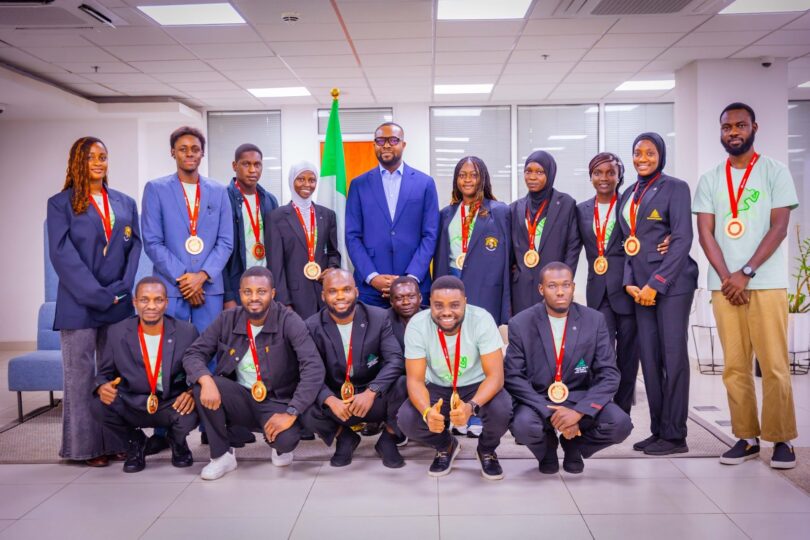
Nigeria has recorded another strong performance on the global technology stage after a team of 15 students returned from China with multiple top prizes from the Huawei Global ICT Competition, where they competed in the Network, Cloud, Computing and Innovation tracks….
By David Bolarinwa
Nigeria has recorded another strong performance on the global technology stage after a team of 15 students returned from China with multiple top prizes from the Huawei Global ICT Competition, where they competed in the Network, Cloud, Computing and Innovation tracks.
The students, drawn from Ahmadu Bello University (ABU), Igbinedion University, Okada (IUO), University of Lagos (UNILAG), Federal University of Technology Minna (FUTMINNA), University of Port Harcourt (UNIPORT) and Nasarawa State University, Keffi (NSUK), progressed through national and regional stages of the year-long Huawei ICT Academy programme before reaching the global finals.
According to the Minister of Communications, Innovation and Digital Economy, Dr Bosun Tijani, who announced the return of the students, Team Nigeria secured two grand prizes in the Network and Innovation categories, two first prizes in the cloud track, and a second prize in the computing category, emerging as the most successful country outside China for the third consecutive year.
Following their return, the students were hosted in Abuja by the minister, who commended their performance and described their achievements as evidence of Nigeria’s growing strength in digital talent development.
A standout moment came from the Innovation Team of Ahmadu Bello University, whose project developed a solar-powered diagnostic tool capable of testing for malaria and intestinal parasites within minutes without internet connectivity.
On the innovation, Tijani said, “Particularly inspiring was the Innovation Team from Ahmadu Bello University, whose solution leveraged Huawei’s AI, Cloud, and Ascend technologies to develop a solar-powered diagnostic tool capable of testing for malaria and intestinal parasites in under three minutes without requiring internet connectivity. It is a powerful example of how young Nigerians are applying technology not only to compete globally, but also to solve some of our most pressing local challenges.
“I am looking forward to connecting these young innovators with the right support and exposure to ensure their passion and creativity can be further built on.”