By Ipole Amajama
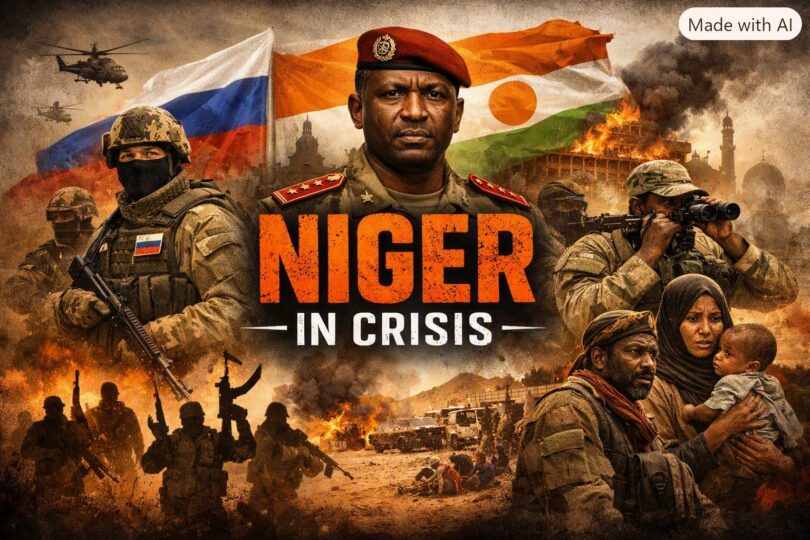
When General Abdourahamane Tiani seized power in Niger in July 2023, ousting the democratically elected president Mohamed Bazoum, he promised stability, sovereignty, and a renewed fight against terrorism. Three years later, those promises ring hollow. Instead, Niger finds itself increasingly dependent on Russia, torn by internal military divisions, and estranged from its West African neighbours. The recent mutiny in Niamey which began on Saturday, August 29 at Base 101, a military installation at Diori Hamani International Airport in Niamey, before fighting spread to other sensitive sites, including areas near the presidential palace and the state broadcaster, was suppressed only with the intervention of Russian paramilitaries, laid bare the fragility of Tiani’s regime and the dangerous trajectory of the country.
The most striking symbol of Niger’s compromised sovereignty is the involvement of Russian paramilitaries from the so‑called “Africa Corps” to suppress the rebellion. Analysts note that this was not simply assistance—it was direct intervention in Niger’s internal affairs. For a country whose junta claims to have broken free from Western “neo‑colonial” influence, the reliance on Moscow’s mercenaries reveals a new form of dependency.
Russia’s involvement in Niger is part of a broader strategy across the Sahel. In Mali and Burkina Faso, Russian operatives have entrenched themselves as security guarantors, trading military support for political loyalty and access to resources. In Niger, the pattern is repeating: sovereignty is eroded as decisions about internal security are increasingly shaped by foreign actors. For many Nigeriens, the irony is bitter—the promise of independence from Western powers has been replaced by subservience to Moscow.
Niger faces one of the most severe jihadist threats in the world. Groups linked to al‑Qaeda and ISIS operate across its borders, exploiting porous frontiers and fragile governance. Yet under Tiani, the fight against terrorism has been subordinated to regime survival. Military resources are diverted to protect the presidency and suppress dissent rather than confront insurgents in Tillabéri, Diffa, and Tahoua.
The mutiny itself was led by soldiers from frontline anti‑terrorism units—men who felt abandoned, under‑resourced, and betrayed. Their decision to turn against their own leadership underscores a dangerous reality: the armed forces are politicised, fragmented, and increasingly alienated from their mission. As one analyst put it, “The junta has militarised politics, but it has not politicised security.” The result is a hollowed‑out counter‑terrorism effort, leaving civilians exposed to relentless attacks while the regime fortifies its own survival.
Tiani’s regime suffers from a fundamental legitimacy crisis. His rise to power was not through elections but through a coup, and Bazoum remains in captivity—a stark reminder of the junta’s disregard for democratic norms. Internationally, Niger’s isolation has deepened. Sanctions, suspension from ECOWAS, and strained relations with Western partners have left the country economically vulnerable and diplomatically cornered.
Internally, the cohesion of the junta is in question. The mutiny revealed cracks within the military establishment. Soldiers storming the presidency is not just a rebellion—it is a profound crisis of trust. Loyalty to Tiani is fragile, and the spectre of further uprisings looms. For ordinary Nigeriens, this instability translates into uncertainty, fear, and a sense that their leaders are more concerned with power struggles than governance.
Against this backdrop, the Economic Community of West African States (ECOWAS) faces its own existential challenge. Burkina Faso, Mali, and Niger—now aligned in the Alliance of Sahel States (AES)—have withdrawn from ECOWAS, citing hostility to military rule. The split has fractured regional integration, undermining collective security and economic cooperation.
Yet the new ECOWAS Commission President, General Birame Diop, has signalled a shift. In his inaugural address in Abuja, Diop declared that ECOWAS must rebuild unity and reopen meaningful engagement with the AES countries. “We have no other choice,” he said, stressing that geography, shared borders, and common threats make cooperation unavoidable. His words reflect a pragmatic recognition: terrorism, organised crime, and migration flows do not respect political boundaries.
Nigeria, too, has urged reconciliation. Ambassador Sola Enikanolaiye, representing President Bola Tinubu, described Burkina Faso, Mali, and Niger as “our brothers and sisters,” underscoring the need for an “ECOWAS of citizens, not governments.” This vision places ordinary West Africans—the traders, migrants, and farmers who cross borders daily—at the heart of integration. For them, regional unity is not an abstract ideal but a lived necessity.
While leaders debate sovereignty and integration, ordinary Nigeriens bear the brunt of instability. In rural areas, communities face relentless jihadist attacks. Farmers abandon fields, traders risk ambushes, and families are displaced. In Niamey, the mutiny brought fear to the capital, with citizens witnessing soldiers turning their weapons inward. The sense of insecurity is pervasive.
Economic hardship compounds the crisis. Sanctions and isolation have disrupted trade, raised prices, and deepened poverty. For a country already ranked among the poorest in the world, the junta’s political choices have tangible consequences: empty markets, shuttered businesses, and dwindling opportunities for youth. The promise of sovereignty feels distant when daily survival is at stake.
Outgoing ECOWAS President Omar Touray left office with a poignant message: “Our borders may divide our territories, but they do not divide our destiny.” His words capture the essence of West Africa’s challenge. The destinies of Niger, Mali, Burkina Faso, and their neighbours are intertwined. Terrorism, migration, and climate change are shared burdens. Division only weakens collective resilience.
For Niger, the path forward is fraught. Tiani’s regime clings to power but lacks legitimacy. Russia’s shadow looms large, offering short‑term security at the cost of sovereignty. The military is fractured, and the fight against terrorism is compromised. Yet amid this bleak picture, ECOWAS’s renewed outreach offers a glimmer of possibility. Reconciliation, though difficult, could restore regional solidarity and provide a framework for addressing shared challenges.
For Niger, the stakes are high. If it continues down its current path, it risks becoming a client state, its sovereignty hollowed out and its citizens abandoned to insecurity. But if ECOWAS and the AES countries can find common ground, there remains hope for a collective response to terrorism, poverty, and instability. For ordinary Nigeriens, that hope is not abstract—it is the difference between despair and survival.
In the words of General Diop, “We have no other choice than to work in a solidary, concerted manner.” The future of Niger, and of West Africa, depends on whether that choice is embraced.
Amajama, a social and policy analyst, writes from Abuja and can be reached via [email protected]