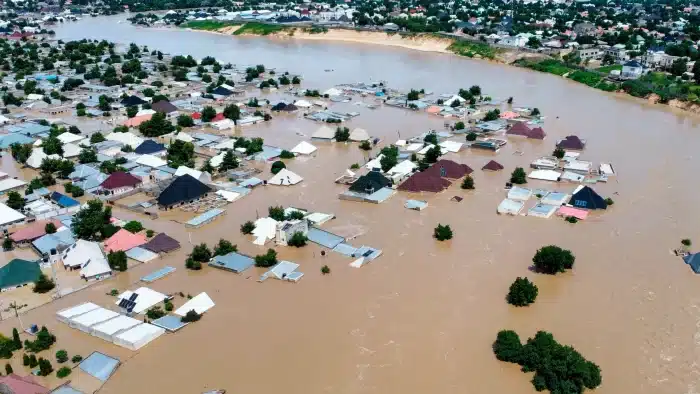
The Nigeria Hydrological Services Agency (NiHSA) has warned that 14 states across the country are at medium risk of experiencing severe flooding between July 14 and July 20, 2026, as heavy rainfall continues to trigger flooding in several parts of Nigeria.
The agency said the latest hydrological forecast indicates that inland flooding is likely along major river channels during the period, urging state governments, emergency management agencies and residents in vulnerable communities to take precautionary measures.
Naijaonpoint reports that the warning was contained in a flood advisory issued on Wednesday by the Director-General of NiHSA, Arc. Umar Mohammed.
According to the advisory, the states identified as being at medium flood risk are Adamawa, Akwa Ibom, Anambra, Bauchi, Benue, Borno, Cross River, Edo, Enugu, Imo, Kaduna, Lagos, Niger and Plateau.
The agency also disclosed that 16 hydrological monitoring stations have been classified as high-risk locations, signalling the possibility of rising water levels and increased flooding in vulnerable areas.
NiHSA cautioned that several communities within the affected states could experience flooding if proactive measures are not implemented.
It added that critical public infrastructure, including schools, healthcare facilities, markets and other public assets, could also be impacted by the expected flood events.
The agency stressed the need for authorities at all levels to intensify preparedness efforts to minimise potential loss of lives and property.
Mohammed reiterated that NiHSA publishes its Annual Flood Outlook at the beginning of every year to provide flood predictions, risk analysis and other hydrological information ahead of the rainy season.
According to him, the annual forecast is aimed at helping federal, state and local governments, as well as emergency response agencies, prepare adequately for anticipated flooding.
He explained that the projections are intended to support comprehensive planning and timely interventions that would reduce the impact of floods on communities across the country.
In view of the prevailing flood situation, the Director-General called on state governments, emergency management agencies and residents in flood-prone communities to take the agency’s early warning advisories seriously.
He urged relevant authorities to strengthen flood early warning systems, activate evacuation plans where necessary, and intensify public awareness and sensitisation campaigns in collaboration with relevant stakeholders.
Mohammed noted that prompt action and coordinated preparedness remain critical to mitigating the devastating effects of flooding during the peak of the rainy season.