The National Institute for Policy and Strategic Studies (NIPSS) has partnered with the Federal Ministry of Art, Culture, Tourism and the Creative Economy to strengthen Nigeria’s creative sector and support President Bola Ahmed Tinubu’s target of a $1 trillion economy by 2030….
The National Institute for Policy and Strategic Studies (NIPSS) has partnered with the Federal Ministry of Art, Culture, Tourism and the Creative Economy to strengthen Nigeria’s creative sector and support President Bola Ahmed Tinubu’s target of a $1 trillion economy by 2030.
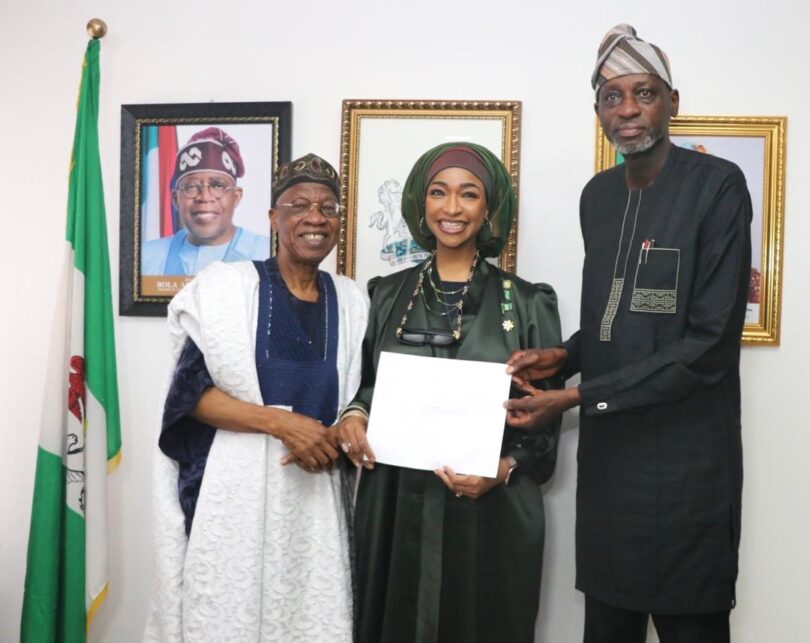
The partnership followed a meeting in Abuja between the NIPSS Director-General, Prof. Ayo Omotayo, and the Minister of Art, Culture, Tourism and the Creative Economy, Hanatu Musawa, during a courtesy visit by the institute’s delegation.
The meeting focused on the forthcoming National Summit and Exhibition on the Orange Economy, which is being organised by NIPSS to develop strategies for unlocking the economic potential of Nigeria’s creative industries.
Omotayo said the institute had identified the creative sector as one of the areas capable of providing significant leverage towards achieving the Federal Government’s $1 trillion economic target.
“For the National Institute, we have bonded ourselves to the agenda of Mr President in which he wants Nigeria to reach a trillion-dollar economy by 2030,” he said.
He said the institute began examining different sectors of the economy in 2023 and identified areas where evidence suggested Nigeria could achieve the target through proper planning.
“For the National Institute, this is the last of the sectors that we believe that we can find enough leverage and push to get Nigeria to the one trillion-dollar economy,” Omotayo said.
He said the summit was also informed by the need to update policy research on Nigeria’s creative industries, particularly in view of rapid technological changes.
“At 50 years back, the technology we have today did not exist and with the technology we have today, a whole lot of things are happening and we believe the arts and culture sector can also benefit,” he said.
Omotayo disclosed that participants in NIPSS’s Senior Executive Course were conducting research across seven Nigerian states, engaging governors and Directors of Arts and Culture on ways to develop the sector.
He added that the participants were also studying creative-sector models in countries including Ghana, The Gambia, Angola, Botswana, Ethiopia, China, India, Singapore, Portugal, Spain and Poland.
According to him, research conducted by the institute indicated that Nigeria’s creative sector could contribute about $250 billion to the economy, with the potential to reach $450 billion if properly harnessed.
Former Minister of Information and Culture and Managing Partner of Bruit Costaud, Lai Mohammed, said the opportunities in the creative economy were enormous, describing the sector as the country’s “next oil”.
“I have always said it when I was a minister that our next oil is actually the creative industry — it’s our films, music, gastronomy, fashion, publishing, sports, etc.,” Mohammed said.
He said the sector was the second-largest employer of labour in Nigeria after agriculture, adding that his firm was enthusiastic about partnering with NIPSS on the summit and exhibition.
Musawa said the ministry was deliberately repositioning the arts, culture and tourism sector under the Renewed Hope Agenda as an engine of national economic growth.
“When the President speaks about trying to increase the GDP to $1 trillion, we believe that this ministry and this industry have the potential of really adding to that,” she said.
The minister said the government had set a target of about $100 billion for the sector’s contribution to GDP, adding that the industry could exceed that figure.
Musawa also disclosed that the ministry had inaugurated four drafting committees focusing on policy and strategy, programmes and implementation, stakeholder engagement, and monitoring and evaluation.
She said the committees were expected to help build the institutional and financial architecture required to strengthen the creative sector.
The minister pledged the ministry’s support for the National Summit and Exhibition on the Orange Economy, describing it as an opportunity to translate the findings of the NIPSS Senior Executive Course into practical policies and economic opportunities for creative professionals and tourism operators.
“It is against this backdrop that I welcome NIPSS proposal for a National Summit and Exhibition on the Orange Economy and this ministry stands ready to work with you, as a technical partner and as a convener of our sector’s stakeholders,” Musawa said.
The National Summit and Exhibition on the Orange Economy is scheduled for October 6–8, 2026, at the Wole Soyinka Centre for Culture and Creative Arts, formerly the National Theatre, in Iganmu, Lagos.
The summit will bring together stakeholders across music, film, publishing, aviation, hospitality, sports, fashion, visual arts, dance, copyright, gastronomy and tourism to develop strategies for a more structured, productive and globally competitive creative economy.