
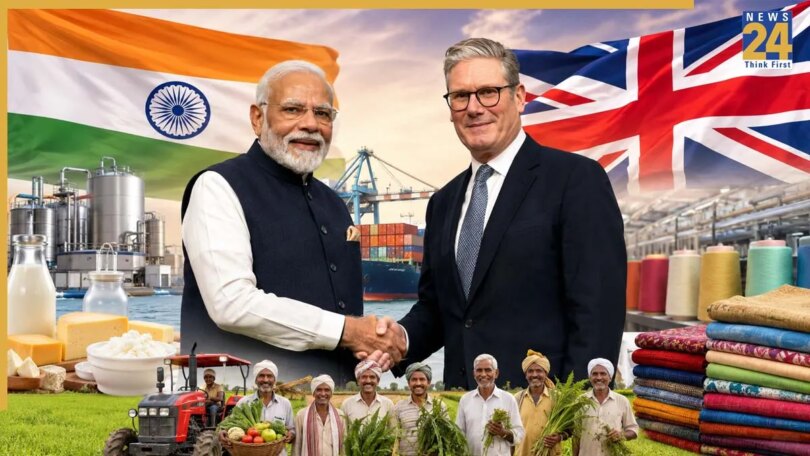
India-UK FTA: The India-UK Comprehensive Economic and Trade Agreement, or CETA, which comes into effect on Wednesday, July 15, 2026, represents a “gold standard.” This deal signed by India is beneficial due to a wide sectoral coverage, which includes farmers, seafood exporters, workers, women entrepreneurs, and labour-intensive industries, Commerce Secretary Rajesh Agrawal said on Tuesday.
“This is one of the first free trade agreements (FTAs) of its kind, which establishes a future-oriented economic architecture between two major economies of the world,” Agrawal told the media. “This is also one of the most ambitious and aspirational FTAs of India, which we are operationalising as till date,” he added.
Agrawal further highlighted the deal’s inclusive nature, underscoring that India’s farmers would benefit from expanded access to the premium UK agricultural market, while seafood exporters would receive the full benefits of complete duty-free access. He also noted that labour-intensive sectors like textiles would benefit, with duties of up to 12% being removed under the agreement.
ALSO READ: BIG relief for India, China as US eases tariff threat from 500% to 100% under revised Russia sanctions bill
India to export 99% of its products to UK without import taxes
“It is a gold standard and the first of its kind because of its wide sectoral coverage and deep reduction in both tariff and non-tariff barriers,” Agarwal said.
Under the agreement, the United Kingdom will quickly lift tariffs on 96.8 percent of its tariff lines, accounting for 97.7 percent of the trade value. An additional 2 percent of tariff lines, amounting to 1.8 percent of trade value, will face lower tariffs depending on quotas. Combined, this accounts for more than 98.8 percent of tariff lines and 99.5 percent of trade value.
Meanwhile, India will immediately remove tariffs on 30.3 percent of the trade value, with 47 percent more seeing tariffs eliminated gradually. It will also provide reduced quota-based tariffs on 12.1 percent of the trade value. In total, this would account for 89.5 percent of tariff lines and 89.4 percent of trade value.
ALSO READ: US reimposes blockade on Iranian ports, launches more strikes, Donald Trump warns of…
Wide-ranging impact of the deal
UK Officials have also welcomed the deal, showing an impact across multiple sectors. “For the City of London, the agreement provides a strong platform to unlock even greater collaboration in financial and professional services, insurance, fintech, sustainable finance and infrastructure investment,” Chris Hayward, Policy Chairman of the City of London Corporation, told The Hindu.
Meanwhile, Agrawal said that the 30 chapters across which negotiations took place under this deal extend beyond conventional tariff liberalisation. He added that the agreement also addresses non-tariff barriers, so that issues like Sanitary and Phytosanitary Measures (SPS) and Technical Barriers to Trade (TBT) “do not become unjustified trade restrictions for our businesses in the future”.
ALSO READ: What is Iran’s Pickaxe Mountain? Secret fortress even Trump’s bunker-buster bombs can’t destroy
Trade deal to protect Indian farmers and dairy industry
The Secretary explained that the agreement with the UK protects India’s dairy, cereals, vegetables, pulses, gold, chicken, eggs, sugar, and other crucial sectors. On the Double Contribution Convention (DCC), he called the deal a “game-changer” for the country’s services sector and skilled workforce.
“Indian employees and their employers contribute around 25% of their salary to the U.K.’s national insurance system,” Mr. Agrawal explained. “Their contribution is like a tax of 25% as employees are unable to draw benefits. These are like sunk costs.” According to him, this will benefit more than 75,000 Indian workers and over 900 employers.
What will become cheaper?
The new trade deal comes into force today. Import duties on cosmetics, Scotch whisky, chocolate, gin, biscuits, and some British cars are set to be gradually lowered.
This will significantly impact the prices of these products over time. In addition, the consumers may end up paying reduced prices than before. There will also be a big cut in tax on scotch and cars. Currently, Scotch whisky in India attracts an import duty of up to 150%, which will be reduced to 75% and then to 40% over the next 10 years under the new deal.
ALSO READ: Mega JACKPOT hidden 700 meter under the sea, world’s biggest treasure found in…, it is a vast deposit of…
First published on: Jul 15, 2026 10:55 AM IST
Get Breaking News First and Latest Updates from India and around the world on News24. Follow News24 on Facebook, Twitter.
End of Article
About the Author
Sheetal Prasad
Sheetal Prasad is a news author with 1.5 years of experience in journalism. She covers a diverse range of topics, including politics, entertainment, and trending news, ensuring her readers stay informed about the latest developments. Sheetal holds a Master’s degree in Journalism from Adamas University, West Bengal, which has equipped her with essential storytelling skills. Previously, she worked as a news journalist at Odisha TV. In addition to her articles, Sheetal manages a live blog that offers real-time updates on breaking news and trending stories. This interactive platform allows her audience to engage with the news as it unfolds, enhancing their understanding of significant issues. Every article she writes is rigorously verified by the News Desk team before publication, ensuring accuracy and reliability. Sheetal is committed to delivering trustworthy information, making her a dependable source for readers seeking quality content. When she’s not writing, Sheetal enjoys creating content for her YouTube channel and watching podcasts and interviews with renowned personalities. You can connect with her on Instagram for more insights and updates.
Read More
Related Story