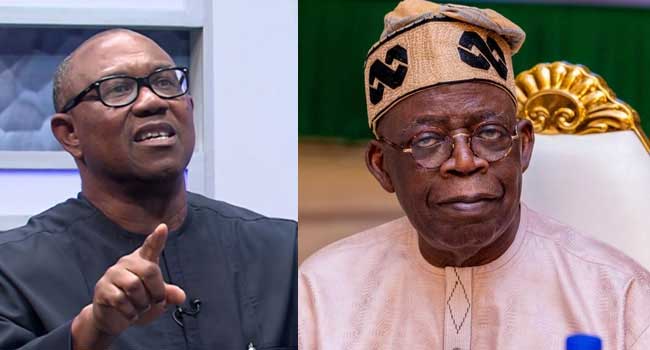
Mr Peter Obi, presidential candidate of the Nigeria Democratic Congress (NDC) and former governor of Anambra State, has criticised the Federal Government’s borrowing trend, saying the sharp rise in national revenue under President Bola Tinubu’s administration has not improved the living standards of Nigerians.
The comments were contained in a statement posted on Obi’s official page, where he responded to the President’s recent review of his administration’s performance after three years in office.
Obi noted that President Tinubu highlighted an increase in government revenue from N16.8 trillion in 2022 to N35 trillion in 2025 as a key achievement of his administration.
However, he argued that despite the revenue growth, Nigeria’s debt burden has continued to escalate.
“Shockingly, while Nigerians expected a reduction in borrowing with the exponential increase in revenue, the opposite is the case,” Obi stated.
He further claimed that Nigeria’s total public debt has now risen to about N200 trillion, representing an increase of over N100 trillion within the past three years.
Obi also argued that the country generated higher-than-projected revenues during the period, driven by global and regional economic factors that boosted commodity prices and government earnings.
He further alleged that several key socio-economic indicators had deteriorated over the same period.
“Alarmingly, even with the astronomical increase in both revenue and debt, almost all key socio-economic and governance indicators are worse than in 2023,” he said.
Obi pointed to rising multidimensional poverty, unemployment, and a decline in gross domestic product (GDP) per capita as major concerns.
According to him, multidimensional poverty rose from about 87 million people in 2023 to over 140 million in 2025.
“The question Nigerians and even the international community are asking is, ‘Where did all the money go?’” Obi stated.
He called for stronger transparency and accountability in the management of public funds, urging the government to provide a clear account of how revenues and borrowed funds have been spent since 2023.