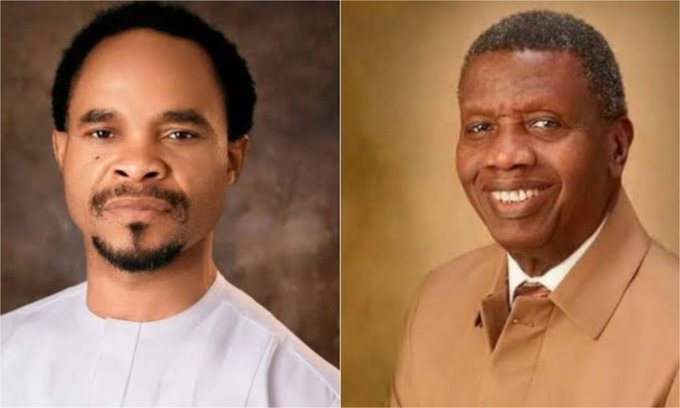
(Odumeje And Pastor Adeboye. Photo Credit: Daily Post)
Popular Onitsha-based cleric and founder of the Mountain of Holy Ghost Intervention and Deliverance Ministry, Chukwuemeka “Odumeje” Ohanaemere, has said religious leaders have a biblical obligation to challenge poor governance rather than align themselves with those in power.
His remarks come days after the General Overseer of the Redeemed Christian Church of God, Pastor Enoch Adeboye, said President Bola Tinubu was doing his best to address Nigeria’s security challenges.
Speaking during a church sermon, Odumeje referenced Adeboye by name while urging pastors to speak boldly against injustice, maintaining that political leaders are elected to serve the people and must be held accountable.
He said he had no interest in engaging Adeboye directly, arguing that scripture requires a pastor to rebuke bad governance rather than seek personal benefit from those in power.
He described himself as a father in the Lord whose voice is amplified by God, not by any individual, stressing that his role was to tell people the truth about what is happening in the country, regardless of personal relationships, and lamented that anyone who fights for the truth or speaks against what he called the evil government of Nigeria tends to be pursued.
The outspoken preacher also urged Nigerians to stop applauding elected officials for carrying out responsibilities they were chosen to perform, arguing that governors, senators and the president are public servants who owe citizens transparency and accountability.
He said it was wrong for citizens to praise officials for managing resources that belong to the public, stressing that such leaders are representatives meant to serve the people, not the other way around, and that they owe citizens accountability for the duties they were elected to perform.
He further argued that many Nigerians do not fully understand their rights, pointing to the tendency to celebrate basic infrastructure such as ordinary roads, which he said other countries had built long ago and moved past, stressing that public projects are funded by collective citizen resources rather than the personal wealth of officials.
Odumeje also insisted that Nigerians should not remain silent over national issues, arguing that successive governments have failed to deliver meaningful development.
He claimed there had been little genuine development in the country and accused politicians of prioritising embezzlement over governance.
He referenced the late Biafran leader, Chukwuemeka Odumegwu-Ojukwu, describing him as someone who, at just 31, recognised what he characterised as injustice against the Igbo people and stood up to challenge it, describing him as a hero and forefather figure whom the Igbo people once rallied around, a period that culminated in the civil war.
The cleric further maintained that public office holders should be judged by their performance rather than their titles, alleging that Nigeria’s resources have not translated into better living conditions for ordinary citizens.
He claimed that while children of the political class attend schools abroad, many Nigerian citizens lack access to good schools despite the country’s resource wealth.
He linked this to broader agitations, including those associated with detained IPOB leader Nnamdi Kanu, and pointed to unrest in Nigeria’s northern region, which he attributed to competition over resources such as mining and gold, alleging that communities in resource-rich areas were being displaced as a result.
He expressed disappointment with the state of affairs, saying he felt his generation had fallen short compared to the boldness shown by Ojukwu at a young age.