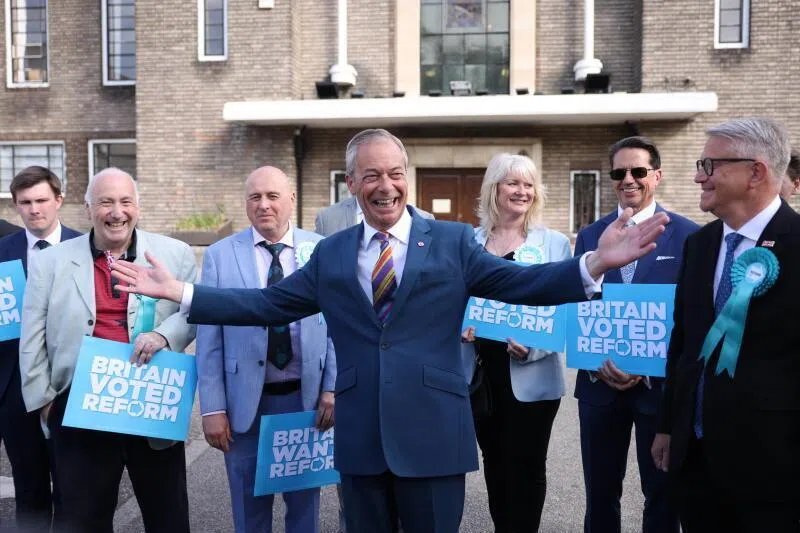
LONDON – Mr Nigel Farage descended from a helicopter as the sun was setting over Chelmsford City Racecourse in Essex. Wearing a blue suit, a multi-coloured tie and a patriotic Union Jack pin, he was getting ready to raise a toast – champagne in hand.
The south-eastern county of England had just fallen to Reform UK, one of a host of council areas to switch to his party in the local election results announced earlier in the day. “There’ll be music, there’ll be drinking,” Mr Farage promised from the lectern, as he ran through all the seats that Reform had flipped while taking swipes at his opponents. “We are the fun party.”
As he walked off-stage to join a crowd dancing to the late 1970s hit Mr Blue Sky, the unapologetic bon vivant was smoking a cigarette and had switched to red wine as he told Bloomberg gilt markets had rallied on May 8 in response to his triumph and his party’s prescription to the nation’s problems.
The catch is that few know what those policies really are. Mr Farage didn’t take long to torch key elements of the manifesto that brought him and his handful of Reform MPs to power, and beyond telling Bloomberg at Davos earlier in 2026 that he wanted to upend “every single tenet” of the UK’s economic rule book, the detail is a work in progress.
The 62-year-old Brexiteer famously spent his early career as a metals trader taking clients for boozy lunches. As he schmoozes wealthy political donors, Mr Farage now has a new-found power base and the prospect of a blank slate on which the party’s policies can be written. The challenge is to cap the fun and rise to the seriousness of the moment, a task whose difficulty is recognised even within his own ranks.
“We’ve got our foot in the door now,” said Mr Darren Dennis, who owns a health and safety consultancy and who attended the Chelmsford rally after winning the Grays Riverside ward for Reform in nearby Thurrock. “We’ve got two or three years to deliver before the general election,” he said. “If we don’t deliver, then it’s over.”
Reform got its first taste of government after winning control of nine councils at 2025’s local elections, and some of its representatives reported difficulties adjusting to the realities of managing refuse collection and adult social care budgets. Now they’ve won 14 more.
Mr Farage’s fresh success in converting poll support into votes at May 7’s ballot – placing first in England while piling up seats in the Scottish and Welsh Parliaments – gives him a real shot at building his party’s flag-waving, European Union-bashing, immigration-sceptic brand.
The opportunity before him appears all the greater in the disarray that emerged from the May 7 vote. A clutch of Mr Keir Starmer’s MPs have told the prime minister they are putting him on notice. More broadly, the collapse in backing for the ruling Labour Party and the main opposition Conservatives has weakened the country’s traditional duopoly and fractured its political landscape.
It’s the kind of scorched earth that Mr Farage, an ally of US President Donald Trump, has proved himself adept at navigating all through the UK’s years of heightened volatility. Yet it’s also going to ask more of the Reform leader: With growing representation comes increased scrutiny and responsibility, making it harder to play the anti-establishment insurgent – while dismissing controversies like the revelation of a £5 million (S$8.6 million) donation from a crypto dealer.
He’s going to come under more pressure to take positions in areas he’s found it convenient to avoid to date. Showing his true colours may prove to be the hardest of all for Mr Farage.
It’s a new reality that even he appears to acknowledge, reminding the new cohort of Reform councillors of their burden of responsibility, since “people have placed their faith and their trust in you” at a time when trust in public officials has never been lower.
Throughout his years in the City of London and in politics, Mr Farage has relied on cultivating trust – first among clients and, more recently, among voters, fellow politicians and donors. But the Farage that each of these groups knows is very different.
Swaths of Reform voters are charmed by his straight-talking, beer-swilling persona, and to those he likes, Mr Farage is affable. Several people who have been close to him over the last couple of decades spoke of his almost uncanny ability to adapt to the room.
That chameleonic quality is at play in how he used to leverage his relationship to Mr Trump until it became politically toxic at home. Mr Farage went from boasting of that friendship to barely bringing up the US leader.
In small social gatherings, he’s likely to be found sipping a gin and tonic as he holds court, stealing a smoke out of a cracked-open window. Depending on the audience, the conversation may resemble anything from pub banter to historical analysis. He speaks almost paternally about younger members of his staff who’ve been with him for years, and when the cameras aren’t rolling, he comes across as irreverent yet thoughtful.
But his belligerent, abrasive style in press conferences has led some close to Mr Farage to warn him to rein in his attitude, concerned that it could be perceived as cantankerous and unstatesmanlike. Others point to a man who’s vindictive, thin-skinned and quick to anger when questioned.
As he attempts to prove Reform can maintain its advances in a general election due by 2029, quietly some supporters – and more noisily, critics – are beginning to wonder if he has what it takes to turn the scrappy populist rebellion that’s hit a chord with disenchanted voters into a force that can govern the country.
To help him, he can lean on some contacts from his metals-trading days.
The young Farage left the fee-paying Dulwich College school aged 18, and shunned university to follow his father into the City. That’s where he met Mr David Lilley, now director of investment firm Drakewood Capital Management, and Mr Mark Thompson of Tamar Minerals. They helped establish two think tanks in the past year designed to inform the policies of Reform and other right-wing parties.
He recalls being driven into politics by a distaste for the European Union – specifically, the UK’s ill-fated attempt to peg sterling to the Deutsche Mark in 1990 through the Exchange Rate Mechanism.
It was a moment that crystallised a European scepticism dating from as far back as the early 1980s, he recalled in an interview with Bloomberg earlier in 2026.
“When I answered the phone on the metal exchange, it could be Paris or Frankfurt, but it was more likely to be Singapore or Santiago,” he said. “And so I thought, well, here we are in London in the ‘80s, every bank in the world wants to come to London. We’re a global trading centre now. Europe is less than a fifth of the overseas business that we do – why are we tying ourselves to a European single market?”
The night the UK joined the ERM, Mr Farage remembers “ranting about it in the bar” after work. He became increasingly political when the Maastricht Treaty was signed in 1991 by the European Economic Community, paving the way for further integration and the adoption of the euro.
After seeing the then-governing Conservatives under former prime minister John Major back the treaty, Mr Farage said he thought “they’re a waste of time,” and joined UKIP as a founder member.
Back then it was a hobby. Now, it’s a business.
Mr Farage sleeps only around five hours per night, a habit he’s had since his teenage years, leaving more time for work – and the money is pouring in.
The Guardian reported that Mr Christopher Harborne, a British crypto investor based in Thailand, gave Mr Farage £5 million privately on top of the record donations he’s made to the party.
Mr Farage has tried to brush off allegations that this should have been reported as a political donation, saying that “I can’t be bullied, I can’t be bribed. I know my own mind.” Billionaire Elon Musk “tried to push me into positions” when the X owner was mooting a UK political donation, Mr Farage said, but he insisted that he stood his ground.
While most politicians of Mr Farage’s stature might feel pressure to consolidate their disparate personas into one backed by a coherent policy platform, the Reform leader may be an exception, according to professor of politics, Rob Ford at the University of Manchester. The election results show that he’s still largely immune to scrutiny of donations and scandals involving offensive remarks by party officials, Prof Ford said.
“If people think the existing political establishment is crooked and corrupt, then pointing at somebody who’s an insurgent and saying he’s crooked and corrupt too, it doesn’t really work,” Prof Ford said.
Since successfully campaigning to pull the UK out of the EU in the 2016 referendum, reducing immigration has remained a Farage priority. That’s the tenet on which he co-founded the Brexit Party in 2018, renamed Reform UK just over two years later, after he decided to quit UKIP.
The local election results show that stance continues to resonate with voters. Leave-backing areas were significantly more likely to vote Reform than those who tended toward Remain.
But success has thrown up new hurdles for Mr Farage, who is more interested in broad-brush politicking than the intricacies of policy, according to people close to him. Previously criticised for being a one-man-band, he’s appointed party spokespeople for home affairs, education, the Treasury and business and energy.
One person who previously worked with Mr Farage said the Reform leader had deliberately run the party on a blank-book basis, as he was happy for it to mean different things to different people if it meant scooping up more votes.
Still, seeing Reform’s policies as full of holes and hence an electoral liability is “a dangerous complacency,” said Manchester’s Ford.
“If people think government doesn’t work, do they care?” he said.
There have been some very public fallouts, hinting at internal party tensions. Mr Farage is no longer on speaking terms with Mr Rupert Lowe, the party’s former MP who was ejected following allegations of bullying which he denied. Not long before, Mr Ben Habib, Reform’s deputy leader, had left the party following an acrimonious split in which he accused Mr Farage of failing to have a political philosophy.
Some former acolytes of Mr Farage’s have begun to doubt him. Mr Shaun Wilkinson, the former head of a Reform branch, said he quit the party after coming to realise that Mr Farage wasn’t following through on initial promises to push for an inquiry into grooming gangs. Reform UK spokesman countered that Farage has been vocal on the issue since 2012 and successfully pressured the government into holding an inquiry.
The criticism has done little to suppress Mr Farage’s spirits after Reform’s local election performance.
A self-confessed “history nut,” Mr Farage cites World War I as the period which interests him most due to its social consequences. It is, he says, “the pivot of the old world and the new world.”
Addressing journalists on the 23rd floor of Reform’s headquarters in Millbank Tower in the early hours of May 8, after watching his party’s victories pile up with his MPs and former UKIP financier Arron Banks, Mr Farage announced an “historic change in British politics.”
The party has achieved success at a local level, but it’s still unclear how well that will translate onto the national stage. Mr Farage’s personality clearly doesn’t appeal to everyone: his net favourability score is below those of Green Party leader Zack Polanski and Tory leader Kemi Badenoch, according to a YouGov poll.
He concedes that at some point “there’ll be someone younger and better looking” to lead the party.
“But right now,” he said, “it’s me.” BLOOMBERG