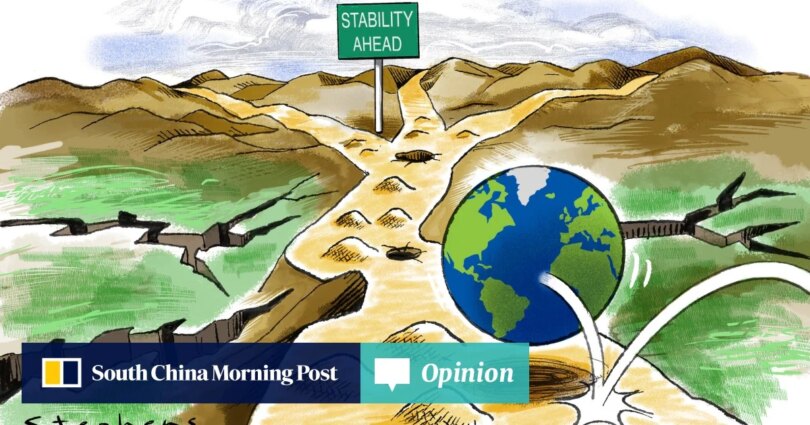
The reshaping of the global economic system we are witnessing has entered an acute phase. This raises several questions. When will the world return to a more stable condition? No less importantly, what places will key countries occupy in the new configuration?
To answer these questions, it is useful to view current events through the prism of systemic interstate conflicts, which are among the main markers of such transformations. By systemic conflicts, however, one should understand not only military conflicts but a broader confrontation involving trade and financial wars, competition for resources and markets and the reconfiguration of trade routes.
In other words, the current systemic conflict should not be seen as a set of separate episodes – such as the US-Israeli war against Iran in the Middle East, Russia’s invasion of Ukraine or the US-China tariff war – but rather as a stage in the broader restructuring of the world system.
If we look at the recurrence of global crises of different scale and nature, several phases can be tentatively identified. Roughly every 70 to 100 years, a major crisis of global scale emerges, associated with a change in world leadership and the international order. Roughly every 40 to 60 years, the technological and economic paradigm changes, then roughly every 25 to 30 years, the internal architecture of a given phase changes.
It should be noted, however, that the historical spiral appears to be tightening, which means these intervals might also be shortening. These intervals should not be regarded as strict historical regularities but rather as tentative systemic parameters.
We saw several such cycles over the past two centuries. From 1815 to 1914 was the relatively long 19th century after the Napoleonic wars, marked by British maritime and financial hegemony, the expansion of world trade and the beginning of industrialisation.