
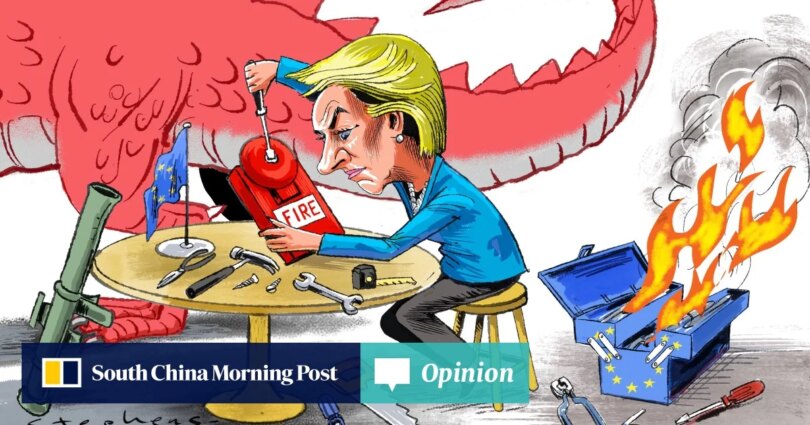
Generals losing a war examine the enemy, battlefield and their own forces. Brussels prefers a different sequence, ordering new weapons first and worrying about the diagnosis later. That instinct was on display at the recent European Council meeting.
Faced with a trade deficit it cannot close and dependencies it cannot shake, the European Union agreed on a new label: “global macroeconomic imbalances”. To solve them, European Commission president Ursula von der Leyen was reportedly directed to engage in dialogue with China with an emphasis on results – an admission that years of escalating pressure have produced none. Her other mandate was to develop more economic security tools. No euphemism has ever confessed “we don’t know what to do” this loudly.
Europe’s China debate has become detached from any assessment of outcomes. If “de-risking”, anti-subsidy investigations, tariffs, trade defence measures, the “trade bazooka” threat and procurement restrictions have all failed to cut dependence, narrow the deficit or restore competitiveness, why should another layer of instruments succeed?
“De-risking” became the flagship policy without ever becoming a measurable one. Three years after the policy’s launch, the European Commission still promotes it. Yet it has never produced a public accounting of which dependencies have been reduced, by how much and at what cost.
The search for the next instrument has become an alibi to avoid more uncomfortable conclusions. Europe keeps looking for a China solution to Europe’s malaise. It treats a competitiveness problem as a trade problem, an industrial problem as a regulatory one, and a technology gap as an external threat. Every new mechanism promises leverage over Beijing while diverting attention from weaknesses born at home.
Brussels still has not settled on what China is. The EU designated China a “systemic rival” in 2019, in the same framework that called it a partner and competitor. Seven years on, the bloc has not decided which label should govern its approach. European policy oscillates between engagement and confrontation because the underlying diagnosis remains uncertain.